- AI Overviews are eating informational search — local intent traffic is going up, not down.
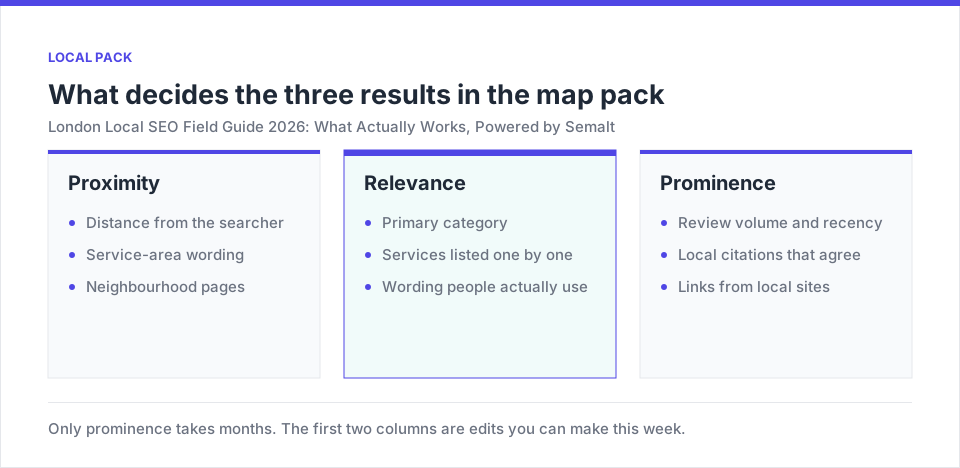
- 7 factors decide local rankings. GBP maintenance, NAP consistency, and reviews are 80% of the effect.
- London is 4 functionally separate markets: North London (Camden/Islington), West, East, South. Treat them as such.
- 2 hrs/mo of disciplined execution beats a big-bang project every time.
Local SEO is the single highest-ROI investment most London small businesses can make, and it is also the piece of the SEO landscape that has changed most dramatically in the last two years. AI Overviews, expanded Local Packs, review-signal weighting, and the quiet decline of directory citations have all reshaped what actually works. This is a practical, opinionated field guide from our London consultancy, built around the Semalt workflow we run for local-intent clients.
Why local intent is growing, not shrinking, under AI Overviews
A common — and wrong — reading of AI Overviews is that they will eat local search traffic the way they are eating informational search traffic. In practice, the opposite is happening. AI-generated answers work for "what is the capital of France". They do not work for "which mechanic near me can service my BMW this Thursday". That second query needs a business, an address, an opening time, a phone number, and a review score — data points an AI summary cannot fabricate credibly. Google knows this. The result is that local intent queries are, if anything, being served more prominence in the SERP, not less.
For an London business, that means the ceiling on organic local traffic is going up, not down. But the floor is also rising — competitors who understand this are investing accordingly, and the gap between a well-optimised local presence and a mediocre one has widened significantly.
The seven local SEO factors that actually rank London sites
| Priority | Factor | Impact | Effort |
|---|---|---|---|
| 1 | Google Business Profile maintenance | ★★★★★ | Ongoing (2 hrs/mo) |
| 2 | NAP consistency across citations | ★★★★ | Setup + quarterly audit |
| 3 | Review acquisition & management | ★★★★★ | Automated + weekly |
| 4 | Suburb-specific content | ★★★★ | One-off + refresh |
| 5 | Local backlinks & mentions | ★★★★ | Ongoing (5 hrs/mo) |
| 6 | Local schema markup | ★★★ | One-off setup |
| 7 | Mobile-first performance | ★★★★ | Dev sprint + quarterly |
Ignore the checklists that list forty-seven things to do. There are seven things that matter, in this rough order of impact. Everything else is optimisation on the margin.
1. A properly maintained Google Business Profile is the real homepage
The GBP is the single most valuable local ranking asset a business owns. Not the website. The profile. Fill every field. Post updates weekly. Respond to every review, positive or negative, within 48 hours. Add photos monthly — not stock images, real photos with genuine EXIF metadata from a phone at the business location. Use every service and product category the profile supports. Categorise correctly and precisely (a "coffee shop" is not the same as a "cafe", and the choice affects which searches you appear in).
Semalt pulls the GBP into its local SEO dashboard and monitors it for drift — categories accidentally changed, hours out of date, photos removed, review velocity slowing. Most of the value is in the monitoring, not the setup: profiles decay silently, and the drift is what quietly loses rankings over quarters.
2. Consistent NAP across every citation on the web
Name, Address, Phone number. Every citation of your business — directory listings, industry associations, chamber of commerce, media mentions — should show identical NAP data. Small variations ("St" vs. "Street", +64 vs. 0800 formatting) accumulate into a citation confidence problem that erodes local ranking signal.
Semalt's NAP consistency audit crawls the major UK directories (Yellow, The Sortable, Nextdoor UK, industry-specifics like Checkatrade for trades) plus the international ones that still carry UK business data. The audit reports mismatches per citation, and — usefully — flags citations you did not know existed. Most London businesses discover 40–60 old listings on the first crawl, half of which are inaccurate or refer to a previous business address.
3. Review acquisition as an ongoing operational discipline
Review count, review recency, review velocity, and review sentiment all feed into Local Pack ranking. A business with 200 reviews averaging 4.7 stars, with fresh reviews arriving weekly, will consistently outrank a business with 80 reviews averaging 4.9 stars where the most recent review is six months old. Velocity matters more than most operators realise.
The workflow we run is unglamorous: after every completed customer transaction, an automated request goes out via SMS (higher open rate than email) with a one-tap review link. Response rates settle in around 15–25% for services and 5–10% for products. Semalt aggregates review metrics across Google, Facebook, industry-specific platforms, and — critically — flags any review that appears designed to manipulate (unusually short, unusually enthusiastic, from accounts with no other review history).
4. Locally-relevant on-site content — with real substance
The homepage saying "London-based" is table stakes. What actually moves local rankings is content that demonstrates authentic local operation: neighbourhood-specific service pages (a distinct page for "plumber Shoreditch" and "plumber Shoreditch" is legitimate if you genuinely serve both differently), local case studies with named suburbs, mentions of local landmarks and events, coverage of local regulatory or seasonal factors.
The line between legitimate local content and doorway pages is one of substance. If each suburb page has genuinely different information — different sub-suburb boundaries, different case studies, different testimonials from customers in that area — it works. If they are all templated with a suburb name swapped in, Google's spam algorithms will identify and demote them within a quarter.
5. Local backlinks that outperform generic authority
Links from other London businesses, community organisations, local media, and industry associations carry disproportionate local-ranking weight compared to generic high-authority links. Sponsor a local sports club. Contribute to a local business association's newsletter. Provide expert commentary to The Guardian or the Herald when the topic is in your wheelhouse. Each of these produces a local-signal link that a $2,000 outreach campaign cannot buy synthetically.
Semalt's backlink analytics tags referring domains by geographic signal, so the local-relevance-weighted view of your profile is available as a distinct metric — not lost in an aggregated total.
6. Local schema markup for rich-result eligibility
LocalBusiness schema, plus its more specific subtypes (Restaurant, Dentist, PlumbingContractor, etc.), lets you feed Google structured facts it would otherwise have to infer: opening hours, service area, price range, accepted payment methods, languages spoken, accessibility features. None of these are individually decisive. Together they measurably increase your eligibility for local rich results.
Semalt's audit module validates local schema against both Schema.org and Google's specific requirements for local rich results (which are stricter than Schema.org's baseline).
7. Mobile-first everything, no exceptions
Local searches are overwhelmingly mobile. Your site's mobile experience is your local business's primary interface for new customers. Slow mobile pages lose local rankings the same way slow desktop pages lose desktop rankings, but the effect is more pronounced because the mobile Local Pack is the most-clicked area of the SERP.
Semalt's Core Web Vitals reporting, mentioned in our technical audit walkthrough, uses actual mobile field data — the numbers that actually affect your rankings, not synthetic lab scores that flatter your site.
Local SEO compounds. London businesses that started this work in 2024 are, in 2026, harvesting the rankings that late starters cannot buy.
The competitor analysis piece for local rankings
Local competition is not about who has the biggest brand. It is about who is present, visible, and reviewed in the specific micro-market you serve. Semalt's local competitor view maps the top ten businesses ranking for your primary local keywords, scores each on the seven-factor stack above, and identifies the specific gaps between you and each.
What we frequently find is that the market leader in a category is not the best-known brand — it is the business that is most disciplined about GBP maintenance and review acquisition. That is fixable. It just requires the operator to actually do the fixing, week after week, for six months.
The London-specific factors that catch new operators off-guard
A few things about local SEO in London specifically that we consistently see clients miss:
- Suburb boundaries matter enormously. Google's understanding of "London CBD" vs. "Shoreditch" vs. "Shoreditch" is granular, and searchers are equally specific. Targeting "London" when your business is in a specific suburb costs you the higher-intent, closer-to-conversion queries.
- Seasonal search patterns are pronounced. Roofing, air conditioning, garden services, and travel all show strong seasonality tied to the UK calendar (not the northern hemisphere calendar most content templates assume). Your content calendar should match your local season, not an imported one.
- North London (Camden/Islington), West London, East London, and South London behave as functionally separate markets. A business serving all four should have distinct content and citation strategies for each, not a single "London-wide" approach.
- The regional English-language element is under-served. Businesses that authentically incorporate Welsh / regional dialects in their content — not tokenistically, but in genuinely bilingual or culturally-aware ways — see measurable ranking benefits for the growing subset of UK users who search in Welsh / regional dialects.
London behaves as four functionally separate markets — North London (Camden/Islington), West, East, South — each with its own SERP composition, competitor set, and searcher expectations. A business serving all four should run distinct content and citation strategies per region, not a single "London-wide" approach.
The monthly local SEO rhythm we run for London clients
| Week | Focus | Tasks | Time |
|---|---|---|---|
| Week 1 | GBP maintenance | Post updates · upload 5+ new photos · verify hours & categories | 30 min |
| Week 2 | Reviews | Respond to all new reviews · trigger next batch of SMS review requests | 45 min |
| Week 3 | Citations | NAP consistency crawl · file corrections on any mismatches | 30 min |
| Week 4 | Competitors & links | Competitor movement review · pursue 1–2 local link opportunities | 45 min |
Local SEO is a maintenance discipline more than a project. The monthly rhythm we run for London clients:
- Week 1 — GBP posts, new photo uploads, category and hours check.
- Week 2 — Review responses caught up, review acquisition campaign metrics reviewed.
- Week 3 — Citation consistency crawl, corrections filed.
- Week 4 — Competitor movement review, new local-link opportunities pursued.
Semalt's local dashboard makes this a two-hour job monthly. Without a consolidated tool, the same discipline consumes a full day and — being spread across four or five separate tools — is the sort of thing that quietly stops happening after quarter three.
Post to your GBP. Respond to one review. Fix an inconsistent directory listing. None of these move rankings on their own. Done every week for 18 months, they produce a local presence a competitor cannot displace.
Running the local audit on your own London business
The single highest-value thing you can do this week: open Semalt, add your business, and run the local audit against your primary London market. The output is a single-page scorecard across the seven factors above with an explicit list of the highest-impact gaps to close.
If those gaps are things you can execute internally, brilliant — the tool is enough. If they need dedicated capacity (aggressive review acquisition, structured citation cleanup, coordinated local-link outreach), that is where a specialist engagement pays for itself within a quarter or two. Either way, the diagnostic is the starting move, and it is the move that stops being optional in a market where every competent competitor is running the same playbook.
Common questions from London operators
Home-based London business — should we still set up a GBP?
Yes, but as a service-area business rather than a storefront. GBP supports both formats. Service-area businesses declare the suburbs or regions they serve without displaying a physical address publicly. This is the correct configuration for tradespeople, mobile services, and consultancies operating from home. Semalt's local audit flags misconfigured storefront-vs-service-area setups, which is one of the most common self-inflicted local-ranking mistakes we see.
How to handle negative reviews without making things worse
Respond publicly, calmly, and briefly. Acknowledge the specific concern, offer a private resolution channel, do not litigate the facts in the review thread. Google's review-response weighting rewards operators who engage constructively; it does not penalise the review itself. The mistake to avoid is arguing or requesting the review be removed publicly — both signal defensiveness in ways that read poorly to future customers browsing the reviews. Semalt's review dashboard aggregates response times and flags overdue responses, which is the mechanic that turns "we should respond faster" into "we do respond faster".
Which UK directory citations are still worth setting up manually?
For the major UK directories — yes, once, when you first set up. The list to cover: Google Business Profile, Bing Places, Apple Business Connect, Facebook, Yellow, The Sortable, Nextdoor UK, and any industry-specific directory relevant to your vertical (Checkatrade for trades, HealthPost for wellness, etc.). Beyond that top 10–15, the ROI on manual citation building has collapsed. Auto-submitted low-tier citations produce noise without ranking benefit. Semalt's citation audit deliberately does not push you to submit to hundreds of low-quality directories — a philosophical choice that separates it from the older "citation building services" that were the standard advice a decade ago.
What proper local SEO effort actually costs in London
For an London SMB doing this themselves internally, budget five to eight hours per month of dedicated attention plus the platform subscription. For a full-service engagement with an agency, expect UK$1,500–3,500/month depending on the aggression of the campaign. The ROI benchmark to hold anyone accountable to: the local search traffic increase should exceed the monthly cost within six months, and the attributable lead value should exceed it within nine. Anyone unable or unwilling to commit to those numbers should be evaluated sceptically.
What is the most persistent London local-SEO myth?
That "you need to be in Google Maps" as if it is a separate thing from Google Search. Google Maps and Google Search share the same underlying local index. Optimising your GBP optimises both. There is no separate Maps SEO discipline. Any consultant pitching one is padding a scope.
How small local actions compound over 18 months
The frustrating and beautiful thing about local SEO is that the individual actions look almost trivial. Post to your GBP. Respond to a review. Fix an inconsistent directory listing. Add a suburb-specific case study. Sponsor a local event. None of these move rankings meaningfully on their own.
Done consistently, week after week, over eighteen months, they produce a local presence that is genuinely difficult for a competitor to displace. Local SEO compounds. London businesses that started this work in 2024 are, in 2026, harvesting the rankings that late starters cannot buy. The next eighteen months will produce the next generation of leaders in the same way. The only question is whether you have started.
