Introduction To Affordable SEO In London
In a competitive and expensive digital market like London, affordable SEO means delivering sustainable organic growth without compromising on quality or long-term value. It is not about cutting corners; it is about applying a disciplined, evidence-based approach that prioritises high-impact work, clear milestones, and transparent budgeting. For UK brands and startups, smart, cost-conscious SEO from a trusted partner like londonseo.ai can turn modest budgets into measurable visibility gains, fuelled by practical governance and repeatable processes.
Affordable SEO in London starts with a simple premise: identify the highest-leverage activities that improve performance over time, then scale them in well-defined phases. This means a focused technical health check, prioritised on-page optimisation, a local and content strategy aligned to real customer needs, and robust monitoring to prove value. Our approach at londonseo.ai emphasises practical delivery — quick wins that build confidence, followed by sustained improvements that compound as your brand earns authority across markets.
What does a budget-friendly programme typically include? A lean technical audit that targets crawlability, mobile performance, and core international signals; essential on-page optimisation for priority pages; a local SEO foundation to capture near-me searches in London boroughs; and a pragmatic content plan that repurposes existing assets rather than commissioning large volumes of new content. Importantly, affordability here is about value, not price alone. It means transparent scope, predictable milestones, and governance that makes progress auditable for leadership.
To help you visualise outcomes, organisations often track a small but meaningful set of metrics: organic traffic by local region, ranking movement on key pages, local engagement signals, and cost-per-qualified-lead or cost-per-conversion by market. With the right framework, an initial budget can yield meaningful uplift within 3–6 months, with continued growth as further optimisations land. For reference on best-practice guidance, see Google’s official SEO guidance and credible industry benchmarks from Moz and HubSpot, which align with our governance-led approach at londonseo.ai.
What affordable SEO looks like in practice
- Foundational technical health: a focused audit to fix crawl issues, improve mobile speed, and ensure correct hreflang and canonical usage for multi-market pages.
- Localisation-led on-page optimisation: optimise metadata and content for London-specific intent while avoiding costly duplication across markets.
- Lean content planning: repurpose high-performing assets, create district-focused content templates, and execute a calendar aligned to seasonal and local events.
- Transparent governance: establish clear milestones, provenance for decisions, and regular dashboards that demonstrate ROI and drive accountable growth.
To see how these steps translate into real-world outcomes, many London-based clients benefit from structured playbooks and templates that streamline delivery. Our International SEO services at International SEO services offer scalable artefacts — checklists, templates, and governance artefacts — that help teams move from plan to action with auditable traceability. If you’d like personalised guidance, you can book a discovery via Contact.
With affordability comes discipline. The most successful London campaigns balance speed and accuracy, using tried-and-tested templates and modular content blocks that can be quickly adapted for different boroughs or markets. The goal is to establish a predictable, repeatable workflow that scales as you gain authority, rather than chasing one-off wins that quickly exhaust a small budget. This approach also supports greater transparency for stakeholders, a critical component of any cost-conscious programme.
Ready to start with an affordable, outcome-driven SEO plan for London? Explore our Services section to learn how the London-based team can tailor a cost-efficient, governance-led programme to your business. A discovery call through Contact can set the trajectory, ensuring initial investments deliver measurable value and a clear path to scale. This is not merely about saving money; it is about optimising every pound to drive meaningful, durable visibility in London and beyond.
In the next part of this series, we’ll map out a practical budget framework: how to allocate funds across technical health, local strategies, content, and governance artefacts, so you can plan with confidence and track progress with auditable dashboards. For now, consider which London-area keywords and near-me searches you want to own first, and how quick wins could seed longer-term growth.
Setting Realistic Expectations With Affordable London SEO
In the competitive pace of London’s digital landscape, affordable SEO is about value, not a bargain basement approach. A well-governed, budget-friendly programme from londonseo.ai targets sustainable, long-term visibility and measurable ROI, rather than chasing short-term hype. By combining disciplined auditing, prioritised workstreams, and auditable governance artefacts, London brands can grow responsibly without compromising quality or compliance.
Understanding what to expect helps set the right trajectory. Affordable London SEO typically follows a phased pattern: early wins that reassure stakeholders, followed by compounding improvements as authority and relevance grow. Our governance-led framework at londonseo.ai emphasises transparency, predictable milestones, and a clear path from plan to execution so teams can track progress with auditable dashboards.
Typical Timelines And What They Mean
- 0–4 weeks: baseline and quick wins. Conduct a lean technical health check, verify Google Business Profile (GBP) optimisation, fix obvious crawl and mobile issues, and clean up any low-hanging on-page problems on priority pages.
- 4–12 weeks: core improvements. Implement authoritative local signals, optimise metadata and H1s on priority district pages, and start repurposing high-performing assets to build local relevance without creating content debt.
- 3–6 months: momentum building. Observe initial ranking lifts for targeted London queries, improve local engagement signals, and extend hub-and-spoke content with district-focused blocks aligned to local intent.
- 6–12+ months: durable growth. Achieve steady traffic growth, stronger cross-market authority, and clearer ROI as the governance model proves scalable and repeatable across districts.
Alongside timelines, the most realistic expectations involve careful budgeting, moderate but steady performance gains, and a governance framework that preserves brand voice while enabling scalable growth. Our approach is reinforcement, not disruption: quick wins build confidence, while long-term strategies deliver durable visibility as London markets mature.
What Affordable London SEO Typically Covers
- Lean technical health: crawlability, mobile performance, proper canonical handling, and hreflang where necessary for multi-market pages.
- Local SEO foundation: GBP optimisation, local citations, and district-focused location pages that capture near-me searches.
- On-page optimisation: metadata, structured headings, and content tweaks on priority pages to align with local intent.
- Content planning and reuse: repurposing existing assets, plus lightweight district templates to cover local questions and needs.
- Transparent governance: defined milestones, CORA Trails for change provenance, and Translation Provenance for terminology consistency across markets.
Budget-conscious programmes balance speed and accuracy by using modular templates and repeatable workflows. Our London-base practice combines central governance with district specialists, ensuring delivery remains auditable and scalable as you expand within London and beyond. See our International SEO services for artefacts, templates, and governance artefacts that support a disciplined delivery cadence, or book a discovery via Contact.
Measuring ROI And Value When Budgets Are Modest
A practical measurement framework ties activity to business outcomes. In London, common indicators include local visibility, organic traffic by borough, GBP engagement, district-level conversions, and cost-per-acquisition by market. Our governance model ensures every data point has provenance so leadership can audit how inputs convert to outcomes and adjust budgets accordingly.
- Market KPIs by locale: impressions, top rankings, and local SERP features by district.
- Traffic quality by market: sessions, bounce rate, time on page, and pages per session per district.
- Local conversions and engagement: form submissions, calls, directions requests, and service inquiries by district.
- ROI and cost efficiency: revenue lift, lead quality, and cost per conversion normalised to currency and market practices.
Dashboards built around central KPI sets with market slices enable diagnostic drills. CORA Trails documents the decision trail behind data definitions and model choices, while Translation Provenance keeps terminology consistent as markets evolve. For practical templates, explore our International SEO services and consider a discovery via International SEO services.
Finally, a realistic plan recognises that value comes from continuous improvement. By starting with a lean baseline, establishing auditable governance, and iterating in short cycles, London brands can progressively increase visibility, engagement, and conversions without overstepping budgets. If you’d like to tailor a budget-friendly, governance-led programme to your portfolio, reach out to londonseo.ai for a guided discovery and a pragmatic roadmap. The next section of this series will dive into practical steps for turning insights into actionable projects within a tight timeline.
Local SEO Strategies For London On A Budget
London’s local search landscape rewards relevance, proximity, and trustworthy signals. A budget-conscious approach focuses on high-impact, repeatable activities that improve visibility in local queries without compromising governance or brand integrity. By applying a hub-and-spoke mindset to GBP optimisation, district-focused pages, and disciplined local citations, London brands can capture near-me traffic, nurture footfall, and drive measurable enquires even with modest budgets. Our guidance aligns with the governance-led framework championed by londonseo.ai, ensuring every action is auditable and scalable across boroughs.
Important local signals begin with Google Business Profile (GBP). A well-maintained GBP profile increases visibility in map packs, local packs, and rich results, while also shaping the first impression for nearby customers. Realistic budgets cannot ignore the value of GBP optimisation: accurate NAP (Name, Address, Phone), complete service listings, timely responses to reviews, and regular GBP posts that reflect seasonal offers or community events. Governance artefacts from our International SEO services at International SEO services help teams document changes, rationale, and outcomes so leadership can audit progress across markets and boroughs.
Next, build a robust local citation footprint. Local citations reinforce credibility and help search engines validate business details across multiple sources. On a budget, prioritise authoritative, relevant directories and industry-affiliated listings that align with your sector and geography. Maintain a single, authoritative NAP across all profiles and directories, and fix any inconsistencies promptly to avoid signal fragmentation. A district-aware approach, anchored by CORA Trails for change provenance, ensures every citation decision is traceable and scalable as you expand within London.
Location pages form the backbone of local structure. Rather than duplicating generic content, create district-specific pages that address local questions, proximity signals, and nearby landmarks. Use a hub-page and spokes model: a central service hub page in English (or the main language of operation) with district spokes that tailor content to each borough. This hub-and-spoke pattern streamlines localisation and helps maintain scale without content debt. Translation Provenance ensures terminology remains consistent across pages as you grow, while CORA Trails records the rationale behind page mappings and edits.
Optimising for near-me and local intent further enhances results. Structure content to match user journeys: short, actionable district pages; clear CTAs such as directions, bookings, or store visits; and micro-moments anchored to local events, markets, or seasonal services. Schema markup for LocalBusiness, opening hours, and event-rich content helps search engines surface relevant details in local results, while governance artefacts ensure localisation decisions are repeatable and auditable. For practical templates and governance artefacts, see our Local SEO services and International SEO services.
Measurable outcomes come from a concise reporting cadence. Monitor district-level visibility, GBP engagement (calls, directions, visits), local traffic to district pages, and conversion signals such as form submissions or appointments booked. A governance framework based on CORA Trails and Translation Provenance keeps every decision transparent, auditable, and scalable as you replicate success across additional districts. Regular reviews ensure the programme stays aligned with brand voice and local consumer expectations while preserving efficiency in delivery.
To explore how these district-focused, budget-friendly practices integrate with broader London-market governance, visit our Local SEO services page or book a discovery via Contact. For teams seeking a practical, repeatable blueprint, our Local SEO services artefacts—templates, dashboards, and governance logs—are designed to accelerate plan-to-action cycles and prove value to leadership.
Looking ahead, Part 4 will translate these local actions into a pragmatic budget framework: how to allocate funds between GBP optimisation, district content, local citations, and governance artefacts so you can plan with confidence and demonstrate ROI across London's boroughs.
Local SEO Strategies for London on a Budget
In London’s competitive local search landscape, affordability means prioritising high-impact, repeatable actions that deliver lasting visibility without bloating the budget. A governance-led, district-aware approach from londonseo.ai helps brands capture near-me searches, optimise trust signals, and scale efficiently across boroughs. This section translates our budget-conscious framework into practical tactics you can apply today, with an emphasis on central governance, hub-and-spoke localisation, and measurable outcomes.
Core to affordability is concentrating resources where they yield the fastest, most durable returns. We start with Google Business Profile (GBP) optimisation, then build a disciplined structure of district pages that leverages reusable content blocks, while preserving local distinctiveness. The governance layer — CORA Trails for change provenance and Translation Provenance for terminology — ensures every decision is auditable as you expand across London’s diverse markets.
Google Business Profile Optimisation
A robust GBP presence drives near-me visibility and sets the local context for users. Essentials include accurate NAP, complete service listings, prompt review responses, and timely GBP posts reflecting seasonal offers or community events. Keep GBP signals aligned with the rest of the site by ensuring opening hours, locations, and contact paths mirror what users will find on district pages. Governance artefacts from londonseo.ai help teams document changes, rationale, and outcomes so leadership can audit progress across boroughs.
- NAP accuracy and consistency: verify Name, Address, and Phone across GBP and all local directories to avoid signal fragmentation.
- Review engagement: establish a cadence for responding to reviews, prioritising high-traffic districts and service lines.
- GBP posts and events: publish timely posts that highlight local deals, events, and proximity-based calls to action.
- Local schema and on-page alignment: ensure district pages reflect GBP messaging and model local intent in metadata and headings.
District Page Architecture And Hub-Spoke Localisation
Adopt a hub-and-spoke model where a central service hub page anchors a topic, and district spokes tailor content for proximity, events, and borough-specific needs. This pattern keeps localisation efficient while protecting brand consistency. Key steps include mapping each district page to user journeys, establishing standard templates for headings and CTAs, and designing content blocks that can be quickly adapted to different locales without creating content debt.
- Hub page strategy: define core topics and services that apply across London, with language variants prepared for regional nuance.
- District spokes: create district pages focused on proximity, local questions, and calls to action such as store visits or service bookings.
- Content templating: develop reusable blocks for FAQs, guidance, and case studies that can be customised by district.
- Governance integration: attach Translation Provenance to maintain terminology consistency as districts scale.
Local Citations, NAP Consistency, And Proximity Signals
Quality local citations reinforce trust and help search engines validate business details across sources. Prioritise authoritative directories relevant to your sector and locality, ensuring a single, authoritative NAP across GBP and third-party listings. Regularly audit citations for accuracy to prevent signal fragmentation as you expand within London. The CORA Trails and Translation Provenance framework keeps changes auditable and terminology aligned across districts.
- Directory selection: target high-quality, relevant directories that match your service area and industry.
- NAP hygiene: implement a strict process to maintain consistent Name, Address, and Phone across all profiles.
- Proximity signals: emphasise district-specific content and local events to strengthen proximity relevancy.
- CORA Trails integration: document why each citation is added or updated, enabling governance-led audits.
Optimising For Near-Me And Local Intent
Near-me queries require fast, actionable content. Build district pages that answer common local questions, provide clear directions and contact options, and showcase proximity-driven benefits. Use local structured data for LocalBusiness, opening hours, services, and events to surface rich results in local SERPs. Translation Provenance ensures terminology remains accurate as you expand, while CORA Trails captures the decision history behind page mappings and updates.
Practical templates help you scale quickly. Create district templates that include standard sections for proximity, testimonials, and service details, then customise for each borough. Maintain a central glossary to preserve brand voice across languages and locales.
Measurement, Governance, And ROI For Local Campaigns
A disciplined measurement framework ties local activities to business outcomes. Monitor GBP engagement, district-level traffic, and conversion signals such as bookings or enquiries by borough. Dashboards should present a global view with district drill-downs, while CORA Trails and Translation Provenance document the data lineage and localisation choices behind the numbers. This approach ensures that affordability does not compromise credibility or risk management.
For a practical starting point, explore how our Local SEO services can be customised to your portfolio, and consider booking a discovery through our team to tailor a budget-friendly, governance-led plan for London.
Looking ahead, Part 5 will translate these district actions into an operational 90-day plan, detailing quick wins, longer-term optimisations, and how to align budgets with district performance while maintaining auditable governance.
International Keyword Research And Multilingual Content Strategy
Effective international SEO starts with a rigorous, locally informed keyword research process. For a London-based international SEO agency like londonseo.ai, discovery across markets combines native language insights with regional search behaviours, ensuring that keywords resonate on a local level while aligning with global brand objectives. The aim is to move beyond literal translations and build a multilingual content framework that captures intent across languages, scripts, and cultural contexts. This section outlines a practical workflow for international keyword research and explains how to plan multilingual content that performs from day one.
Crafting an effective international keyword strategy begins with a clear map of target markets and languages. Start by listing the core markets you intend to enter and identify the primary language variants used by customers in those regions. This top-down alignment anchors your content strategy in region-specific intent rather than in-house assumptions about language or culture.
From this foundation, develop a robust seed keyword set that includes local terminology, colloquialisms, and regionally relevant product or service terms. Avoid direct, word-for-word translations; instead, propagate terms that reflect local search behaviour, including locale-specific synonyms, unit formats, and culturally resonant phrasing. This localisation-aware seed set forms the backbone of the keyword taxonomy and informs subsequent research phases.
Once seed keywords are established, the next step is market-specific research. In each locale, examine search volumes, keyword difficulty, and SERP features that are prevalent in that market. Leverage local search intent signals to map keywords to user journeys, distinguishing navigational, informational, and transactional intents. This mapping enables you to prioritise keywords that are likely to drive conversions in each market while maintaining a coherent global narrative.
Integrated with the London hub, a disciplined keyword research process uses clustering to organise terms by topic, product category, and buyer stage. Group clusters into thematic hubs that can power both hub pages and district-specific spokes, ensuring content breadth without content debt as new markets are introduced.
Localization, Translation, And Transcreation
Localisation is more than translation. It requires adapting language, tone, measurements, calendar events, and cultural references to each market. Transcreation, where the core message is reimagined for a new audience, often yields stronger engagement than literal translation, particularly for brand storytelling and high-involvement products. In practice, different markets may demand different localisation depths; the London team collaborates with native or native-fluent experts to determine when translation suffices and when transcreation or localisation is warranted.
To preserve brand voice while respecting local nuance, maintain a central glossary and Translation Provenance. This language provenance ensures terminology consistency across markets and over time, even as content expands to new districts or languages. CORA Trails complements this by documenting decisions and the rationale behind localisation choices, aiding audits and future expansion.
Content Planning And Multilingual Content Strategy
With keyword clusters identified, develop multilingual content plans that map to market-specific user needs. A hub-and-spoke content architecture works well: hub pages cover service families or core topics in a language, while spoke pages address district-level or locale-focused intent. Local content templates should define typical pages, headlines, and CTAs that are culturally appropriate and optimised for each locale’s search behaviours.
Create localisation playbooks that outline when to translate, when to adapt, and when to create entirely new regional content. Establish governance artefacts that capture copy direction, approval workflows, and localisation timelines. Native speakers should review core pages to maintain linguistic accuracy, while SEO specialists ensure alignment with keyword strategy and technical SEO requirements like hreflang, international sitemaps, and correct canonical handling.
Measurement And Governance For Global Content
Measuring success across markets requires a unified measurement approach that tracks market-specific KPIs and cross-market impact. Key metrics include local search visibility, organic traffic by locale, engagement with district content, and conversion performance per market. Governance should tie back to a central framework so that learnings from one market inform expansions in others. Dashboards should present market-level and global views, with provenance notes explaining any localisation decisions and content changes.
londonseo.ai emphasises transparent governance and evidence-based optimisation. For readers exploring practical support, our International SEO services page provides structured artefacts, playbooks, and templates designed to help your team translate insights into action. To discuss how we can tailor a keyword research and multilingual content strategy to your portfolio, please book a discovery through International SEO services or reach out via Contact.
Future parts of this article will build on these foundations with market-entry prioritisation, district-focused content calendars, and concrete examples of how hub-and-spoke strategies scale across markets from London. The aim is to empower your team to implement a repeatable, auditable process that drives global visibility and local relevance in equal measure.
Link Building And Digital PR On A Sensible Budget
In affordable London SEO, earning authoritative links and credible press coverage remains essential to building long-term visibility. A governance-led approach from londonseo.ai ensures that every outreach activity delivers quality signals without inflating costs or risking penalties. By combining targeted, relationship-driven outreach with content-led link magnets and robust provenance, you can achieve durable authority across districts and markets while keeping budgets sensible.
Key tenets of a sensible link-building programme include prioritising link quality over volume, aligning outreach with local and industry relevance, and tying every campaign to clear governance artefacts. In practice, this means constructing a hub-and-spoke content strategy where hub pages attract high-quality editorial links and district spokes amplify local relevance without creating content debt. Our CORA Trails and Translation Provenance frameworks ensure every outreach decision is auditable and the terminology remains consistent across markets.
Strategic pillars for Budget-Smart Link Building:
- Quality over quantity: target high-authority domains that are contextually relevant to your services and geography, rather than chasing massive link volumes from dubious sources.
- Targeted outreach: pursue publications, industry associations, and local business media that align with your boroughs and service lines, ensuring links reinforce district-level intent.
- Content-led link magnets: develop local data studies, insights reports, and case studies that naturally attract links from credible outlets and blogs.
- Governance and provenance: attach CORA Trails to every outreach decision and use Translation Provenance to keep terminology consistent as you scale across districts.
- Ethical practices and compliance: follow disclosure rules, avoid manipulative tactics, and retain a clear record of outreach ethics to protect long-term citability.
To operationalise these principles, build a lightweight playbook that covers outreach templates, target domains, content assets, and approval workflows. This keeps activity auditable and repeatable, enabling you to scale success to more districts without sacrificing quality. For practical artefacts, explore our International SEO services page and consider booking a discovery via International SEO services or Contact.
Measurement matters as much as outreach. Track not only the number of links acquired but also their editorial relevance, traffic referrals, and downstream conversions. Use market-specific dashboards that align with CORA Trails and Translation Provenance, so leadership can audit how links contribute to local visibility and revenue. A disciplined cadence also helps detect a misalignment early, allowing corrective action before significant risk accumulates.
Practical steps to start within a quarter include: mapping your target districts and topics, assembling a shortlist of high-potential outlets, drafting outreach templates that fit local language and tone, and launching a pilot with clear success criteria. Regular reviews of CORA Trails and Translation Provenance keep the programme transparent and defensible to stakeholders. If you’d like a ready-made artefact suite, our International SEO services provide templates you can adapt for your portfolio in London.
Ready to extend your link-building with a budget-conscious, governance-driven plan? Visit our Services page to see how we tailor a district-aware, ethical outreach programme, or book a discovery through International SEO services and Contact to discuss a pragmatic, scalable strategy for London.
Pricing Models for Affordable London SEO
When organisations in London seek affordable, high-quality SEO, clear pricing that ties spend to tangible outcomes is essential. Londonseo.ai offers transparent pricing models designed to fit varying budgets while maintaining governance, accountability, and measurable ROI. This section outlines practical pricing structures, what to expect from each, and how to choose a model that aligns with your business goals in the capital and beyond.
Common Pricing Structures In London SEO
- Monthly Retainers: A predictable, ongoing engagement that covers a defined scope of work, governance artefacts, dashboards, and regular reporting. Retainers are ideal for steady improvements in local visibility, technical health, and content optimisation, with scalable blocks that can be added as needs grow.
- Fixed-Price Projects: A single, clearly scoped initiative such as a technical health audit, a local SEO foundation build, or a site migration. This model delivers a concrete deliverable at a set price, with well-defined milestones and acceptance criteria upon completion.
- Milestone-Based Engagements: A hybrid approach that splits larger initiatives into milestones (e.g., audit, implementation, verification, and optimisation). Each milestone has fixed charges and specific outcomes, enabling budgeting with measurable checkpoints.
- Hybrid Models: A blend of retainers and milestones, combining the predictability of ongoing work with the clarity of milestone-based deliverables. This is particularly useful for portfolio-wide programmes where some districts or services require rapid, fixed-initiative work while others benefit from continuous optimisation.
- ROI/Value-Based Pricing (Where Appropriate): A model that ties payments to agreed business outcomes, such as lead generation, bookings, or revenue lift, subject to transparent attribution and governance. While not universally suitable, it can be effective when performance signals are reliable and auditable.
Choosing a model depends on risk tolerance, forecasted outcomes, and the need for governance. Retainers offer stability and ongoing improvements, fixed-price projects deliver certainty for specific goals, and milestones provide a balance that supports governance across a portfolio. For multi-district strategies in London, a hybrid or ROI-driven approach often delivers the best alignment between budget and impact, while ensuring each activity remains auditable through CORA Trails and Translation Provenance.
What Should Be Included In A Budget-Friendly Package
- Lean technical health and prioritised work: a concise audit focused on crawlability, mobile speed, structured data, canonical handling, and hreflang for multi-market pages where necessary.
- Local SEO foundations: GBP optimisation, consistent NAP across local directories, and district-focused landing pages to capture near-me searches.
- On-page optimisation: metadata, headings, schema, and content adjustments tailored to local intent on priority pages.
- Content planning with reuse: repurposing existing assets and creating lightweight district templates to cover local questions and needs, reducing content debt.
- Transparent governance: defined milestones, CORA Trails for change provenance, and Translation Provenance for terminology consistency across markets.
- Reporting cadence: regular performance dashboards that prove progress against KPIs and enable course corrections.
Calculating ROI And Cost Justification
ROI should be planned from the outset using an auditable framework. A practical approach is to forecast market-specific outcomes (visibility, traffic, and conversions) and tie them to the chosen pricing model. For example, a small London business might operate under a monthly retainer of £1,000–£2,000 with additional district-focused milestones. If the programme delivers a measured uplift in organic traffic, GBP engagement, and local conversions, track the incremental revenue against the retained cost. Under CORA Trails and Translation Provenance, every uplift can be traced to specific changes and governance decisions, enabling leadership to see how spend translates into real-world results.
To make ROI tangible, establish a baseline for each KPI, set target improvements, and agree on attribution windows. Use market-specific dashboards to monitor progress and adjust budgets as you validate what works. For practical artefacts and templates, explore our International SEO services and request a discovery to tailor a cost-justified plan for your portfolio.
Red Flags And Hidden Costs To Watch For
- Unclear scope or creeping scope: avoid proposals with vague deliverables or undefined boundaries that permit scope expansion without governance.
- Unrealistic guarantees: no agency can guarantee first-page rankings; seek promises grounded in process, governance, and measurable outcomes.
- Hidden fees: beware setup fees, tool licences, or territory-specific surcharges that aren’t disclosed up front.
- Rigid contracts: prefer flexible arrangements with clear renewal terms, exit clauses, and transition support.
- Lack of transparency: insist on CORA Trails and Translation Provenance to document rationale, decisions, and localisation terminology.
Getting The Most Value From An Affordable London SEO Partner
Maximise value by ensuring alignment between business goals and the chosen pricing model. Start with a discovery to define the scope, markets, and KPI targets. Require governance artefacts as standard practice, including CORA Trails for change provenance and Translation Provenance for terminology continuity, so you can audit progress and justify spend to stakeholders. Demand transparent reporting that ties activity to outcomes, and insist on a plan that can scale across districts without creating content debt or governance complexity.
For organisations ready to proceed, our services page offers a range of governance-enabled artefacts and templates. You can also book a discovery via Contact to tailor a budget-friendly, auditable pricing plan that matches your London ambitions.
Link Building And Digital PR On A Sensible Budget
In affordable London SEO, earning authoritative links and credible press coverage remains essential to building long-term visibility. A governance-led approach from londonseo.ai ensures that every outreach activity delivers quality signals without inflating costs or risking penalties. By combining targeted, relationship-driven outreach with content-led link magnets and robust provenance, you can achieve durable authority across districts and markets while keeping budgets sensible.
Key tenets of a sensible link-building programme include prioritising link quality over volume, aligning outreach with local and industry relevance, and tying every campaign to clear governance artefacts. In practice, this means constructing a hub-and-spoke content strategy where hub pages attract high-quality editorial links and district spokes amplify local relevance without creating content debt. Our CORA Trails and Translation Provenance frameworks ensure every outreach decision is auditable and the terminology remains consistent across markets.
Strategic pillars for Budget-Smart Link Building:
- Quality over quantity: target high-authority domains that are contextually relevant to your services and geography, rather than chasing massive link volumes from dubious sources.
- Targeted outreach: pursue publications, industry associations, and local business media that align with your boroughs and service lines, ensuring links reinforce district-level intent.
- Content-led link magnets: develop local data studies, insights reports, and case studies that naturally attract links from credible outlets and blogs.
- Governance and provenance: attach CORA Trails to every outreach decision and use Translation Provenance to keep terminology consistent as you scale across districts.
- Ethical practices and compliance: follow disclosure rules, avoid manipulative tactics, and retain a clear record of outreach ethics to protect long-term citability.
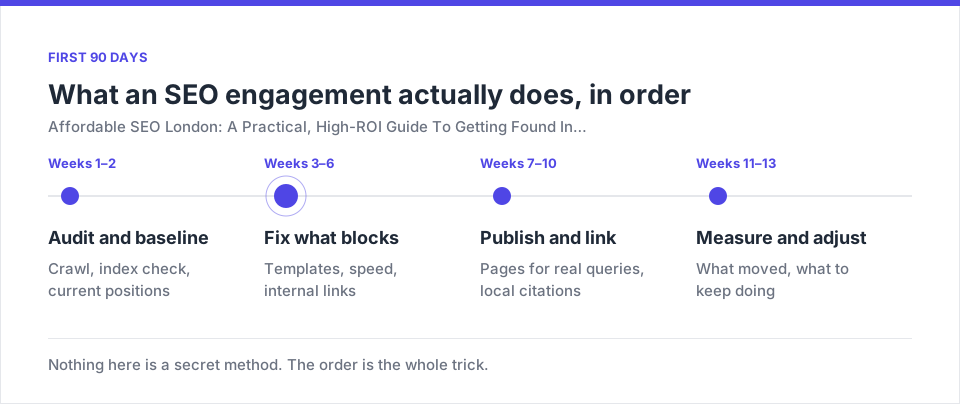
To operationalise these principles, build a lightweight playbook that covers outreach templates, target domains, content assets, and approval workflows. This keeps activity auditable and repeatable, enabling you to scale success to more districts without sacrificing quality. For practical artefacts, explore our International SEO services and booking a discovery to tailor a plan for your portfolio.
Measuring Impact, Risk, And Compliance
A disciplined measurement framework ties outreach to business outcomes. Track not only the number of links acquired but also their editorial relevance, referrals, and conversions attributed to link-driven visits. Use market-specific dashboards that align with CORA Trails and Translation Provenance, so leadership can audit how links contribute to local visibility and revenue. Regular governance reviews help detect misalignment early and prevent reputational risk.
Practical metrics include referring domains with district granularity, referral traffic by borough, and conversions generated from linked pages. Dashboards should connect link activity to GBP engagement and district content performance to demonstrate a coherent ROI narrative. For templates and artefacts, visit our International SEO services page.
Putting this into action requires a pragmatic rollout. Phase one focuses on mapping districts, identifying high-potential outlets, and creating outreach templates. Phase two executes outreach with a controlled pilot of 2–3 district spokes, generating early signals and refining messaging. Phase three scales to additional districts, expanding content assets and governance logs to sustain auditable momentum. Throughout, CORA Trails captures decisions and Translation Provenance preserves terminology as you grow.
For organisations ready to begin, our International SEO services provide structured artefacts and playbooks that you can adapt, or you can book a discovery via Contact to tailor a plan for your London portfolio.
Pricing Models For Affordable London SEO
In London, cost matters but so does value. At londonseo.ai we offer pricing that aligns with governance and measurable ROI. Transparent, flexible, and scalable pricing ensures you can plan with confidence.
We recognise that businesses in the capital face varying needs. This is why we present pricing options that couple clarity with governance. Several common structures exist, each designed to balance predictability with scalable growth. Where appropriate, we align pricing with our hub-and-spoke approach to GBP optimisation, local district pages, and ongoing measurement.
Common Pricing Structures In London SEO
- Monthly Retainers: A predictable, ongoing engagement covering a defined scope, governance artefacts, dashboards, and regular reporting. Retainers provide a stable platform for iterative improvements in local visibility, technical health, and content optimisation, with scalable blocks added as needs evolve.
- Fixed-Price Projects: A single, clearly scoped initiative such as a technical health audit, a local SEO foundation build, or a site migration. This model yields a concrete deliverable at a fixed price with milestones and acceptance criteria.
- Milestone-Based Engagements: Larger initiatives split into milestones (audit, implementation, verification, optimisation). Each milestone has fixed charges and outcomes, enabling budgeting with auditable checkpoints.
- Hybrid Models: A blend of retainers and milestones, combining predictability with milestone clarity. Particularly useful for portfolio programmes where some districts require rapid work while others benefit from continuous improvement.
- ROI / Value-Based Pricing (Where Appropriate): Ties payments to agreed outcomes such as lead generation or revenue lift, subject to transparent attribution and governance. Not universally suitable, but effective when performance signals are reliable and auditable.
Choosing a model depends on risk appetite, forecasted outcomes, and the need for governance. Retainers offer stability; fixed-price projects provide certainty for a defined goal; milestones offer a structured governance cadence; hybrids balance the benefits; ROI-based pricing aligns price with measurable impact where governance is strong enough to attribute outcomes credibly.
What Should Be Included In A Budget-Friendly Package
- Lean technical health and prioritised work: a concise audit focused on crawlability, mobile speed, structured data, and canonical handling with multi-market considerations where relevant.
- Local SEO foundations: GBP optimisation, consistent NAP across local directories, and district-focused landing pages to capture near-me searches.
- On-page optimisation: metadata, headings, schema, and content tweaks tailored to local intent on priority pages.
- Content planning with reuse: repurposing existing assets and creating lightweight district templates to cover local questions.
- Transparent governance: defined milestones, CORA Trails for change provenance, and Translation Provenance for terminology consistency across markets.
- Reporting cadence: regular performance dashboards that prove progress against KPIs and enable course corrections.
Choosing The Right Model For Your London Business
Consider several decision criteria to pick the most suitable model for your organisation:
- Budget stability and predictability: would you benefit from monthly liquidity or fixed upfront costs?
- Scope clarity: is your project bounded or expected to evolve over time?
- Governance needs: do you require auditable decision logs and dashboards from day one?
- Risk tolerance: how willing are you to experiment with new tactics and adjust budgets accordingly?
What A Budget-Friendly Package Typically Includes
- Lean technical health and prioritised work: concise crawl, mobile speed, canonical handling, and hreflang for multi-market pages where necessary.
- Local SEO foundations: GBP optimisation, consistent NAP across local directories, and district-focused landing pages for near-me searches.
- On-page optimisation: metadata, headings, schema, and content tweaks aligned to local intent on priority pages.
- Content planning with reuse: repurposing existing assets and creating lightweight district templates to cover local questions, reducing content debt.
- Transparent governance: defined milestones, CORA Trails for change provenance, and Translation Provenance for terminology consistency across markets.
- Reporting cadence: dashboards tracking KPI progress and enabling course corrections.
To explore pricing that aligns with governance-led SEO in London, visit our Services page for artefacts and templates, or arrange a discovery via Contact. A transparent pricing discussion helps ensure you receive the highest possible ROI within your budget. For additional guidance, see Google's SEO starter guide and best practices, which inform our approach to sustainable results at londonseo.ai.
Measuring ROI In Affordable London SEO
In affordable London SEO, measuring return on investment is essential to translate modest spend into meaningful business value. A governance-led, ROI-focused programme from londonseo.ai aligns activity with real outcomes, using auditable CORA Trails and Translation Provenance to keep decisions transparent as campaigns scale across boroughs and markets.
Key to success is a framework that links inputs to measurable outputs: visibility, traffic quality, engagement, and revenue. This section outlines a practical approach to designing an ROI model that suits affordable SEO in London, including the role of governance artefacts and market-specific measurement.
First, define the core ROI question for each market: what business outcome will a specific SEO activity drive, and within what time horizon? At londonseo.ai we advocate for a procurement of governance artefacts that enables auditable decisions, such as CORA Trails documenting why changes were made and Translation Provenance ensuring terminology remains consistent as campaigns expand.
Framework For ROI Modelling
- Define market-specific goals: local visibility, GBP engagement, district conversions, or revenue lift, with clear success criteria.
- Map inputs to outcomes: link technical fixes, GBP optimisation, and district content to specific KPI lifts.
- Choose an attribution approach: multi-touch attribution, time decay, or controlled experiments to assign credit across touchpoints.
- Estimate incremental value: forecast uplift in organic traffic, engagement metrics, and conversions attributable to SEO activity.
- Plan budgets and milestones: align spend with defined milestones and governance checkpoints to maintain accountability.
For credible external context, Google’s guidance on measurement and SEO best practices can inform your framework. See Google’s SEO Starter Guide for baseline principles, while applying London-specific governance through CORA Trails and Translation Provenance for auditable traceability. Google's SEO Starter Guide.
Core Metrics And Their Interpretations
- Market visibility and engagement: track impressions, top rankings, and local SERP features by district to assess prominence and intent capture.
- Traffic quality by locale: monitor sessions, bounce rate, time on page, and pages per session, ensuring traffic aligns with district needs.
- Local conversions and GBP engagement: form submissions, calls, directions requests, and service inquiries attributed to local signals.
- ROI and cost efficiency by market: calculate revenue lift against spend, normalised to currency and local economic context.
- Content effectiveness by district: hub depth, spoke performance, and localisation impact on conversions.
A practical approach is to run a baseline period (e.g., 4–6 weeks) and compare against a target period after implementing lean improvements. Use CORA Trails to document the rationale behind each KPI choice and Translation Provenance to maintain consistent terminology as you expand.
Governance Artefacts That Support ROI
Governance provides the framework that makes ROI credible. Central artefacts include:
- CORA Trails: change provenance logs detailing what was changed, why, who approved it, and when.
- Translation Provenance: terminology consistency across languages and locales to ensure comparable metrics.
- Auditable dashboards: KPI views with drill-downs by district and market, plus governance notes for each milestone.
Combining these artefacts with robust analytics enables teams to justify budget decisions and show tangible progress. For practical templates, see our Services page and consider booking a discovery via Contact.
To illustrate the value, consider a hypothetical London borough programme: a modest monthly spend of £1,500 yields a measurable uplift in district conversions, GBP engagements, and organic revenue over a 6–9 month window. By attributing uplift to specific activities and tracking cost per conversion, leadership can see a compelling ROI trajectory and continue to fund scalable district initiatives. This is the essence of affordable SEO: disciplined governance, transparent measurement, and repeatable success across districts. For tailored guidance, our Services offer governance-enabled artefacts you can adapt, or book a discovery via Contact to map an ROI-driven plan for your London portfolio.
Choosing An Affordable London SEO Partner
Selecting the right partner in London is about value, governance, and long-term performance as much as it is about price. An affordable London SEO partner should deliver measurable improvements, operate with transparent processes, and provide a scalable framework that can grow with your business. The guidance below helps brands evaluate potential agencies, understand what a practical, phased engagement looks like, and recognise how londonseo.ai can align budget with durable outcomes across boroughs and markets.
A strong partner is defined by more than competitive fees. It is about a transparent scope, auditable governance, and a plan that links every activity to business outcomes. In London’s diverse economy, the right partner will harmonise central governance with district-specialist execution, ensuring local relevance without content debt or governance drag. This is the core premise behind londonseo.ai’s approach to affordable, high-value SEO in the capital.
Key Selection Criteria For A London-Based Partner
- Proven cross-border track record: demonstrable success across multiple markets or boroughs, with case studies that show sustainable visibility, traffic, and conversions in contexts similar to yours.
- Multilingual capability and local insight: access to native or native-fluent experts who can adapt language and tone to local audiences while preserving brand voice.
- Governance and transparency: clear change provenance, auditable decision logs, and dashboards that leadership can trust and reproduce.
- Technical sophistication and scalability: robust frameworks for hreflang, international sitemaps, and scalable site architecture that support growth without friction.
- Measurement discipline and ROI focus: market-specific KPIs, cross-border attribution, and dashboards that connect activity to revenue and strategic objectives.
- Collaboration model and programme governance: defined roles, regular rituals, and a seamless handoff between central governance and local-market specialists.
When evaluating proposals, look for concrete evidence of repeatable delivery: templates for district pages, hub-and-spoke content blocks, and standardised reporting. Ensure the agency can demonstrate CORA Trails for change provenance and Translation Provenance for terminology consistency across languages and markets. These artefacts are not bureaucratic; they enable auditable progress and risk management as you scale.
What An Effective, Phased International Roadmap Should Include
- Market prioritisation and sequencing: a data-driven plan that identifies initial districts or markets with the greatest potential and the shortest path to impact.
- Domain structure and signals: decisions on ccTLDs, subdirectories, or subdomains, plus hreflang and canonical strategies aligned to each market.
- localisation depth and content calendars: guidelines for translating, adapting, or creating local content, with templates to accelerate district-scale output.
- Technical readiness: a readiness checklist covering site speed, mobile performance, structured data, and sitemap architecture integrated with governance.
- Measurement and governance cadence: a plan for dashboards, attribution, and CORA Trails updates that document decisions and outcomes.
Part of the roadmap is a clear onboarding plan that ensures a swift start without compromising governance. Expect a 90-day ramp with baselines, first wins, and a cadence for governance reviews. London brands will benefit from a partner who can translate data into actionable priorities and justify every investment with auditable outputs.
Questions To Ask A Potential Partner
- Can you share multiple-market case studies with measurable lifts? Ask for impact data, not just outputs, and request details about markets similar to yours.
- How do CORA Trails and Translation Provenance operate in practice? Seek demonstrations of change provenance logs and terminology governance across districts.
- What is your approach to hub-and-spoke localisation? Request templates and examples showing district pages connected to service hubs.
- How do you handle cross-border attribution? Inquire about the attribution model, data sources, and how insights translate into budget decisions.
- What is the exact governance cadence and reporting format? Ask for sample dashboards and the schedule of reviews for leadership and practitioners.
Additionally, request a demonstration of a discovery process, a starter roadmap, and a sample artefact suite that includes templates for local pages, GBP management, and reporting. Your aim is a partner who can operate transparently from day one and scale your efforts without introducing governance drag.
How londonseo.ai Addresses These Needs
londonseo.ai brings a governance-led, hub-and-spoke framework to affordable London SEO. You gain auditable CORA Trails that capture the rationale behind every change, and Translation Provenance that preserves terminology as markets grow. Our approach combines central governance with district specialists to ensure proximity and relevance without content debt. We provide GBP optimisation, district landing pages, and a scalable content architecture designed for rapid expansion across London and beyond. Our dashboards are built to offer global visibility plus district-level detail, enabling leadership to track ROI and hold teams accountable through a transparent, repeatable process.
If you’d like to explore a tailored, governance-enabled plan for your portfolio, start with a discovery via Contact or review our Services to see artefacts you can adapt. A well-structured partnership turns affordability into predictable, durable growth in London’s dynamic search landscape.
Next, Part 12 will walk through common pitfalls and risk mitigation strategies when adopting an affordable London SEO framework, helping you steer clear of overpromising, hidden costs, and low-quality shortcuts while maintaining compliance and trust.
AI-Powered SEO: Balancing Cost and Outcome
In affordable London SEO, AI tools can speed up data analysis, keyword discovery, and competitive insights while human strategy remains essential to ensure relevance, governance, and long-term value. At londonseo.ai we integrate AI within a governance-led framework to deliver measurable ROI on modest budgets. The goal is to automate repetitive tasks, accelerate decision cycles, and empower specialists to focus on locality, quality content, and strategic prioritisation.
AI can streamline seed keyword generation, clustering, and scenario planning. Start with London-market informed seed keywords, then leverage AI to expand into long-tail variants, intent-based groupings, and content gaps. Yet outputs must be validated by SEO professionals and aligned with CORA Trails for change provenance and Translation Provenance for terminology across districts and languages. This guardrail ensures scale without eroding quality or brand voice.
Practical workflow for AI integration includes: 1) AI-assisted keyword discovery, 2) human validation and cleansing of clusters, 3) briefs for content teams, and 4) AI-enabled ideation of topics with final human editorial approval. The governance layer records decisions, maintains provenance, and ensures repeatable delivery as you expand across London boroughs.
Cost efficiency materialises when AI accelerates data collection, reporting, and trend modelling. The economics improve further when human review, thresholding, and governance are layered on top. We advocate a staged approach: pilot AI-enabled SEO in one district, demonstrate auditable value, then scale with governance artefacts such as CORA Trails and Translation Provenance to maintain consistency across markets.
Key considerations When Embedding AI In Affordable London SEO
- Data quality and accuracy: AI insights are only as good as the underlying data; ensure feeds from analytics, GBP, CMS, and CRM are clean and documented.
- Transparency and disclosure: clearly mark AI involvement in content and responses where appropriate, following governance protocols.
- Compliance and ethics: verify that AI-assisted outputs comply with privacy, platform policies, and disclosure norms.
- Human-in-the-loop: keep editors and localisation experts involved to safeguard tone, nuance, and local relevance.
- Provenance and auditability: maintain CORA Trails and Translation Provenance for every AI-assisted decision and content iteration.
As with all affordable programmes, the objective is durable growth. AI accelerates research, testing, and reporting, but it does not replace strategic prioritisation, quality control, and robust measurement. If you’d like to pilot AI-enabled SEO within a governance framework, start with a discovery via Services and Contact to tailor a scalable plan for your London portfolio.
In summary, AI accelerates many components of an affordable London SEO programme, but governance, human expertise, and auditable measurement remain non-negotiable. If you’re ready to explore AI-enabled SEO that respects budget and compliance while driving durable growth, londonseo.ai invites you to schedule a discovery and discuss a measured, district-aware strategy for London.
AI-Powered SEO: Balancing Cost And Outcome
In affordable London SEO, AI tools accelerate data analysis, keyword discovery, and competitive insights, but human strategy remains essential. Londonbrands benefit from AI-enabled speed and scale while preserving governance, locality, and ethical standards. At londonseo.ai, we combine AI-assisted workflows with CORA Trails and Translation Provenance to ensure every data point and decision is auditable, reproducible, and aligned with local market nuances.
Artificial intelligence can turbocharge three core activities in London SEO: seed keyword discovery, topical clustering, and competitive intelligence. AI can scan search results, extract patterns from hundreds of districts, and surface long-tail opportunities that would take humans weeks to surface. Yet, outputs must be validated by SEO specialists and connected to governance artefacts so that decisions stay traceable and aligned with district needs.
A practical AI-enabled workflow for affordable London campaigns includes four phases. First, data capture and quality assurance from Google Analytics, Google Search Console, GBP insights, and CMS analytics. Second, AI-assisted analysis to generate seed keyword sets, topic clusters, and potential content gaps focused on London districts and near-me searches. Third, human validation and briefs to guide content teams, ensuring language, tone, and local relevance remain authentic. Fourth, implementation and measurement within a governance framework that records decisions and outcomes for auditable review.
This approach allows a lean baseline to scale quickly. With small budgets, AI helps identify the highest-leverage opportunities first, then compounds value as you expand to more boroughs and service lines. For guidance on the governance layer that makes AI-driven work auditable, explore our CORA Trails and Translation Provenance artefacts within our International SEO services.
The hub-and-spoke model pairs AI-generated topic clusters with district spokes. AI helps map clusters to district pages, proximity signals, and local questions, while human editors ensure content remains trustworthy and contextually accurate. This synergy supports scalable localisation without compromising quality or brand voice, with CORA Trails capturing the rationale behind each mapping and Translation Provenance maintaining terminology consistency across markets.
Budget considerations are straightforward: use AI to accelerate low-risk, high-ROI tasks first, and reinvest saved hours into governance-driven activities such as district content calendars, GBP optimisation, and local link-building strategies. AI should reduce cycle times, not replace strategic thinking or local judgement. Our experience shows that disciplined AI adoption, matched to a clear governance model, delivers meaningful uplift in visibility and conversions in London’s competitive landscape.
Ethical use of AI is non-negotiable. Disclose AI involvement where relevant, preserve human oversight for localisation, and ensure data-handling practices comply with privacy regulations. CORA Trails provides an auditable decision log for AI-assisted actions, while Translation Provenance protects terminology consistency as content scales across boroughs. This governance discipline protects citability and trust while enabling scalable outcomes.
Measuring ROI in AI-enabled SEO rests on linking AI-driven insights to concrete outcomes: district visibility, GBP engagement, traffic quality, and local conversions. Use attribution models that recognise multi-touch interactions and tie results back to the governance framework. Regular reviews of CORA Trails and Translation Provenance ensure the AI-led approach remains credible and auditable as campaigns expand across London.
For teams ready to harness AI responsibly, our Services offer governance-supported artefacts, templates, and dashboards you can adapt to your portfolio. If you’d like a personalised AI-enabled roadmap, you can book a discovery via Contact to tailor a pragmatic plan that aligns with your London ambitions.
AI-Powered SEO: Balancing Cost and Outcome
In affordable London SEO, AI tools accelerate data analysis, keyword discovery, and competitive insights while human strategy remains essential to preserve relevance, governance, and long‑term value. At londonseo.ai we integrate AI within a governance‑led framework to deliver measurable ROI on modest budgets. The aim is to automate repetitive tasks, speed up decision cycles, and empower specialists to focus on locality, quality content, and strategic prioritisation.
AI can turbocharge seed keyword generation, topical clustering, and competitive intelligence. Begin with London‑market informed seed keywords, then use AI to expand into long‑tail variants, intent‑based groupings, and content gaps. Outputs must be validated by SEO professionals and aligned with governance artefacts such as CORA Trails for change provenance and Translation Provenance for terminology across districts and languages. This guardrail prevents scale from eroding quality or brand voice.
A practical AI workflow for affordable London campaigns includes four phases. First, capture and cleanse data from Google Analytics, Google Search Console, GBP insights, and CMS analytics. Second, apply AI to generate seed keyword sets, topic clusters, and content gaps focused on London districts and near‑me searches. Third, perform human validation and craft briefs that guide content teams, ensuring language, tone, and local relevance remain authentic. Fourth, implement and measure within a governance framework that records decisions and outcomes for auditable review.
This collaborative model leverages AI to accelerate discovery while preserving editorial stewardship. AI outputs should feed central templates and dashboards that your team uses to track progress against district goals, GBP signals, and on‑site performance. By tying AI‑driven insights to CORA Trails and Translation Provenance, you maintain a verifiable lineage for every decision, making citability stronger as districts scale.
Cost efficiency emerges when you deploy AI first on lower‑risk, high‑impact tasks. Reinvest the time saved into governance‑driven activities such as district content calendars, GBP refinements, and local link‑building strategies. The objective is not to replace expertise but to magnify it, delivering faster wins without compromising governance or quality.
Practical guidelines for AI in affordable London SEO include maintaining data integrity, ensuring disclosure where AI contributes to content or replies, and keeping editors in the loop for localisation and nuance. Align AI initiatives with established policy and platform guidelines to protect trust and citability. External references such as Google’s earned‑trust guidance can help shape responsible AI usage within search ecosystems ( Google's earned user trust guidelines).
To operationalise AI responsibly, adopt a staged rollout: begin with a pilot in a single district, validate outcomes with auditable dashboards, then scale to additional boroughs. Use CORA Trails to document the rationale behind each mapping and Translation Provenance to preserve terminology as content expands. This disciplined approach ensures AI accelerates growth while safeguarding quality, compliance, and local relevance.
Key Considerations For AI‑Enabled SEO
- Data quality and provenance: AI insights depend on clean analytics, GBP signals, and CMS data; document sources and validations within CORA Trails.
- Transparency and disclosure: clearly indicate where AI contributed to content or replies, with sources for factual claims.
- Editorial governance: maintain a human‑in‑the‑loop for localisation, tone, and cultural relevance; AI should inform, not replace, editorial judgment.
- Compliance and ethics: ensure adherence to privacy, platform policies, and disclosure norms in all automated outputs.
- Measurement with governance: tie AI‑driven actions to district KPIs via auditable dashboards, with CORA Trails recording decisions and Translation Provenance preserving terminology across markets.
If you’re ready to pilot AI within a governance framework, explore our Services page for artefacts you can adapt, or book a discovery via International SEO services to tailor an AI‑assisted, district‑aware plan for London. For ongoing guidance on AI integration, you can also contact us through Contact.
In the next part of this series, Part 15 will address common pitfalls and risk mitigation strategies when deploying an affordable London SEO framework, helping you avoid overpromising, hidden costs, and low‑quality shortcuts while maintaining compliance and trust.
FAQs About Affordable SEO In London
As a capstone to the London-focused, governance-led approach described across this series, these frequently asked questions distil practical guidance for brands seeking affordable SEO that delivers measurable value. The emphasis remains on auditable processes, district-level relevance, and durable growth within London’s competitive search landscape. For deeper context on governance artefacts, hub-and-spoke localisation, and ROI-driven planning, visit our Services page at londonseo.ai and consider a discovery via the Contact page.
Q1 — What does affordable SEO mean in London?
In London, affordable SEO means prioritising high‑leverage activities that deliver durable visibility without wasteful spend. It combines lean technical health, optimised Google Business Profile signals, and district‑level page improvements with repurposed content, all under a transparent, governance‑driven scope. The aim is to achieve measurable ROI rather than chasing short‑term hype. Our approach at londonseo.ai ties these elements together in a staged, auditable programme, designed to scale across boroughs while preserving brand integrity.
Q2 — How long does affordable London SEO take to show results?
Early, tangible gains typically appear within 3–6 months in local visibility and GBP engagement, with district pages beginning to outperform nominal competitors as authority grows. Substantial, durable growth in organic traffic and conversions generally emerges in the 6–12 month window, especially as hub‑and‑spoke content and local signals compound. The exact pace depends on baseline health, competitive density, and the rigor of governance artefacts (CORA Trails and Translation Provenance) that track decisions and outcomes. London brands partnering with londonseo.ai often see a progressive uplift aligned to planned milestones rather than overnight miracles.
Q3 — What should be included in a budget‑friendly London SEO package?
A lean, governable package typically covers lean technical health (crawlability, mobile speed, canonical handling), Google Business Profile optimisation, district‑focused landing pages, and a hub‑and‑spoke content structure that can be quickly customised for each borough. It also includes a disciplined local citation strategy, metadata and schema refinements, and a minimum viable content plan that reuses existing assets rather than creating debt. Importantly, governance artefacts such as CORA Trails for change provenance and Translation Provenance for terminology consistency are standard to ensure auditable decisions from plan to action.
Q4 — How is return on investment (ROI) measured for affordable London SEO?
ROI is framed around business outcomes tied to market, district, and funnel, not vanity metrics. Key indicators include local visibility and top rankings, GBP engagement (calls, directions, clicks), district traffic, and conversions such as enquiries or bookings. Attribution should be multi‑touch and time‑based where appropriate, with CORA Trails documenting data lineage and Translation Provenance ensuring terminology consistency. Central dashboards aggregate global views with district drill‑downs, enabling leadership to see how inputs translate into revenue and to adjust budgets in a controlled, auditable way.
Q5 — Are rankings guaranteed with affordable London SEO?
No reputable agency can guarantee first‑page rankings due to the fluid, competitive nature of search. What is guaranteed is a disciplined process: transparent scope, auditable governance, and consistent reporting that ties activity to outcomes. We focus on delivering ongoing, measurable progress and improving the quality of traffic and conversions, subject to algorithmic changes. Ethical, governance‑driven SEO from londonseo.ai aims to produce durable visibility rather than sensational, unsustainable promises.
Q6 — How does AI fit into affordable London SEO?
AI accelerates data analysis, keyword discovery, and competitive insights, reducing cycle times and enabling smarter prioritisation. However, human strategy remains essential. We embed AI within a governance framework that includes CORA Trails and Translation Provenance, ensuring transparency, traceability, and locale accuracy. A staged approach works best: pilot AI‑assisted tasks in a single district, validate impact with auditable dashboards, then scale with governance artefacts to preserve consistency across London’s boroughs.
Q7 — How do you scale across London's boroughs without losing local relevance?
The hub‑and‑spoke localisation model is central. A strong central service hub anchors topics while district spokes tailor content to proximity, events, and local needs. Consistency is preserved through Translation Provenance; signals such as GBP alignment and canonical structures are replicated with district templates to avoid content debt. CORA Trails records the rationale behind mappings and edits, enabling auditable growth as you expand beyond initial districts.
Q8 — How should a London business start with londonseo.ai?
Begin with a discovery via the Contact page and review our Services to understand artefacts available for governance‑led delivery. A typical path includes a baseline audit, KPI alignment, proposal of a phased plan, and an initial sprint focused on quick wins that demonstrate value. We emphasise auditable governance from day one, with CORA Trails and Translation Provenance guiding every district expansion and localisation decision.
These FAQs reinforce a practical framework for affordable SEO in London: value over price, governance over guesswork, and a scalable model that grows visibility and conversions across boroughs. To tailor an affordable, governance‑driven plan for your portfolio, book a discovery via Contact or explore our Services for artefacts and templates you can adapt. The London team at londonseo.ai is ready to collaborate on district‑level strategy, GBP optimization, and auditable performance improvements that compound over time.
