Why London Businesses Need a Dedicated SEO Partner
London is a global hub of commerce, culture, and innovation, where thousands of businesses compete for visibility every day. The city’s search landscape is exceptionally dynamic: people search at all hours, in multiple languages, and across a wide range of devices. In such a fast-moving market, a London-focused SEO partner brings more than technical expertise. They bring local insight, governance discipline, and a proven framework that translates proximity to tangible outcomes—whether that’s more walk-ins, phone inquiries, or e-commerce orders.
Partnering with a dedicated London SEO agency such as London SEO AI means aligning your digital strategy with the realities of the capital’s diverse consumer base. It’s not enough to rank for generic terms; you want visibility that reflects neighbourhood dynamics, commuter patterns, and the unique intent behind searches in Notting Hill, Shoreditch, Chelsea, Canary Wharf and beyond. A London-first approach considers local competition, borough-specific trends, and the way Google organises results in Local Pack and Maps for nearby customers.
This opening section sets the stage for a practical guide to selecting the best London SEO agency. Across the following sections, you’ll find criteria, core services, and governance practices that distinguish top-tier providers from ordinary SEO teams. The aim is to empower you to demand transparency, measurable outcomes, and alignment with your business goals as you engage with a partner who understands London’s market nuances.
What makes a London agency standout goes beyond keyword lists and link counts. It encompasses how they manage Google Business Profile (GBP), map-based visibility, local citations, and the consistency of NAP (Name, Address, Phone) across the city’s many directories. A truly London-centric firm will demonstrate an ability to translate borough-level insights into optimised landing pages, content strategies, and a prioritised roadmap that scales from a single neighbourhood to a city-wide plan.
In the upcoming sections, you’ll see a clear framework for evaluating potential partners, ranging from governance artefacts to measurement of ROI. The goal is to equip you with a practical checklist that helps you compare agencies, request verifiable references, and run a controlled pilot to validate capability before committing long-term.
What the best London SEO agency delivers
A top London SEO partner combines technical excellence with a localisation mindset. Expect the following capabilities as standard practice, not as fringe offerings:
- Technical SEO with a local lens: solid site health, mobile optimisation, fast loading, structured data, crawlability, and a clean, borough-aware URL architecture that scales from a central hub to multiple neighbourhoods.
- On-page optimisation and local content strategy: optimised meta data, header structure, and page content that speaks to local intents and quadrant-level needs in London.
- GBP and Maps excellence: verified GBP ownership, consistent NAP across directories, active local posts, timely responses to reviews, and accurate business attributes that boost Local Pack visibility.
- Content strategy with local relevance: editorial calendars built around London’s events, transport patterns, and neighbourhood interests to sustain engagement and authority.
- Analytics, reporting and ROI: clear KPIs, lightweight dashboards, and attribution models that connect local visibility to revenue and growth.
London’s complexity demands a governance framework that records decisions and rationale. What-If baselines help teams anticipate scenarios such as seasonal shopping spikes around the West End, or shifts in commuter patterns into Canary Wharf. Provenance Trails provide traceability for audits, ensuring your strategies are transparent to stakeholders and regulators, and compliant with EEAT guidelines.
To experience this approach in practice, explore London SEO AI’s solutions at our SEO services. You’ll find governance artefacts, templates for What-If baselines, and Provenance Trails designed to support auditable growth. For a personalised discussion, book a consultation to tailor a London-focused strategy to your sector and target boroughs. You can also review Google’s EEAT guidelines and adapt them to the London context: EEAT guidelines.
Next, Part 2 will delve into benchmarks and criteria for evaluating a London SEO agency, including case studies and references you can request as part of your vendor shortlisting process.
What defines the best London SEO agency: benchmarks and criteria
In London’s crowded search landscape, selecting a partner demands more than a promise of rankings. The best London SEO agencies demonstrate a replicable framework grounded in governance, transparency, and measurable outcomes that translate visibility into revenue. London SEO AI positions you to demand not just clicks, but a governance-enabled approach that regulators and stakeholders can audit with confidence.
Key benchmarks to use when shortlisting agencies combine governance artefacts, data-driven performance, and fluency with London audiences. A top partner will balance technical excellence with local relevance and a disciplined governance model that supports transparent reporting and accountability.
Core benchmarks for a London-focused partner
- Transparency and governance: the agency provides What-If baselines, Provenance Trails, and regulator-friendly dashboards that make every decision traceable and auditable.
- Outcomes and ROI clarity: clear KPIs, attribution models, and case studies that connect Local Pack visibility and GBP health to tangible revenue, leads, or store visits.
- London-market expertise: demonstrable knowledge of Notting Hill, Shoreditch, Chelsea, Canary Wharf, and other boroughs, translating borough signals into borough landing pages and a structured content calendar.
- On-going governance cadence: structured onboarding, regular check-ins, and monthly reporting that aligns with EEAT guidelines and local expectations.
- References and verifiable results: access to references, permission to contact clients, and public case studies with data points.
- Pilot capability: willingness to deploy a low-risk pilot (for example, a borough landing page) to validate capability before a broader rollout.
Beyond these benchmarks, the strongest agencies integrate Local SEO with Maps and GBP health, maintain consistent NAP across directories, and deploy LocalBusiness, FAQ and Event data schemes to capitalise on rich results. London’s proximity-driven searches reward precise local signals and well-structured local content that connects users with neighbourhoods and services.
Deliverables you should expect from a top London SEO agency
- Governance artefacts: What-If baselines, Provenance Trails, and governance dashboards that document every decision and its expected impact.
- Regulator-friendly dashboards: accessible dashboards with drill-down into ward-level signals and spine-term performance for auditability.
- Onboarding and cadence: a documented onboarding plan, clear milestones, and regular reporting cycles that keep stakeholders informed.
- Case studies and references: 2–3 detailed case studies with measurable outcomes and verified client references from London markets or similar urban contexts.
- Pilot plan: a structured pilot proposal by borough or by landing page, with explicit success criteria and exit criteria.
- EEAT-aligned content governance: a framework ensuring content quality, authority, and trust signals with proper attribution and sourcing.
Request references and tangible evidence from potential partners to assess their capability to deliver in London’s complex market. Validate their claims by contacting previous clients in similar sectors or boroughs, and seek data points that mirror your metrics and goals.
To gain practical insight into a London-first governance mindset, browse our London SEO AI solutions for auditable artefacts and governance templates. Consider booking a consultation to tailor a locality-focused plan that aligns with your sector and targets.
A controlled pilot helps demonstrate capability, validate the governance framework, and build momentum for scale. The goal is to generate early wins that are measurable and easily scalable across additional boroughs, while maintaining regulatory and EEAT alignment.
In practice, you’ll want a London partner who can translate spine terms into district signals, with ward-proof outputs that retain local identity while contributing to a coherent city-wide authority. If you’re looking for a rigorous, auditable approach to locality-first SEO, explore the SEO services section at our SEO services and arrange a consultation to tailor a London-focused plan for your market. Google’s EEAT guidance is a reliable compass to ensure your governance remains robust as markets evolve: EEAT guidelines.
Core services you should expect from a top London SEO agency
In London’s highly competitive search landscape, a first‑class SEO partner delivers a clearly defined, locality‑driven suite of services. A top London SEO agency combines technical excellence with a deep understanding of boroughs, transport corridors, and consumer intent, translating proximity into measurable business outcomes. London SEO AI approaches this with governance, transparency, and a practical road map that scales from a single neighbourhood to a city‑wide programme while maintaining auditable traceability for stakeholders and regulators.
Core offerings typically span six interlocking disciplines. Each is designed to reinforce proximity signals, improve maps visibility, and connect search activity with real-world outcomes such as store visits, calls, and conversions. These services are not stand‑alone tactics; they are coordinated through a spine‑to‑ward framework that preserves brand consistency and maximises local relevance.
- Technical SEO foundation with a London focus: robust site health, mobile‑first optimisation, fast loading, Core Web Vitals, structured data, crawlability, and a borough‑aware URL architecture that scales from central hubs to neighbourhood landing pages. A London‑centred technical baseline ensures Google can reliably index and understand the local signals that matter most to your audience.
- On‑page optimisation and local content strategy: optimised metadata, semantic header structures, and page content tailored to local intents. This includes borough‑level landing pages and content clusters that align with Notting Hill, Shoreditch, Chelsea, Canary Wharf and other districts, ensuring relevance across the capital.
- Google Business Profile (GBP) and Maps health: ownership verification, consistent NAP (Name, Address, Phone), active GBP postings, timely responses to reviews, and accurate business attributes. These signals are critical for Local Pack visibility and near‑me searches, especially in dense urban areas where competition for proximity is intense.
- Local content strategy and hub‑and‑spoke architecture: a scalable content model with a central brand hub and district spokes. This structure allows local pages to accumulate authority without duplicating content, while interlinking to trusted pillar pages that reinforce thematic depth across London.
- Link building and digital PR with local relevance: relationship‑based outreach to London‑focused publishers, neighbourhood blogs, and partner organisations. The aim is contextually relevant, editorial links that bolster local authority without risking penalties or unnatural patterns.
- Analytics, attribution and governance: clear KPI trees, lightweight dashboards, and attribution models that connect Local Pack impressions, GBP health, and map interactions to revenue, leads or store visits. Governance artefacts (What‑If baselines and Provenance Trails) ensure every decision is traceable and auditable.
Deliverables are designed to be regulator‑friendly as well as business‑friendly. Expect detailed dashboards, annotated change logs, and a clear mapping between borough signals and page outputs. The best London agencies won’t just promise improved rankings; they will demonstrate how technical health and local relevance drive tangible outcomes in your target districts.
A practical example is the hub‑and‑spoke model: a central borough or city page anchors a cluster of district pages, with interlinks that distribute authority while preserving district specificity. This approach helps Google understand the relationship between your brand and London’s diverse localities, reducing content duplication and improving crawl efficiency across the capital.
GBP health, Maps health, and structured data for LocalBusiness, FAQ and Event are essential parts of the local visibility stack. A cohesive GBP strategy includes verification, accurate hours, services, and engaging responses to reviews. When these signals align with district landing pages and hub content, your business gains stronger presence in Local Pack, Maps and rich results across London.
Beyond implementation, governance matters. What‑If baselines forecast potential uplifts under changing conditions (seasonality, transport patterns, local events) and Provenance Trails document data sources, calculations, owners and dates. This framework underpins auditability for stakeholders and regulatory bodies while providing a transparent narrative for clients about how and why actions were taken.
For a concrete starting point, explore London SEO AI’s governance artefacts and templates in our SEO services section. They are designed to help you demand clarity, accountability and measurable ROI from a best‑in‑class London partner. You can review our SEO services and book a consultation to tailor an approach that fits your sector and London boroughs. For external guidance on EEAT, see Google’s guidance: EEAT guidelines.
Ready to align your local strategy with a top London SEO agency? Visit our SEO services page or book a consultation to start building a locality‑first plan that delivers real results across London.
Local SEO mastery: winning in London’s search landscape
London’s Local SEO strategy demands more than generic optimisations. It requires a borough-aware, governance-driven approach that converts proximity into tangible business outcomes. A top London SEO agency blends technical excellence with deep local insight to align GBP health, Maps visibility, and district-level signals with your revenue goals. This section drills into the practical levers that separate best-in-class London programmes from standard SEO playbooks.
The London market is characterised by dense competition and a mosaic of neighbourhoods. The most effective agencies map spine terms to ward proofs and construct a scalable hub-and-spoke architecture that preserves brand integrity while delivering hyperlocal relevance. This requires robust governance, traceable decision trails, and a disciplined approach to measurement that extends beyond vanity rankings to demonstrable business impact.
Key London-specific tactics focus on GBP health for Local Pack prominence, borough landing pages that reinforce central pillars, and a city-wide content calendar aligned with events, transport patterns, and district-level consumer behaviour. A London-first programme also demands clear ownership, predictable cadences, and auditable dashboards that stakeholders and regulators can review with confidence. This is the foundation for scalable growth across Notting Hill, Camden, Chelsea, Shoreditch, Canary Wharf and beyond.
London-focused deliverables and governance
- Governance artefacts: What-If baselines, Provenance Trails, and regulator-friendly dashboards that make every decision traceable and auditable.
- GBP and Maps health management: verified ownership, consistent NAP across London directories, active GBP posts, timely review responses, and accurate business attributes that boost Local Pack visibility.
- borough landing pages and central hub: a hub-and-spoke structure with district pages linked to a central brand hub, ensuring local relevance without content duplication.
- Local data signals and structured data: LocalBusiness, FAQ and Event schema deployed across boroughs to support rich results and Maps panels.
- Analytics, attribution and ROI: clear KPI trees and attribution models that connect Local Pack impressions, GBP health, and map interactions to store visits and revenue.
To operationalise these capabilities, expect a tight cadence of delivery and a practical pilot plan. A borough-by-borough pilot (for example, a single district landing page paired with GBP optimisation and a local content cluster) can validate capability, governance, and ROI before wider rollout. London-specific pilots should include explicit success criteria, exit conditions, and a clear path to scale while preserving model integrity.
Content plays a pivotal role in proving locality relevance. Editorial calendars should be London-centric, weaving in events such as London Fashion Week, seasonal shopping spikes, and transport-linked consumer patterns. Borough-focused pages must connect to pillar content that speaks to local needs, while maintaining global brand voice. This alignment enhances authority, improves user experience, and boosts the likelihood of appearing in rich results for geo-specific intents.
From a governance perspective, every action should be auditable. What-If baselines forecast uplifts under defined conditions, while Provenance Trails document data sources, calculations, owners and dates. London agencies that publish regulator-friendly dashboards and maintain transparent data lineage are better positioned to withstand algorithm changes and policy updates while keeping stakeholders confident. For practical guidance, London‑focused artefacts and templates are available through London SEO AI’s SEO services, and you can book a consultation to tailor a borough-driven plan to your sector and target audience. For best-practice reference, review Google’s EEAT guidelines and adapt them to your London context.
Ready to translate London proximity into measurable outcomes? Explore our SEO services or book a consultation to start designing a locality-first strategy for your London business.
Content strategy and editorial planning for the London market
In London, content strategy must merge audience insight with locality signals to translate visibility into tangible business outcomes. A London-first editorial plan links GBP health, Maps visibility, and district signals to a coherent user journey across Notting Hill, Shoreditch, Chelsea, Canary Wharf and beyond. London SEO AI champions a governance-led editorial framework that supports auditable decisions and EEAT-aligned content, ensuring every piece contributes to proximity-driven growth.
London’s audience is a mosaic of languages, cultures and shopping behaviours. The content strategy begins with rigorous audience research to identify key boroughs, commuter corridors and user journeys. Build personas that reflect both central business districts and residential hubs, then map their intents to content clusters. This approach guarantees landing pages, blog posts and guides speak with authority to readers in districts like Notting Hill, Shoreditch, Chelsea and Canary Wharf, while preserving a consistent brand voice across the capital.
Audience research for London audiences
Effective research combines qualitative interviews with quantitative analytics to segment demand by boroughs, transit patterns and typical purchase journeys. Use GBP and Maps usage data to understand what local readers want in each area, then translate those insights into district-level content that advances the customer journey from search to conversion.
Practical steps include interviewing representative customers, analysing local review trends, and evaluating search behaviour in high-traffic zones such as the West End, Marylebone and East London corridors. The output should feed on-page copy, hub content and a borough-specific editorial calendar that supports long-term authority and local relevance.
Keyword and search intent analysis for London terms
Develop a spine of terms that captures proximity and intent, then expand with district qualifiers. Core spine terms might include london seo agency, best london seo agency, and seo consultant london, but pair them with boroughs and neighbourhoods (for example, seo agency Notting Hill, seo consultant Chelsea). Map user intents to content formats: informational queries become practical guides, transactional queries drive service pages, and navigational queries leverage GBP and Maps presence.
Content should reflect London’s transport and lifestyle rhythms. Use keyword-led content clusters that connect central pillar pages with district spokes, ensuring every district contributes to the overall authority while retaining local flavour. Include multilingual considerations where relevant to capture the capital’s diverse audience, ensuring translations preserve intent and local relevance.
Editorial calendar and governance
The content calendar should align with London events, seasonal consumer patterns and transport schedules. Establish a quarterly plan that weaves in Notting Hill events, theatre openings, financial district activity and major conferences, while keeping content fresh, accurate and locally authoritative. A reliable cadence underpins search performance and user trust.
Editorial governance is essential. Create hub-and-spoke outputs that connect to pillar pages and deliver district-level signals. What-If baselines forecast uplifts during seasonal peaks and specific events, while Provenance Trails document data sources, calculations, owners and dates. This discipline provides auditable proof of strategy and supports EEAT alignment as markets evolve.
Develop a regulator-friendly dashboard that presents executive summaries with drill-downs to ward-level outputs and the data lineage behind each decision. This transparency is vital for stakeholders and regulators, and it strengthens the credibility of your locality-first approach.
Quality standards and formats that work in London
- Editorial quality and authority: author bios with verifiable expertise, clear sourcing, and a distinctive London voice that reflects real local insight.
- Content formats for locality: borough landing pages, neighbourhood guides, practical how-tos, FAQs, event calendars and district case studies that demonstrate local relevance and results.
- Structured data and localisation: deploy LocalBusiness, FAQ and Event schemas to support rich results in Maps, Local Pack and knowledge panels, enhancing proximity signals across London.
Editorial output should be embedded in a robust governance framework. Provenance Trails capture authors, sources and change history, while What-If baselines forecast the impact of editorial decisions under varying market conditions. This structure supports regulator-readiness and ensures content remains credible, accurate and aligned with EEAT principles.
Explore London-focused editorial artefacts and governance templates on the londonseo.ai site. For EEAT guidance, consult Google’s guidelines: EEAT guidelines. If you’d like a tailored borough plan, book a consultation.
When planning content formats, London businesses benefit from a mix of borough pages, district guides, event calendars and practical checklists. Each format should link back to pillar pages and to relevant GBP/Maps signals, creating coherent pathways that guide users from discovery to action. A disciplined cadence supports ongoing optimisation, ensuring content remains fresh, accurate and aligned with evolving local signals.
To learn more about London-specific content governance and to access practical templates, visit our SEO services page. For strategic guidance on EEAT and local content, see Google’s EEAT guidelines and use them to strengthen trust signals in your London content program: EEAT guidelines.
Ready to implement a locality-first content strategy for London? Explore our SEO services or book a consultation to tailor a London-centric plan that integrates GBP, Maps and local content with auditable governance.
Collaboration and process: from onboarding to ongoing optimisation
In London, partnering with the best london seo agency is about establishing a transparent, scalable process as much as it is about technical proficiency. A well-structured collaboration frame ensures every action drives proximity signals, aligns with EEAT principles, and delivers measurable business outcomes. London SEO AI champions a governance-led workflow that keeps stakeholders informed, decisions auditable, and optimisation continuous across Notting Hill, Chelsea, Shoreditch and the wider capital.
The onboarding phase sets the tone for success. It is a multi-day, client-inclusive process designed to capture business goals, access to data, and the governance requirements that regulators or senior leadership expect. A typical kick-off covers roles, communication channels, decision rights, and a clear, shared definition of success tied to Local Pack visibility, GBP health, and tangible outcomes such as store visits or qualified calls.
Key roles and governance in a London project
- Client sponsor and project lead: owns business objectives, signs off on the KPI tree, and ensures cross-functional alignment with marketing, sales, and operations.
- Agency Programme Manager: coordinates cross-disciplinary teams, manages timelines, and maintains the governance artefacts that support auditability.
- Technical SEO Lead: oversees site health, indexing strategies, structured data, and mobile performance, with a local focus that scales to borough-level pages.
- Content and Local Signals Lead: drives hub-and-spoke content, editorial calendars, and district landing pages aligned to London’s boroughs and transport corridors.
- Analytics and ROI Lead: designs KPI trees, attribution models, and dashboards that translate visibility into revenue and feet-on-street outcomes.
Effective governance relies on artefacts that are understandable to both executives and regulators. What-If baselines forecast uplifts under defined market conditions, while Provenance Trails document data sources, calculations, owners and dates. These tools create a transparent narrative for decision-making and a robust trail for audits. See how London SEO AI structures these artefacts to support auditable growth across the capital: SEO services.
From day one, expect a clear cadence of delivery. Weekly stand-ups, bi-weekly sprints, and a monthly governance review keep the programme adaptive while preserving strategic coherence. The collaboration model integrates GBP health checks, Maps data health, content updates, and hub-spoke signal propagation into a single, auditable stream of work.
Onboarding: practical steps to start
- Access and permissions: obtain site access, analytics, GBP ownership, and any required CMS permissions to implement changes quickly and safely.
- Baseline audits: perform a technical and local visibility baseline, including Core Web Vitals, mobile performance, structured data health, and Local Pack positioning by borough.
- KPI tree and What-If baselines: agree on a KPI framework that links Local Pack impressions, GBP health, map interactions, and conversion metrics to revenue and store visits.
- Governance artefacts: establish What-If baselines, Provenance Trails, and regulator-friendly dashboards that can be audited by stakeholders.
- Pilot planning: identify a borough or district landing page as a controlled pilot to validate capability before scaling.
After onboarding, the programme moves into execution with a tightly managed plan that connects GBP health, Maps signals, and content strategy. The London-first approach uses a hub-and-spoke structure to centralise brand authority while delivering hyperlocal relevance. You should expect regular progress updates, explicit ownership, and a clear path to scale if initial results meet agreed criteria.
Delivery cadence and communications
- Weekly updates: rapid status checks on technical health, content production, and local signal improvements.
- Bi-weekly sprints: focused batches of experiments, such as a borough landing page, GBP optimisation, or a content cluster test.
- Monthly governance reviews: detailed performance reviews, KPI progress, and alignment with the EEAT framework.
- Quarterly business review (QBR): strategic assessment of ROI, market shifts, and expansion plans across additional boroughs.
All communications should be channel-appropriate and distraction-free. A single, regulator-ready dashboard should summarise executive-level results while enabling drill-downs to ward-level outputs and data lineage. This balance between clarity and depth is what differentiates the best london seo agency from the rest.
Deliverables you should expect from a London partner
- Onboarding pack: governance artefacts, What-If baselines, and Provenance Trails that document every decision and assumption.
- Technical baseline and borough audit: site health, Core Web Vitals, mobile experience, and district-specific signals identified for optimisation.
- Hub-and-spoke architecture plan: central spine terms mapped to borough pages with clear interlinking strategy.
- GBP, Maps and Local data strategy: GBP ownership, consistent NAP, posts, reviews, and structured data for LocalBusiness, FAQ, and Event.
- Editorial calendar and governance: a London-centric content plan with What-If baselines and Provenance Trails for every major activation.
In practice, the best london seo agency makes governance real. Dashboards should be regulator-friendly, highlighting spine-to-ward mappings, data lineage, and KPI performance. The combination of auditable governance with hands-on delivery ensures you can justify each decision and anticipate algorithm or policy changes with confidence.
Learn more about governance artefacts and templates on londonseo.ai. To tailor a locality-first plan to your sector and target boroughs, book a consultation. For EEAT alignment and best-practice reference, review Google's EEAT guidelines: EEAT guidelines.
Ready to implement a collaborative, governance-driven London SEO programme? Visit our SEO services page or book a consultation to start building a scalable, auditable plan that delivers real proximity gains across London.
Link building and digital PR in the UK ecosystem
In the UK, link building and digital PR are not about chasing volume; they are about building a credible, locality-aware signal set that Google and other search engines can trust. For London-focused campaigns, the objective is to secure links from authoritative, relevant UK sources that strengthen proximity signals, bolster district-level authority, and complement GBP and Maps health. A governance-forward approach—as championed by London SEO AI—ensures every outreach activity is anchored in What-If baselines and Provenance Trails so outcomes are auditable and scalable across Notting Hill, Shoreditch, Chelsea, Canary Wharf and beyond.
Ethical link building begins with relevance. UK publishers, local business directories, trade associations, and regional outlets offer high-quality signals when their audiences align with your services. It’s about connecting with readers who are genuinely local to London and the wider UK, not simply accumulating links from generic sites. A London-first programme treats district relevance as a core value proposition, translating proximity into authoritative, context-rich placements that feel natural to both readers and search engines.
Editorial-led outreach remains central. When you publish data-driven studies, local event analyses or neighbourhood guides, you create content that journalists and editors want to reference. These assets become natural linkable assets that extend beyond mere anchor text. In practice, this means developing cornerstones around UK-local topics—borough event calendars, transport-driven consumer patterns, and proximity-based buyer journeys—that dovetail with your product or service narrative. The governance framework at londonseo.ai provides templates to capture outreach rationales, target domains, and response outcomes, ensuring every link is traceable and aligned with EEAT.
StrategicTopics and anchor-text discipline are essential. Avoid generic, non-descriptive anchors and instead opt for contextual phrases that describe the linked content. For example, a local study about consumer travel patterns in London can link to a district landing page with anchor text such as London transport affordability insights, rather than a blunt keyword like best London SEO agency. This approach improves relevance, avoids over-optimisation, and enhances user experience—while still contributing to your overall authority in proximity signals.
Outreach in the UK ecosystem is most effective when it is value-driven. Outreach-worthy assets include data visualisations derived from credible sources, local industry reports, and guides relevant to London’s business community. Building relationships with editors, regional journalists, and niche trade publications yields editorial backlinks that carry more weight than generic directories. A robust outreach plan, logged in Provenance Trails, makes it straightforward to demonstrate what was requested, what was delivered, and how it contributed to business goals.
Quality over quantity remains the guiding principle. A London programme should prioritise 10–20 high-quality links from UK sources with strong domain authority, relevant topical alignment, and genuine readership. Diversification matters too: include editorial backlinks from regional newspapers, trade associations, city-wide business publications, university-affiliated outlets, and distinguished local blogs. A diversified portfolio resists algorithmic shifts and supports resilient proximity signals in Local Pack and Maps results across London boroughs.
Risk management is integral to UK link strategy. Regularly audit your link profile for toxic or duplicative links, apply disavow procedures where appropriate, and document decisions in Provenance Trails. The goal is to maintain a clean, high-quality backlink profile that reinforces authority without triggering penalties. For governance, London SEO AI provides a framework that records sources, dates, authors, and rationale, ensuring you can justify actions to stakeholders and regulators while preserving trust with search engines.
Measurement and attribution are crucial in the UK context. Track metrics such as referring domains, domain authority trends, anchor-text diversity, and the downstream impact on Local Pack impressions, GBP health, and district landing page performance. Use a lightweight dashboard to connect link activity to map-based visibility and to on-site outcomes like phone calls, store visits, or form submissions. The governance approach ensures you can present regulator-ready evidence of how link-building activities contribute to proximity validation and local trust signals.
To operationalise, establish a quarterly link-building sprint that targets district-relevant publishers, followed by a Digital PR initiative focused on London-specific events or data releases. This cadence keeps the strategy fresh, while the Provenance Trails ensure every outreach decision is auditable. For practical templates and artefacts, explore londonseo.ai’s SEO services; they include governance artefacts, What-If baselines, and Provenance Trails designed to support auditable growth across the capital. You can also book a consultation to tailor a UK-focused plan for your sector and boroughs.
Practical takeaways for UK link-building success include prioritising local relevance, maintaining ethical practices, and integrating link-building with a holistic proximity strategy. The objective is not only to elevate search rankings but to strengthen the user’s perception of your brand as an authoritative London partner. For ongoing guidance and auditable governance, review our solutions at our SEO services and consider booking a consultation to tailor a UK-wide or London-centric plan. As you implement, align with Google’s EEAT guidelines to ensure trust, authority, and transparency remain central to your backlink programme: EEAT guidelines.
Link building and digital PR in the UK ecosystem
Within London’s fast-moving, proximity-driven search landscape, link building and digital PR must prioritise relevance and local authority over sheer volume. A best-in-class London partner recognises that durable signals come from credible UK sources that align with districts, transport corridors and community interests. By combining what-if forecasting, Provenance Trails and regulator-friendly governance, you can execute outreach programmes that are auditable, scalable and protective against algorithmic shifts. This approach is central toLondon SEO AI’s philosophy for clients who want measurable proximity gains across Notting Hill, Shoreditch, Chelsea, Canary Wharf and beyond.
Begin with relevance. UK publishers, regional business directories, trade associations and city-wide media offer opportunities that carry meaningful local intent. District-aligned links help Google connect your brand with actual neighbourhood audiences, strengthening proximity signals that influence Local Pack, Maps panels and non-branded discovery alike. A London-first programme treats district signals as the core, translating them into authoritative placements that feel natural to readers and safe for search engines.
You should frame outreach around asset quality. Editorial-led assets such as local data studies, community guides and transport-pattern analyses give editors a reason to reference your content. These assets become durable linkable resources that extend beyond a single campaign, reinforcing relevance across boroughs such as Notting Hill, Camden, or Canary Wharf. Governance artefacts in londonseo.ai help capture outreach rationales, target domains and response outcomes, ensuring every link is traceable and aligned with EEAT principles.
Anchor text discipline matters. Prefer contextual, descriptive anchors that reflect the linked content rather than generic phrases. For example, a study on London transport affordability could anchor to a borough landing page with anchor text like London transport affordability insights, not simply best london seo agency. This enhances readability, sustains user trust and strengthens the relevance signals that contribute to authoritative local rankings.
Diversification also matters. A well-rounded UK link portfolio includes regional newspapers, trade associations, university publications, industry blogs and niche local portals. Each link type carries distinct authority signals, helping your proximity story resonate across different reader cohorts while reducing vulnerability to single-source volatility. All outreach activity should be logged in Provenance Trails to demonstrate what was requested, what was delivered, and how outcomes were measured.
- Prioritise local relevance: target sources connected to your district audience and service area, not just national reach.
- Maintain ethical practices: avoid manipulative tactics, disavow toxic links, and document decisions with provenance.
- Anchor text discipline: use descriptive, content-specific anchors that reflect the linked asset.
- Editorial-led assets: invest in data-rich studies, guides and events that journalists can cite naturally.
Risk management sits at the heart of UK link strategy. Regular audits identify toxic patterns, maintain anchor-text integrity and ensure a healthy domain profile. Provenance Trails capture data sources, outreach rationales and decision dates, enabling regulators and stakeholders to review the rationale behind every link. This governance discipline strengthens confidence in proximity-based strategies and supports long-term resilience against search-policy shifts.
Measurement is the final lever. Track referring domains, domain-authority trends, anchor-text diversity and the downstream impact on Local Pack visibility, GBP health and district-page performance. A lightweight, regulator-friendly dashboard should expose both executive summaries and drill-downs to ward-level outputs, keeping you informed without sacrificing depth of analysis. For practical governance templates, explore londonseo.ai’s SEO services and consider booking a consultation to tailor a UK-wide or London-centric plan for your sector. EEAT alignment remains a guiding principle: see Google’s guidance on EEAT for practical, site-wide governance signals.
If you’re searching for a partner that treats proximity as a strategic asset, begin with a UK-focused link-building plan that integrates editorial-led assets, district-level signals, and auditable governance. Visit our SEO services to review governance artefacts and What-If baselines, or book a consultation to craft a district-aware strategy for your London business. For external guidance on trust signals and content quality, consult Google’s EEAT guidelines and apply them to your UK outreach framework.
Governance, audits, and continuous improvement in a London SEO programme
In London’s fast-moving search landscape, a robust governance and audit framework is essential to sustain performance. Regular audits ensure technical health, local relevance, and content quality stay aligned with user intent and regulatory expectations. London SEO AI advocates a disciplined, evidence-based cycle of assessment, learning, and iteration that translates what works in Notting Hill into scalable improvements across the capital.
This is what the best London SEO agency delivers through governance, transparency, and demonstrable ROI.
The audit lifecycle starts with a comprehensive baseline that mirrors earlier governance artefacts: technical health, GBP and Maps health, Local Pack visibility, and district-level content signals. By documenting current state, you create a reference point against which future improvements can be measured in a controlled, auditable way.
Key audit pillars include:
- Technical SEO health: speed, mobile performance, Core Web Vitals, structured data completeness, and crawl/indexing status for borough landing pages and hub content.
- GBP and Maps health: ownership, consistent NAP, GBP posts, hours accuracy, and attribute accuracy that influence Local Pack visibility.
- Content quality and EEAT alignment: authoritativeness, clear sourcing, accurate local information, and maintenance of up-to-date event data.
- Local signal integrity: NAP consistency across directories, local citations quality, and ward-level signals that reinforce proximity relevance.
- Backlink health: relevance of link profiles to London topics, toxicity checks, and alignment with the district strategy.
Cadences for audits should be pragmatic and regulator-friendly. A quarterly technical audit, a semi-annual content and localisation audit, and a monthly KPI check-in provide balance between speed and oversight. When combined with What-If baselines and Provenance Trails, these cadences create a transparent narrative for stakeholders and a reliable proof-of-performance for audits.
Continuous improvement thrives on a structured experimentation framework. Each test should have a clear hypothesis, expected uplift, success criteria, and an owner. Findings feed into the editorial calendar, hub-and-spoke architecture, and GBP health actions, ensuring that learning compounds across districts rather than being isolated to a single page or term.
Practical tips for London teams include embedding audit findings into dashboard narratives that are accessible to executives and regulators. Use simple summaries for leadership while preserving drill-down capability for ward-level outputs and data lineage. A regulator-ready dashboard should foreground spine terms, district outputs, and the data sources behind calculations.
Risk management is an integral part of this process. By linking audits to a risk register and explicit exit criteria for experiments, you can mitigate potential downsides and preserve trust with search engines and local audiences. The governance artefacts from londonseo.ai help standardise risk logging, decision rationales, and the mapping between audits and business outcomes.
As algorithmic and policy changes emerge, a London-focused programme must stay adaptable. The audit framework should accommodate new data signals, such as evolving Maps features or shifts in local consumer behaviour, while protecting core proximity signals that underpin Local Pack performance. Use the EEAT guidelines as a compass to ensure content quality, authority, and trust persist through changes in the search landscape.
For practical templates and artefacts, explore londonseo.ai’s governance resources in the SEO services section, and consider booking a consultation to tailor an auditable improvement plan for your sector and boroughs. Regular reviews with a clear action backlog ensure momentum and accountability throughout the year.
If you’re aiming to turn audits into sustained growth, align every action with a clear outcome pathway: from technical optimisations and GBP health to district content and Local Pack presence. A London-focused governance approach makes growth repeatable and defensible, even as search signals evolve. To start, explore our SEO services for auditable templates and scheduling a consultation to craft a locality-first improvement plan for your business. For broader guidance on EEAT, reference Google’s guidelines and apply them to your London strategy: EEAT guidelines.
Analytics, reporting and ROI: measuring real impact
In London’s fast-moving, proximity-driven search landscape, measuring success goes beyond ranking positions. A best-in-class London SEO programme ties visibility to tangible business outcomes through a clear KPI tree, auditable dashboards, and robust attribution. By aligning analytics with your strategic goals, a London-focused agency translates Local Pack visibility, GBP health, and map interactions into store visits, qualified inquiries, and revenue growth. This disciplined approach is a cornerstone of sustainable improvement and regulator-friendly governance.
The first step is to define a KPI framework that mirrors your organisation’s objectives. This includes proximal metrics such as Local Pack impressions and GBP health, as well as mid- and bottom-funnel outcomes like click-throughs to borough pages, inquiry form submissions, and in-store visits. A well-designed KPI tree helps stakeholders see how local visibility activities cascade into revenue, enabling evidence-based decisions and steady investment in locality-first initiatives.
Defining the KPI tree for a London programme
Core categories to cover in your KPI tree include proximity signals, engagement depth, conversion events, and financial impact. Proximity signals capture Local Pack visibility, Maps impressions, and NAP consistency across London directories. Engagement depth measures on-site interaction with district content, GBP posts, and event schema results. Conversion events track calls, form submissions, door-swing footfall, or online bookings attributable to local intent. Financial impact translates those signals into revenue, average order value, and return on investment (ROI) for locality-led initiatives.
- Local visibility and Local Pack performance: impressions, proximity reach, and Maps presence by borough, with trend analyses over time.
- GBP health and local signals: ownership status, hours accuracy, service attributes, and review response speed influencing proximity results.
- On-site engagement metrics: dwell time, page depth for district pages, and interlinking effectiveness between hub and spokes.
- Lead and conversion metrics: calls, form submissions, appointment bookings, and footfall driven by local actions.
- Revenue attribution and ROI: multi-touch attribution, lift analyses, and cost-per-acquisition specific to locality campaigns.
- Operational efficiency: cost per milestone, sprint velocity, and governance adherence to What-If baselines and Provenance Trails.
With a London-specific KPI framework in place, create lightweight dashboards that executives can read at a glance while giving analysts the depth needed for optimisation. A regulator-friendly design should offer clear drill-downs to ward-level outputs and a transparent data lineage so that every metric can be traced back to its source and assumption.
Dashboards, reporting cadence and governance
Governance is not a perfunctory layer; it is the backbone of trust and accountability. Establish dashboards that partition executive summaries from technical detail. Executive views should highlight top-line ROI, Local Pack momentum, and GBP health trends, while the deeper layers reveal data sources, calculation methods, and owner responsibilities. Regular cadences—weekly health checks, bi-weekly optimisation sprints, and monthly governance reviews—keep the programme aligned with EEAT principles and London’s evolving market signals.
Key reporting deliverables you should insist on include:
- KPI dashboard: a single source of truth that combines Local Pack, GBP health, and on-site engagement with clear ownership and update frequency.
- What-If baselines and Provenance Trails: documented scenarios, data sources, and decision rationales to support audits and regulatory reviews.
- Attribution model documentation: multi-touch models that align with your sales funnel, city-wide and borough-level contributions, and cross-channel touchpoints.
- ROI and business outcomes report: linking SEO activities to revenue, store visits, and qualified leads, with explicit assumptions and confidence intervals.
- Governance and change logs: a transparent record of changes to terms, pages, and data sources to enable traceability.
To operationalise reporting, integrate your analytics stack with London-focused governance artefacts provided by londonseo.ai. These templates support What-If baselines, Provenance Trails and regulator-friendly dashboards, ensuring every activity can be justified to stakeholders. For practical implementation, explore the SEO services section and consider a consultation to tailor dashboards to your sector and locality goals: SEO services. For EEAT-aligned evaluation, review Google’s guidance: EEAT guidelines.
Ready to establish auditable analytics that prove locality-driven ROI? Visit our SEO services page or book a consultation to design a London-focused measurement framework tailored to your business goals.
Ethics, Myths And Best Practices In SEO
London’s locality‑first SEO programmes hinge on ethics as a core governance principle. Trust signals, EEAT alignment, and regulator‑readiness are not afterthoughts but foundations that enable durable growth across Notting Hill, Chelsea, Shoreditch, Canary Wharf and beyond. The objective is to translate proximity into meaningful outcomes while maintaining transparency about data sources, decision logic and measurement. A disciplined approach starts with governance artefacts and What‑If baselines that capture the rationale behind every action, making the strategy auditable for stakeholders and compliant with evolving search policies.
In practice, ethics in SEO mean prioritising user experience and accuracy over manipulative tactics. It also means openly communicating how signals such as Local Pack visibility, GBP health and district content contribute to business outcomes, so clients and regulators can assess value without ambiguity. The London‑first framework at londonseo.ai provides structure for decision accountability, traceability, and compliance with EEAT principles as markets evolve.
Common myths in SEO, debunked
- Myth: Quick wins from black‑hat tactics yield lasting results. Reality: Short‑term gains vanish under penalties; sustainable gains come from ethical, audience‑focused strategies that build authority over time.
- Myth: Rank alone is the metric that matters. Reality: User satisfaction, engagement and trust signals drive long‑term success and regulator acceptance.
- Myth: Local SEO is only about NAP accuracy. Reality: Local relevance requires ward proofs, hub content, and governance that align spine terms with district signals.
- Myth: Proximity signals can be bought via aggressive link schemes. Reality: Editorially grounded, local links deliver durable authority and EEAT compliance.
These myths persist because easy shortcuts can seem attractive, but they undermine credibility and long‑term performance. A robust locality programme treats signals as a coherent system—GBP health, Maps presence, hub‑and‑spoke content, and district signals—governed by transparent processes that regulators recognise and trust.
Best practices for ethical SEO in London centre on clarity, accountability and sustainability. What‑If baselines forecast potential uplifts under defined conditions, while Provenance Trails document data sources, calculations, owners and dates. This governance rightfully lives in a regulator‑friendly framework and is reinforced by EEAT‑aligned content that organisations can audit as markets change.
To operationalise these principles, organisations should couple a clear governance model with practical artefacts and templates. London SEO AI offers governance artefacts and What‑If baselines designed to support auditable growth across boroughs, districts and citywide initiatives. See how our SEO services can help you embed ethics, transparency and pro‑ximity signals into your programme: SEO services. For guidance on EEAT, consult Google’s guidelines: EEAT guidelines.
Concrete best practices for a trustworthy London SEO programme
- Editorial quality and authority: include author bios with verified expertise, clear sourcing, and a distinctive London voice grounded in real local insight.
- Content formats for locality: develop borough landing pages, neighbourhood guides, practical how‑tos, FAQs and event calendars that demonstrate local relevance and outcomes.
- Structured data and localisation: deploy LocalBusiness, FAQ and Event schemas to support rich results in Maps, Local Pack and knowledge panels, reinforcing proximity signals across London.
- Ethical link building and digital PR: prioritise editorial‑led assets and local relevance; pursue high‑quality links from London outlets and community sources rather than mass, non‑specific link schemes.
- Analytics, attribution and governance: maintain a KPI tree, lightweight dashboards, and transparent attribution models that connect proximity signals to real business outcomes, with What‑If baselines and Provenance Trails ensuring traceability.
Beyond tactics, the ethical framework supports regulator readiness. Dashboards should present executive summaries alongside drill‑downs to ward outputs and data lineage, enabling swift audits and clear explanation of how locality signals drive near‑term conversions and long‑term brand authority.
For practical governance artefacts, templates and EEAT guidance, visit londonseo.ai and review our SEO services. If you would like tailored guidance for your ward portfolio, book a consultation to design a locality‑first plan that aligns with your sector and audience. You can also reference Google’s EEAT guidelines for further context: EEAT guidelines.
Ready to embed ethics and best‑practice principles into your locality strategy? Explore our SEO services or book a consultation to tailor a regulator‑friendly, proximity‑driven plan for your London business.
Upcoming Part 12 will translate these ethics and myths into a concrete, actionable conclusion with a practical checklist to start implementing a London‑focused SEO plan. In the meantime, you can explore governance artefacts and templates at londonseo.ai to begin applying What‑If baselines and Provenance Trails to your locality campaigns.
Final Steps In London SEO Marketing: Turning Insights Into Action
With the locality-first framework established through the preceding sections, this concluding step focuses on translating insights into auditable, regulator-ready action that can scale across London’s boroughs. The aim is to convert proximity signals into tangible outcomes—store visits, qualified inquiries, and revenue—while maintaining governance, transparency, and a clear data lineage that stakeholders and regulators can trust.
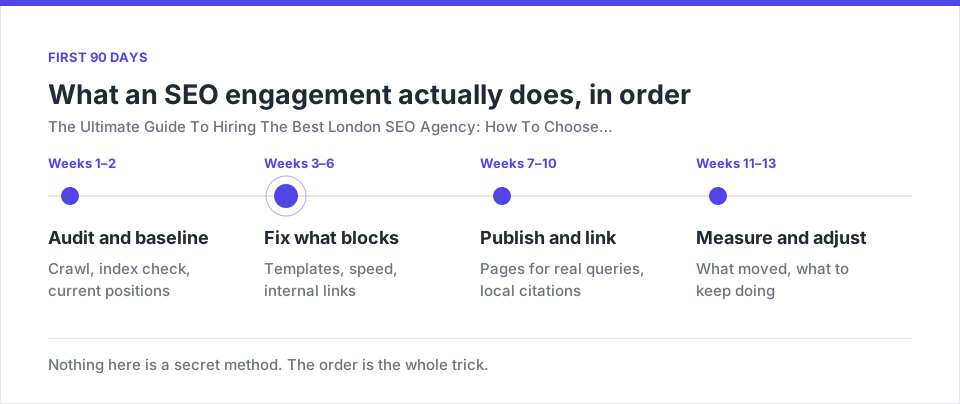
Begin with a practical 90-day action plan that aligns governance artefacts, What-If baselines and Provenance Trails with day‑to‑day delivery. The plan below translates strategy into a repeatable operating model that your in‑house team or external partner can execute with discipline and clarity.
- Confirm sponsor, KPI tree, and governance cadences: identify an executive sponsor, agree on a clear KPI framework that links Local Pack visibility, GBP health, map interactions and conversion metrics, and establish weekly, bi-weekly and monthly governance rituals.
- Complete baseline audits (technical and local visibility): run a comprehensive site health audit, Core Web Vitals check, mobile performance review, and Local Pack/Maps health assessment by borough to identify quick wins and longer-term priorities.
- Define borough priorities and hub‑and‑spoke plan: map spine terms to ward proofs and establish district landing pages that connect to a central brand hub, ensuring consistency and avoiding content duplication.
- Launch first ward landing page pilot: select a high-potential borough, implement GBP improvements, local content clusters and schema deployments, and measure initial impact against baseline baselines.
- Develop What-If baselines for activations: forecast uplifts under defined market conditions for each activation, and plan review cycles to recalibrate baselines as signals evolve.
- Set up Provenance Trails for auditability: document data sources, calculations, ownership and dates for every activation to support regulator-readiness and internal auditing.
- GBP and Maps health optimisation: verify GBP ownership, maintain consistent NAP, publish regular GBP posts, and tighten review responses to strengthen Local Pack presence.
- Architect hub-and-spoke content structure: ensure district pages anchor to pillar content, with logical interlinking that distributes authority while preserving local relevance.
- Deploy local data signals and structured data: implement LocalBusiness, FAQ and Event schemas on borough pages to support rich results and Maps panels.
- Set up lightweight analytics and ROI attribution: design a KPI dashboard that tracks spine terms, ward outputs, and on-site outcomes, with a clear link to revenue and store visits.
- Regular cadence for optimisation and governance reviews: schedule weekly health checks, bi-weekly experiments, and monthly governance reviews to maintain momentum and compliance with EEAT principles.
Beyond the 90 days, scale the model to additional boroughs by reusing proven artefacts: What-If baselines, Provenance Trails, regulator-friendly dashboards, and district governance plans. London‑focused governance should be tangible to both executives and regulators, with data lineage visible in dashboards and auditable in reports. London SEO AI’s templates and artefacts are designed to support this continuity, helping you maintain proximity signals as markets evolve. For reference and practical templates, explore our SEO services and governance artefacts at our SEO services and book a consultation to tailor a locality-first plan. For EEAT context, review Google’s EEAT guidelines.
This closing section emphasises practical, auditable action. By keeping What-If baselines current and Provenance Trails up to date, your governance becomes a living record that underpins transparency, regulatory confidence, and sustained proximity gains in London’s dynamic market.
If you’re seeking a structured way to turn insights into deliverable results, start with London‑focused artefacts and templates available through londonseo.ai. To tailor a locality-first approach for your sector and boroughs, book a consultation and begin translating proximity into measurable outcomes. For broader guidance on trust signals and content quality, consult Google’s EEAT guidelines.
Ready to translate insights into scalable, regulator-ready growth? Visit our SEO services page for auditable playbooks and provenance artefacts, or book a consultation to tailor a locality-first plan for your London business.
