Best SEO in London: A Practical Guide by londonseo.ai
London presents a unique SEO playground where sheer scale, diversity, and fast-moving consumer behaviours intersect. As a global business hub, the capital commands high search volumes across many sectors, from finance and legal services to nightlife, tourism and tech. For brands aiming to be found by Londoners and London's international audiences, a locality-first approach is essential. londonseo.ai combines traditional UK-focused SEO disciplines with Generative Engine Optimisation (GEO) insights to ensure visibility across organic results, Maps, and AI-assisted search experiences. This introductory guide sets the stage for a London-centric framework that links city-wide spine terms to ward- and borough-level signals while maintaining regulator-friendly governance and transparent measurement.
In London, user intent often blends informational queries with highly localised needs. People search on mobile while commuting, during office hours, or while exploring neighbourhoods for services, dining, or professional help. The scale of the market means that small optimisations can compound into meaningful visibility gains if they are tied to real local signals, such as borough-level hours, landmarks, or transit routes. A well-structured London SEO programme therefore starts with strong technical health, accurate local data, and ward-level content that answers very specific questions about places people actually visit and rely on.
londonseo.ai recognises that London requires both breadth and depth: broad city-focused spine terms paired with granular ward and borough content. This means aligning Google Business Profile (GBP) health, maintaining consistent NAP across directories, and building high-quality, ward-relevant local citations. Additionally, a London strategy should incorporate structured data that highlights local events, landmarks and service areas, ensuring rich results that appear in Local Packs and Maps during peak commuter periods.
The London landscape also demands an awareness of multilingual and multicultural audiences. Queries may come in English, Polish, Bengali, Portuguese, and other languages spoken across the city. A robust London SEO plan therefore embraces hreflang strategy where appropriate, localised content variants, and editorial signals from trusted local sources. The aim is a coherent signal journey from a city-scale spine to district-level proofs that remain truly distinct for each ward or borough, reducing content duplication and improving user trust.
londonseo.ai also places a premium on governance artefacts that show how London activations link to spine terms, ward proofs, and What-If baselines. What this looks like in practice is a regulator-friendly framework where data sources, calculations, and ownership are clearly documented in Provenance Trails. Executives can see how a GBP update or a ward-proof adjustment cascades through the signals to Local Pack visibility and Maps health, while regulators can audit the decision-making trail with confidence.
To support ongoing UK-market compliance and trust, every activation should be anchored to What-If baselines and linked to auditable dashboards. For practical templates and governance artefacts, explore londonseo.ai’s SEO Services page, or book a consultation to tailor a locality-first London plan that ties spine terms to ward proofs. For trusted guidance on trust signals and data provenance, review Google’s EEAT guidelines and ensure your London campaigns align with current best practices.
The London SEO landscape: opportunities and challenges
London’s opportunities come from a dense market with high consumer demand and a vibrant mix of sectors. Financial services, professional services, technology, beauty, hospitality and arts all contend for visibility, making local differentiation essential. Yet the city’s breadth also creates competition across many wards and boroughs. The challenge is to scale a locality-first approach without losing signal clarity or diving into content duplication. A robust framework blends city-spine coverage with ward-specific signals, underpinned by governance artefacts that demonstrate data provenance and accountability.
London as a multilingual and multi-market ecosystem
London’s population is among the most linguistically diverse in the world. From a technical SEO perspective, this means planning for multilingual content where appropriate, implementing accurate language targeting, and supporting users in their preferred language. Localised content should reference borough landmarks, public transport routes, and community resources that locals recognise. Ward proofs should reflect the local context to preserve relevance and avoid generic, one-size-fits-all pages.
Regulator-readiness and EEAT in the UK context
In the London market, credibility and transparency are non-negotiable. EEAT alignment—expertise, authoritativeness, trustworthiness—must be evident across ward content, external references, and the authorship of content. What-If baselines provide foresight into potential uplift or risk, while Provenance Trails offer a transparent data lineage that regulators can inspect. This approach not only supports compliance but also strengthens client confidence in the long-term viability of a locality-first strategy.
For London campaigns, a regulator-friendly governance model is especially valuable when campaigns span multiple boroughs, require local partnerships, or interact with city data such as transport updates or cultural events. The combination of structured data, ward-specific content, and auditable governance helps ensure your London SEO program remains robust as search engines evolve and as public expectations for trust and transparency grow.
If you’re ready to begin or expand a locality-first London plan, visit our SEO Services page to review auditable playbooks and governance artefacts, or book a consultation to tailor a London-focused strategy that connects spine terms with ward proofs and What-If baselines. To ground your approach in trusted standards, review Google’s EEAT guidelines as you build regulator-friendly, scalable local campaigns across London.
What makes London unique for SEO
London presents a singularly competitive and dynamic SEO landscape. As a global economic hub, the capital combines high search volumes with a mosaic of industries, languages, and local behaviours. A locality‑first approach in London means translating city‑level spine terms into ward‑level proofs that address the real-world needs of Notting Hill, Kensington, Chelsea, Fulham, Hammersmith and beyond. londonseo.ai integrates traditional UK SEO disciplines with Generative Engine Optimisation (GEO) to ensure visibility across organic results, Local Packs, Maps, and AI‑assisted search experiences. This section delves into what makes London distinct and how to harness those signals through auditable governance and governance artefacts.
London’s sheer scale means that small, well‑targeted optimisations can compound into meaningful gains when they connect city‑wide spine terms with ward‑level realities. A robust London SEO programme starts with solid technical health, accurate local data, and ward‑level content that answers questions locals actually ask about places they visit, work in, or pass through on the way to work and leisure. Governance artefacts such as What‑If baselines and Provenance Trails help capture the decision journey from hypothesis to outcome, making the process transparent for regulators and stakeholders alike.
London-specific signals that move rankings
- City spine to ward‑level alignment: Map broad terms like SEO London to ward‑level topics such as SEO services Notting Hill or local SEO Kensington, ensuring each ward page carries a unique, locally relevant signal.
- Google Business Profile health in a dense market: Claim every location, maintain precise categories, up‑to‑date hours, photos and posts, and respond to questions to strengthen local intent signals in the Local Pack during peak commuting hours.
- Ward‑proof content strategy: Create ward pages with distinct signals—landmarks, transport routes, and community resources—while linking back to a hub that anchors city‑level intent.
London’s multilingual and multicultural fabric adds complexity and opportunity. Queries surface in English, Polish, Bengali, Portuguese and more. A London SEO plan should treat language targeting and localisation with care, using hreflang where appropriate, localised editorial signals, and UK‑specific authority sources. Ward‑level content must remain distinct and locally authentic, reducing duplication and improving user trust as people move between wards via bus, Underground and cycling routes.
Governance, EEAT, and regulator readiness in the capital
Credibility matters in London. EEAT—expertise, authoritativeness, trust—must be evident across ward content, external references and author signals. What‑If baselines provide foresight into uplift or risk, while Provenance Trails document data sources and calculations so regulators can audit the reasoning behind ward activations. A regulator‑friendly governance model helps London campaigns span multiple boroughs, collaborate with local partners, and stay compliant as search engines evolve.
For practical governance artefacts, London‑centric strategies should reference Google’s EEAT guidelines and embed them into ward content development, data provenance, and auditable dashboards. See our SEO Services page for auditable playbooks and governance artefacts, or book a consultation to tailor a locality‑first London plan that links spine terms to ward proofs and What‑If baselines.
Proximity signals are strongest when ward content resonates with local life. Include indicators such as nearby landmarks, transit routes and neighbourhood resources. By structuring London pages with a hub‑and‑spoke architecture, you can preserve signal clarity while allowing ward pages to reflect their own time‑sensitive realities. Provenance Trails ensure every edit is traceable, supporting regulator readability as your London portfolio scales across districts.
Putting London first in practice
To operationalise a London‑centred SEO strategy, start with a regulator‑ready cockpit that aggregates spine term depth, ward proofs, What‑If baselines and Provenance Trails. This centralised framework feeds executive dashboards that are easy for regulators to review, while still offering granular provenance details for internal teams. A scalable hub‑and‑spoke model ensures signal clarity as ward landscapes evolve in areas like Notting Hill, Chelsea and Marylebone.
For practical templates and governance artefacts, explore our SEO Services page or book a consultation to tailor a locality‑first London plan. Review Google’s EEAT guidelines to align with regulator expectations and maintain trustworthy signals across city, borough and ward levels.
Ready to build regulator‑friendly London campaigns? Visit our SEO Services page for auditable playbooks and governance templates, or book a consultation to tailor a locality‑first plan that binds spine terms to ward proofs and What‑If baselines for regulator readiness.
Core components of a London SEO strategy
London’s search landscape is a dense, competitive arena where a locality‑first approach must translate city‑level spine terms into ward‑level signals that locals recognise. londonseo.ai combines traditional UK SEO disciplines with Generative Engine Optimisation (GEO) insights to ensure visibility across organic results, Local Packs, Maps and AI‑assisted search experiences. The core components described here form a practical blueprint for turning locality ambition into auditable, regulator‑friendly outcomes across Notting Hill, Kensington, Chelsea, Fulham, Hammersmith and adjacent districts.
A London‑focused strategy begins with robust technical health and precise local data. You need multiple location profiles that reflect each ward’s real‑world signals while ensuring a coherent overarching London narrative. A hub‑and‑spoke architecture links city spine terms to ward proofs, enabling scalable growth without content duplication. Governance artefacts such as What‑If baselines and Provenance Trails provide an auditable trail from hypothesis to outcome, supporting regulator readability as your London portfolio expands.
Google Business Profile health and local intent signals
GBP health is the frontline of local discoverability. For central London locations and outlying wards alike, ensure every physical site is claimed, verified, and represented with precise primary and secondary categories that reflect the core services you offer. Maintain up‑to‑date hours, service areas, and high‑quality imagery that mirror the on‑ground reality. Regular GBP posts and active Q&A engagement strengthen local knowledge panels during peak commuter windows and after‑hours searches in busy districts.
- Accurate categorisation: select precise, ward‑specific categories to prevent misclassification in the Local Pack.
- Complete profiles: ensure NAP, hours, locations, and photos are consistently accurate across all London profiles and directories.
- Engagement signals: publish timely updates, respond to questions, and feature local events to keep GBP profiles lively and trustworthy.
NAP consistency, local citations, and ward alignment
Consistency of Name, Address and Phone across directories reduces friction for users and search engines alike. In London, maintain a canonical NAP across maps, business directories, and ward‑level pages that reference the same ward proofs. Prioritise high‑quality, local citations from reputable London sources, such as esteemed business associations or city‑focused directories, rather than broad, generic listings.
- Directory hygiene: regularly audit key listings, fix duplicates, and resolve mismatches promptly.
- Quality over quantity: seek authoritative London‑focused domains with clear ward relevance.
- Ward alignment: ensure citations link to ward pages or hub content that reflect postcode and district signals.
Ward‑proof content strategy and schema
Ward pages should answer suburb‑level questions with signals locals recognise—landmarks, transport routes, development plans, and community facilities. Each ward page should carry distinct content while linking back to a city hub that anchors spine terms. Use LocalBusiness, FAQ and Event schemas to support proximity signals and to surface rich results in Local Pack and Maps during busy periods in London’s city and borough corridors.
- Content relevance to ward intent: tailor topics to Notting Hill, Kensington, Chelsea, Fulham, and Hammersmith, ensuring each page reflects unique local conditions.
- Structured data strategy: deploy LocalBusiness, FAQ and Event schemas to illuminate ward signals and improve rich results.
- Canonical and duplicate management: avoid cross‑ward content duplication by using canonical tags where appropriate and maintaining clear ward‑to‑hub relationships.
Technical health underpins every activation. Prioritise Core Web Vitals, mobile‑first performance, secure connections and accessible design. Ward proofs rely on reliable crawlability and indexation; a hub‑and‑spoke architecture helps sustain signal clarity as London’s wards evolve and new neighbourhoods emerge.
Technical SEO, UX and performance for London sites
Performance is a proximal signal in London where users search on mobile journeys during commutes or city exploration. Focus on fast loading times, efficient image handling, and robust server responsiveness. Optimise for mobile with responsive design and stable layouts to minimise CLS, ensuring a smooth experience from the city spine pages to ward content. Implement a clean internal linking structure that preserves crawl efficiency and directs user journeys from city pages through ward proofs to conversion pages.
Governance, EEAT, and regulator readiness
Regulator readiness requires clear data lineage, credible authorship, and transparent measurement. What‑If baselines forecast uplift from GBP adjustments, local citation changes, and ward‑proof content edits. Provenance Trails document data sources, calculations and owners for each activation, providing regulators with an auditable journey from hypothesis to outcome. A regulator‑friendly dashboard should combine executive summaries with drill‑down provenance so you can validate signals at city, ward and individual page levels.
Embedding EEAT principles in London campaigns means referencing authoritative local sources, ensuring author expertise is visible, and maintaining trust through transparent content provenance. For practical governance artefacts, visit londonseo.ai’s SEO Services page to review auditable playbooks and governance artefacts, or book a consultation to tailor a locality‑first London plan that ties spine terms to ward proofs and What‑If baselines. For trusted standards, review Google’s EEAT guidelines.
Ready to implement regulator‑friendly governance for London campaigns? Visit our SEO Services page to access auditable governance templates, or book a consultation to tailor a locality‑first London plan that binds spine terms to ward proofs and What‑If baselines.
Local SEO and Google Business Profile Mastery
Local visibility in London hinges on a disciplined approach to Google Business Profile (GBP) health, ward-focused signals, and a regulator-ready governance framework. londonseo.ai combines classic UK local SEO practices with Generative Engine Optimisation (GEO) insights to ensure GBP activity syncs with ward-proof content, city spine terms and What-If baselines. This section outlines practical steps to master GBP, unify local citations, and architect a ward-aware local page system that supports near-me searches across Notting Hill, Kensington, Chelsea, Fulham and surrounding boroughs.
Begin with GBP hygiene as the keystone of local reach. Ensure every London location is claimed, verified, and presented with precise primary and secondary categories that capture core services. Hours, service areas, and contact details should mirror on-ground realities to align proximity signals with user intent during peak commute times and after-hours searches.
GBP health foundations for London
- Accurate location ownership: Verify all London profiles to unlock full GBP capabilities and protect profile integrity across wards.
- Precise categorisation: Select exact primary categories and relevant secondary ones to align with ward-level search intent.
- NAP consistency: Maintain uniform name, address, and phone numbers across Maps, directories and ward-proof pages to minimise user friction.
- Up-to-date hours and attributes: Reflect real operating times and service attributes, including accessibility notes for each ward.
Beyond setup, implement a steady GBP maintenance cadence. Regular posts highlight services, local events and promotions; respond promptly to Q&As to reinforce trust. Each GBP update should feed What-If baselines so executives can anticipate uplift or risk and regulators can review a transparent signal journey through Provenance Trails.
Ward-proof content and local signals
Ward pages must address locality-specific questions with signals locals recognise, such as nearby landmarks, transport routes, and community resources. Use a hub-and-spoke architecture to link ward proofs back to a city spine page, preserving signal clarity while enabling ward-level differentiation. Structured data plays a critical role here, with LocalBusiness, FAQ and Event schemas supporting proximity signals in Local Packs and Maps during busy city periods.
- Ward intent clarity: tailor topics to Notting Hill, Kensington, Chelsea, Fulham and Hammersmith, ensuring each page reflects unique local conditions.
- Schema deployment: apply LocalBusiness, FAQ and Event markup to illuminate ward signals and surface richer results.
- Canonical discipline: use canonical tags or hub-to-ward relationships to prevent content duplication while maintaining distinct ward proofs.
Local citations and link authority underpin GBP health. Focus on ward-aligned citations from reputable London sources, including city business associations and district-level directories, rather than broad, generic listings. Maintain NAP harmony across all essential local platforms to bolster proximity signals and reduce confusion for search engines.
Local citations and governance
- Directory hygiene: Regularly audit critical listings, remove duplicates, and fix mismatches promptly.
- Quality over quantity: Prioritise authoritative London-focused domains with clear ward relevance.
- Ward-linked citations: Ensure citations tie to ward pages or hub content reflecting postcode and district signals.
Ward-proof content should be supported by robust internal linking. Ward pages connect to hub content that organises district-level intent while ward pages deliver timely, localised signals about hours, directions, and amenities. Provenance Trails document data sources, calculations and owners for every activation, helping regulators review the rationale behind GBP and ward decisions with confidence.
Measurement and regulator readability
GBP health, ward signals and local citations feed regulator-ready dashboards. What-If baselines forecast uplift from GBP optimisations and citation changes, while Provenance Trails capture inputs, calculations and ownership. Such governance ensures transparency for executives and regulators alike, reinforcing EEAT alignment through credible sources, transparent authorship and clear data lineage.
To operationalise GBP mastery at scale, London teams should adopt standard templates for ward-proof landing pages, hub pages and GBP activity logs. Regular governance sprints maintain signal clarity as wards evolve and new neighbourhoods emerge. For practical templates and governance artefacts, explore londonseo.ai’s SEO Services page or book a consultation to tailor a locality-first GBP plan that integrates spine terms with ward proofs and What-If baselines. For trusted guidance on trust signals and data provenance, review Google’s EEAT guidelines.
Ready to master GBP for London with regulator-friendly governance? Visit our SEO Services page to access auditable GBP playbooks and provenance templates, or book a consultation to tailor a locality-first GBP plan for your wards.
AI integration and Generative Engine Optimisation (GEO)
London's search landscape is rapidly evolving as AI-driven surfaces become more prevalent across organic results, Maps, shopping and AI-assisted responses. Generative Engine Optimisation (GEO) marries the brand authority and editorial discipline of traditional UK SEO with the responsiveness and scale of AI content generation. At londonseo.ai, GEO is designed to surface local expertise in Notting Hill, Kensington, Chelsea, Fulham and surrounding boroughs by amplifying ward-level signals without sacrificing the regulator-friendly governance that underpins trust and EEAT alignment.
Key to GEO success is a disciplined framework that respects the city-wide spine terms while generating ward-appropriate content that locals recognise. GEO content should be produced through prompts informed by local knowledge, stakeholder inputs and editorial guidelines. The output must be anchored to verifiable data sources, be easily attributable, and integrate with Provenance Trails so regulators can trace decisions from hypothesis to impact.
A practical GEO implementation combines four pillars: governance, content discipline, data provenance and measurable impact. Governance artefacts include What-If baselines to forecast uplift or risk, and Provenance Trails that document inputs, calculations and owners. Content discipline ensures AI-generated elements augment rather than replace expert edits, with ward-specific prompts steering outputs toward local relevance and accuracy.
From a London perspective, GEO enables scalable content that still feels authentically local. For example, ward pages can dynamically respond to near-term events, transport changes or local business developments while preserving a stable spine term. This approach helps maintain EEAT by ensuring human editors set the strategic direction, validate outputs, and own the final content that audiences trust.
Operationalising GEO requires a clear workflow. Start with a London spine term map, then assign ward-proof prompts that translate those terms into locality signals. Establish an approval loop where editors review AI drafts, inject local landmarks, transit references and community resources, and approve content for publication. Link all outputs to the hub-and-spoke site structure so searches for city-level terms like SEO services London funnel into ward-focused pages that deliver distinct value.
Structuring GEO within London campaigns also means integrating structured data and schema with AI-generated content. Ward pages should maintain LocalBusiness, FAQ and Event schemas that reflect local realities, while AI content adds depth to editorial entries such as local guides or event calendars. This combination enhances proximity signals for Local Pack and Maps and supports regulator-readiness by aligning AI assistance with human oversight.
Practical takeaways for London practitioners include: map spine terms to ward-level intents, craft safe, localised prompts for AI content, attach What-If baselines to every activation, and maintain Provenance Trails across all GEO outputs. The governance layer should be visible to clients and regulators, offering both high-level executive summaries and drill-down provenance that demonstrates how content decisions translate into measurable proximity health in Local Pack and Maps across London.
For practical templates and governance artefacts to operationalise GEO in London, explore londonseo.ai’s SEO Services page. You can also book a consultation to tailor a locality-first GEO plan that ties spine terms to ward proofs and What-If baselines. To ground GEO in trusted standards, review Google’s EEAT guidelines and ensure your London campaigns convey transparent, credible authority even when AI surfaces assist content creation.
Ready to implement GEO at scale for London? Visit our SEO Services page for auditable playbooks and provenance templates, or book a consultation to tailor a locality-first GEO strategy linking spine terms to ward proofs and What-If baselines.
Keyword Research And London Search Intent
In London, keyword research must translate a city-wide spine into ward-level signals that locals recognise and act upon. At londonseo.ai, we blend traditional UK SEO practices with Generative Engine Optimisation (GEO) insights to surface targeted signals across Notting Hill, Kensington, Chelsea, Fulham, Hammersmith and surrounding boroughs. A disciplined approach to keyword discovery creates a robust foundation for Local Pack visibility, Maps health and AI-assisted surfaces, while keeping governance and EEAT alignment at the forefront.
The core idea is to move from broad city-level terms to ward-specific intents that residents recognise in daily life. Ward signals should reflect landmarks, transit routes, local services and community resources. This ensures every ward page contributes a distinct, locally authentic signal while remaining part of a coherent London-wide strategy. What-If baselines and Provenance Trails provide the governance backbone so executives and regulators can trace how a spine term becomes a ward-proof activation.
Defining spine terms and ward signals
Start with spine terms that mirror London’s key service lines and audience needs, for example: SEO services London, local SEO London, London SEO agency. From there, build ward-specific derivatives that capture precise local intent, such as SEO services Notting Hill, local SEO Chelsea, or ward-proof London marketing Notting Hill. Each ward derivative should be distinct enough to avoid content cannibalisation while pointing back to a central London hub that anchors city-level intent.
Intent classification by ward
Classify keywords by user intent to shape page type and calls to action. In London, common buckets include:
- Informational: guides to SEO terminology, local search patterns, and ward-specific FAQs.
- Navigational: searches for specific London providers, maps, or local offices within a ward.
- Transactional: service inquiries, consultations, and requests for proposals tied to a London ward.
Mapping these intents helps you assign ward pages to the appropriate content formats—comprehensive guides for informational queries, service pages for transactional intents, and location hubs for navigational intents. This alignment strengthens user experience and supports regulator-ready signal journeys from city spine terms to ward proofs.
Ward-level keyword discovery process
- Identify spine terms and ward modifiers: Begin with core London services and append ward identifiers to reveal locally relevant variants (e.g., SEO services Notting Hill, SEO London agency Chelsea).
- Assess intent and context: Classify terms by informational, navigational or transactional intent to guide page type and CTAs.
- Evaluate volume and difficulty at ward level: Use tools such as Google Keyword Planner, Ahrefs, Semrush and Moz to estimate demand and competition within each ward context. Prioritise terms with meaningful proximity signals and credible competition in London wards.
- Construct ward keyword maps: Create a matrix linking spine terms to ward topics, ensuring each ward page has a unique set of target queries and supporting content.
- Plan a ward-focused content calendar: Schedule ward-specific content updates, reflecting local events, landmarks and seasonal variations to maintain freshness and relevance.
Ward keyword maps should feed into the site structure in a way that preserves signal clarity. Ward pages sit within a hub-and-spoke architecture that connects city spine terms to ward proofs while enabling lineage tracing through What-If baselines and Provenance Trails. This ensures that every activation has a transparent rationale that regulators can review.
Practical keyword discovery steps in London
- Topic clustering by ward: Group related queries around Notting Hill, Kensington, Chelsea, Fulham and Hammersmith to create coherent content clusters that reflect local needs.
- Local intent signals: Prioritise keywords tied to local resources, landmarks, transport routes and community assets that locals rely on.
- Seasonality and events: Incorporate terms linked to London events, exhibitions and seasonal activities to capture time-sensitive interest.
- Competitor benchmarking: Analyse what London rivals target in each ward and identify gaps where you can deliver uniquely local value.
- Content mapping: Ensure every ward page has a defined set of target queries and a content plan that addresses those queries with local specifics.
To scale effectiveness, pair ward-proof content with structured data. Implement LocalBusiness, FAQ and Event schemas on ward pages to highlight proximity signals in Local Pack and Maps results. A well-constructed ward page anchors to the city hub, while the ward content exhibits unique, timely relevance. This alignment supports EEAT by making local authority signals explicit and verifiable.
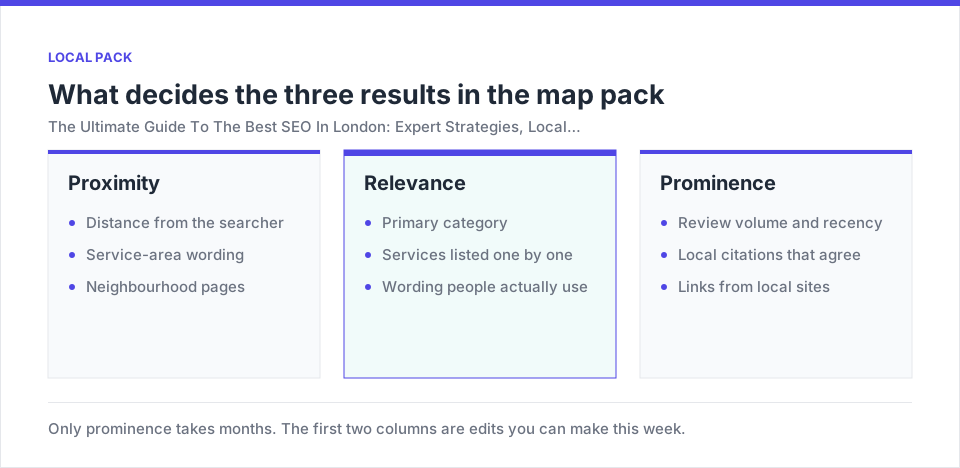
Your keyword strategy should be grounded in auditable governance. Attach What-If baselines to keyword activations and document decisions in Provenance Trails so regulators can review the data lineage from hypothesis to outcome. Regular governance sprints help maintain clarity as London’s wards evolve and new neighbourhoods emerge. For practical templates and governance artefacts, explore londonseo.ai’s SEO Services page or book a consultation to tailor a locality-first London plan that ties spine terms to ward proofs and What-If baselines. To ground your approach in trusted standards, review Google’s EEAT guidelines.
Interested in a regulator-friendly, locality-first keyword strategy for London? Visit our SEO Services page for auditable playbooks and governance artefacts, or book a consultation to tailor a ward-focused keyword programme that aligns spine terms with ward intents and What-If baselines.
Choosing and Working With A London SEO Agency
For the best seo in london, selecting the right partner is a strategic decision. A locality‑first agency should translate city‑level spine terms into ward‑level proofs, operate with regulator‑friendly governance, and deliver measurable proximity health through What‑If baselines and Provenance Trails. londonseo.ai stands as a practical exemplar, blending traditional UK SEO discipline with Generative Engine Optimisation (GEO) to ensure London campaigns perform across organic results, Local Packs and Maps while staying transparent and auditable.
This part outlines a pragmatic framework to evaluate, select and collaborate with a London agency. It emphasises governance, data provenance, and a clear path from spine terms to ward proofs, so executives, practitioners and regulators share a common understanding of where value comes from and how it is proven.
- London market experience and locality focus: Look for demonstrable success in Notting Hill, Kensington, Chelsea, Fulham and surrounding wards, with case studies that show how spine terms map to ward signals and how proximity health was measured.
- GEO competence and alignment with EEAT: Confirm the agency has a credible approach to Generative Engine Optimisation that augments human editors without compromising trust or data provenance, and that outputs are anchored to verifiable sources in line with Google’s EEAT guidelines.
- Governance, What‑If baselines and Provenance Trails: Assess whether the agency can provide auditable baselines, data lineage, ownership maps, and regulator‑friendly dashboards that connect spine terms to ward outputs.
- Ward‑proof content and hub architecture: Ensure the agency can implement a hub‑and‑spoke site structure that preserves signal clarity as wards evolve and that ward pages remain authentic, locally relevant and non‑duplicative.
- GBP health and local signal integration: The partner should demonstrate disciplined Google Business Profile management and alignment with ward content to strengthen Local Pack visibility across multiple London districts.
- Reporting cadence and stakeholder communication: Require regular, transparent reporting with executive summaries and drill‑downs to ward proofs, so leadership understands progress and regulators can review the trail.
- Team structure and client collaboration: Look for dedicated account teams, clear escalation paths, and a collaborative process that keeps you involved without slowing execution.
- Commercial model and value delivery: Seek a pricing model that aligns with outcomes, includes clear SLAs and a roadmap for scale, and provides predictable ROI within a regulator‑friendly governance framework.
To explore a locality‑first London plan that ties spine terms to ward proofs, visit our SEO Services page or book a consultation to tailor a governance‑backed strategy. For broader governance standards, review Google’s EEAT guidelines.
RFP and due diligence: what to request from a London agency
A well‑structured RFP helps surface the capabilities that matter most in a London context. Request evidence of ward‑level activations, governance artefacts, and a demonstrable pathway from spine terms to ward proofs. Ask for sample What‑If baselines, a Provenance Trails ledger, and regulator‑ready dashboards that summarise both intent and outcomes. Require a clear plan for GBP health, ward‑proof content, and schema deployments that bolster Local Pack visibility.
Collaboration cadence and governance in practice
A successful London partnership uses structured collaboration rituals. Establish a quarterly plan review, monthly performance updates, and weekly tactical standups to align on ward activations, What‑If adjustments and content governance. Ensure that every activation is captured in Provenance Trails and linked to a regulator‑ready dashboard, so teams can trace the journey from spine terms to ward outputs with confidence.
Key questions to ask during discovery
- Can you show ward‑level case studies that map spine terms to local signals in London wards?
- How will What‑If baselines be maintained as markets shift in Notting Hill, Chelsea or Fulham?
- What is your approach to data provenance and regulator readability?
- How will you integrate GBP health with ward proofs and hub content?
- What reporting formats will we receive, and how often can regulators review the data lineage?
If you’d like practical templates for ward proofs, What‑If baselines and Provenance Trails, consult londonseo.ai’s SEO Services or book a consultation to tailor a locality‑first governance model for London campaigns. For evidence on trust signals and data provenance, review EEAT guidelines.
Choosing and Working With A London SEO Agency
Selecting the right partner in London is a strategic decision that underpins the success of a locality‑first SEO programme. A capable London agency should translate city‑level spine terms into ward‑level proofs, maintain regulator‑friendly governance, and deliver durable proximity health across Notting Hill, Kensington, Chelsea, Fulham, and Hammersmith. At londonseo.ai, we blend traditional UK SEO disciplines with Generative Engine Optimisation (GEO) to ensure transparency, auditability and sustained results across organic, Local Packs and Maps. This section guides you through the practical criteria, RFP expectations, collaboration rituals and warning signs that distinguish a high‑quality, London‑ready partner from a generic vendor.
A London‑centric agency should be the bridge between city‑scale intent and ward‑level realities. The right partner understands how to align GBP health, ward proofs and spine terms within a hub‑and‑spoke site architecture while keeping content authentic to each community. They should also embed EEAT‑driven governance so that every activation has traceable provenance and auditable decision paths for regulators and stakeholders alike.
What to look for in a London SEO partner
- London market fluency and ward outcomes: Demonstrated success in Notting Hill, Kensington, Chelsea, Fulham and Hammersmith, with case studies showing how spine terms map to local signals and uplift in ward pages.
- GEO competence with governance: Proven ability to create ward‑specific prompts that scale while anchoring outputs to What‑If baselines and Provenance Trails for full traceability.
- EEAT alignment and credibility signals: Clear author proofs, authoritative references, and transparent data provenance that regulators can inspect.
- Hub‑and‑spoke architecture: A scalable site structure that preserves signal clarity as wards evolve, minimizing duplication while maximising local engagement.
- GBP health and local signal integration: Systematic Google Business Profile management across multiple locations, with consistent categories, hours, posts and Q&A that reinforce proximity signals.
- Regulator‑readiness and governance artefacts: What‑If baselines, Provenance Trails and regulator dashboards that combine executive summaries with drill‑downs for provenance review.
- Reporting cadence and stakeholder partnership: Regular, transparent reporting with predictable dashboards and proactive communication from a named client team.
What to request in an RFP
To avoid ambiguity and accelerate comparison, structure your RFP to elicit concrete evidence of capability, governance and delivery. Key requests include:
- Ward activation case studies: Examples that show spine terms mapped to ward signals, with measured proximity health outcomes.
- What‑If baselines and provenance documentation: Baselines that forecast uplift or risk, plus end‑to‑end provenance Trails for each activation.
- Governance dashboards: Regulator‑friendly views that combine executive summaries with drill‑downs into ward proofs and data sources.
- GBP health and ward content integration: Demonstrable GBP management and ward‑level content alignment across multiple London districts.
- Ward‑proof content templates and hub architecture: A defined template library and site structure that preserves signal distinctiveness while enabling scale.
- Structured data plan: LocalBusiness, FAQ and Event schemas tailored to ward contexts and city spine terms.
In addition, ask for a detailed transition plan covering onboarding, knowledge transfer and a realistic rollout schedule. Ensure the proposal includes a clear path to regulator‑readiness, with a governance playbook, data dictionaries and versioned baselines that mature as your ward portfolio expands.
Collaboration cadence and governance
Effective collaboration in London requires a disciplined rhythm. Establish a governance cadence that pairs strategic oversight with tactical execution, enabling both high‑level accountability and fast, auditable decision making.
- Onboarding and discovery: A structured intake that translates spine terms into ward proofs and maps existing data sources to Provenance Trails.
- Weekly tactical standups: Short, focused updates on ward activations, content progress, GBP health and technical fixes.
- Monthly performance reviews: Deep dives into KPI trends, What‑If baselines updates and pathway to ward‑level milestones.
- Quarterly business reviews (QBRs): Strategic alignment with governance dashboards, regulator feedback and roadmap recalibration.
- Dashboards and provenance access: Shared, regulator‑friendly dashboards offering both executive summaries and drill‑downs into data lineage.
- Regulatory liaison and audits: Periodic audits of data provenance, author signals and external references to ensure EEAT integrity.
Red flags to avoid
- Guaranteeing #1 rankings: No agency can promise top placements across all ward terms.
- Lack of transparency: Hidden methods, undisclosed data sources, or opaque reporting undermine trust and regulator confidence.
- Redirection to generic links: Broad link schemes or low‑quality local citations that lack ward relevance.
- Absence of governance artefacts: Missing What‑If baselines, Provenance Trails or regulator dashboards.
- Content duplication across wards: Ward pages that duplicate signals without local authenticity.
- Non‑London experience: Inadequate understanding of local market nuances and ward dynamics.
When evaluating proposals, look for evidence of prior London work, ethical link building, transparent pricing and a clear SLA framework. Your chosen partner should demonstrate that ward signals remain authentic, governance trails are complete, and dashboards provide both strategic clarity and granular provenance for regulator scrutiny.
How londonseo.ai can help
If you’re ready to engage a locality‑first partner with a proven London framework, start by reviewing our SEO Services page for auditable playbooks and governance artefacts, or book a consultation to tailor a ward‑level strategy that links spine terms to ward proofs and What‑If baselines. For trusted guidance on trust signals and data provenance, consult Google’s EEAT guidelines.
Ready to choose with confidence? Visit our SEO Services page or book a consultation to tailor a regulator‑friendly, locality‑first London plan that binds spine terms to ward proofs and What‑If baselines.
Backlinks, Digital PR And Authority Building
For brands pursuing the best seo in london, quality backlinks remain a fundamental signal of authority and trust. In a market as saturated as London, editorial, relevance-led links from locally credible sources are more valuable than sheer quantity. londonseo.ai emphasises a locality-first approach to link acquisition: every relation, every placement, and every mention must reinforce ward-level relevance while mapping cleanly back to spine terms in the city overview. A regulator-friendly governance framework ensures that backlinks are earned, traceable, and verifiable within Provenance Trails and What-If baselines, so executives and stakeholders can see precisely how authority signals propagate through Local Pack visibility and Maps presence across Notting Hill, Kensington, Chelsea, Fulham, and surrounding districts.
High-quality backlinks should be sourced from London-focused domains with clear topical relevance. Editorial links from regional outlets, professional associations, and respected community portals carry more weight than generic directories. Build a disciplined outreach plan that prioritises credibility, context, and content alignment with ward proofs. Tie every link activation to a What-If baseline so leadership can forecast uplift and regulators can audit the provenance of decisions via Provenance Trails.
Strategic principles for London backlink growth
- Editorial relevance over volume: target London-centric publications that speak to Notting Hill, Chelsea or Marylebone, ensuring anchors reflect ward-level intent.
- Local authority and professional references: secure mentions from city business chambers, local councils, and sector bodies to strengthen credibility with local audiences.
- Unlinked brand mentions: recover or convert unlinked mentions into editorial links where appropriate, preserving natural anchor text tied to ward signals.
- Link quality assurance: perform risk scoring on domains, verify editorial standards, and avoid reciprocal or manipulative schemes that could undermine EEAT.
- Provenance and governance: attach What-If baselines and Provenance Trails to each placement, so regulators can review the inputs, decisions and outcomes behind every backlink.
Digital PR in London isn’t just about link volume; it’s about storytelling that resonates with ward audiences and demonstrates real local impact. Develop data-driven narratives around local events, transport developments, business milestones, or neighbourhood initiatives. Publish these stories through trusted London outlets and gate them to ward-proof pages that anchor to city spine terms. These placements should be accompanied by structured data, author signals, and provenance documentation to satisfy EEAT expectations.
Digital PR playbook for London wards
- Story ideation rooted in local signals: craft narratives around landmarks, routes, and community projects that locals recognise and journalists want to cover.
- Editorial outreach with value exchange: offer data-driven insights, expert commentary, and original research that editors find valuable for local audiences.
- Anchor text and placement strategy: align anchor choices with ward intents while preserving natural language and avoiding over-optimisation.
- Unlinked mentions to editorial placements: pursue opportunities to convert mentions into links where editorially appropriate, maintaining content integrity.
- Governance for regulator-readiness: document each PR activity in Provenance Trails and attach What-If baselines to forecast performance and risk scenarios.
Authority building also hinges on trustworthy third-party references. Seek citations from respected local institutions, industry bodies, and regional press that can substantiate your ward proofs. Each link or citation should reinforce a distinct ward signal and point back to hub content that anchors a city-scale spine term. This discipline reduces duplication across wards and strengthens regulator confidence in the integrity of your London portfolio.
Measurement, provenance and regulator readability
Link health must be visible alongside other proximity signals. Integrate backlink metrics into regulator-ready dashboards that balance executive summaries with drill-down provenance. What-If baselines forecast uplift from link activations, while Provenance Trails capture the sources, calculations and owners behind each backlink decision. This dual focus on outcomes and data lineage supports EEAT alignment and demonstrates responsible authority-building in a high-competition market.
To operationalise these practices, adopt auditable templates that map each backlink activation to ward proofs and spine terms. Maintain a living library of outreach templates, editorial standards, and a governance playbook that teams can use to replicate success across Notting Hill, Kensington, Chelsea, Fulham and adjacent wards. For practical templates and governance artefacts, explore londonseo.ai’s SEO Services page, or book a consultation to tailor a locality-first backlink programme that binds spine terms to ward proofs and What-If baselines. To ground your approach in trusted standards, review Google’s EEAT guidelines.
Ready to scale ethical, locality-focused backlink and digital PR activity across London? Visit our SEO Services page for auditable playbooks and governance artefacts, or book a consultation to tailor a ward-proof backlink programme that aligns spine terms with ward intents and What-If baselines for regulator-readiness.
Choosing and Working With A London SEO Agency
Selecting the right partner in London is a strategic decision that underpins a locality-first SEO programme. A capable London agency translates city-scale spine terms into ward-level proofs, operates within regulator-friendly governance, and delivers measurable proximity health across Notting Hill, Kensington, Chelsea, Fulham and Hammersmith. At londonseo.ai, we model a locality-first framework that foregrounds What-If baselines, Provenance Trails and auditable dashboards to ensure every activation is traceable and verifiable for executives, clients and regulators alike.
This part of the journey starts with a rigorous supplier evaluation. You should look for demonstrated London market fluency, ward-level delivery, and governance maturity that aligns with EEAT expectations. The aim is not merely a tactical campaign but a scalable, regulators-friendly operating model that can grow as your ward portfolio expands within the city’s dynamic districts.
Key evaluation criteria for a London partner
- London market fluency and ward outcomes: Showcased case studies across Notting Hill, Kensington, Chelsea, Fulham and surrounding wards, with clear mappings from spine terms to ward signals and documented uplift.
- GEO and EEAT alignment: A credible approach to Generative Engine Optimisation that augments human editorial control and anchors outputs to verifiable sources, with explicit author signals and data provenance.
- Governance artefacts: What-If baselines, Provenance Trails, regulator dashboards and a transparent escalation process demonstrating traceability from hypothesis to outcome.
- Hub-and-spoke architecture: A scalable site structure that preserves signal clarity as wards evolve while avoiding duplication and signal cannibalisation.
- GBP health and local signal integration: Demonstrated management of Google Business Profile health across multiple locations, with ward-aligned content and schema that boost Local Pack visibility.
- Reporting cadence and stakeholder collaboration: Regular, transparent reporting with executive summaries and drill-down provenance for regulator readability.
Beyond capabilities, the relationship should emphasise governance discipline, data provenance, and regulator readability. London campaigns benefit from a partner that can blend spine-term strategy with real-world ward contexts, ensuring content remains fresh, locally authentic and strategically coherent across districts.
What to include in an RFP and how to evaluate responses
A clear RFP helps surface maturity and guardrails. Request evidence of ward activations, governance artefacts and a concrete pathway from spine terms to ward proofs. Require sample What-If baselines, a Provenance Trails ledger, regulator dashboards and a scalable plan for GBP health integration. Ask for ward-proof landing page templates, hub architecture diagrams and a detailed data dictionary that maps every signal to an auditable source.
Additionally, assess the partner’s capacity to integrate with your internal teams. A London-focused agency should provide collaborative rituals, a shared language around spine-to-ward signal journeys, and a plan for knowledge transfer so your in-house team can sustain governance after onboarding ends.
Collaboration cadence and governance in practice
Effective governance in London requires disciplined rituals that balance strategic oversight with tactical execution. Establish a regular rhythm that includes onboarding, weekly tactical standups, monthly performance reviews and quarterly governance sprints. Ensure dashboards present executive summaries alongside drill-down provenance, and that What-If baselines are updated to reflect market realities and regulatory guidance.
A practical collaboration model pairs dedicated account teams with clear escalation paths. Maintain a living library of ward-proof templates, hub-spoke site architecture diagrams, and governance artefacts so teams can replicate success across Notting Hill, Kensington, Chelsea, Fulham and adjacent wards. This approach keeps signal integrity intact as the city’s ward landscape shifts and new neighbourhoods emerge.
Red flags to avoid
- Guaranteeing top rankings: No agency can promise page-one results across all ward terms; look for a transparent plan with realistic milestones.
- Opacity in methods: Hidden strategies or undisclosed data sources undermine trust and regulator confidence.
- Generic local citations: Links that lack ward relevance or local authority alignment dilute signal quality.
- Lack of governance artefacts: Missing What-If baselines, Provenance Trails or regulator dashboards.
- Duplication across wards: Ward pages that mirror each other without meaningful local differentiation.
- London market inattention: Inadequate understanding of local dynamics, landmarks, transport routes and ward-specific realities.
When evaluating proposals, look for evidence of London-specific outcomes, ethical link-building, transparent pricing and a clear SLA framework. The right partner will demonstrate ward signals that remain authentic, governance trails that are complete, and dashboards that provide both strategic clarity and granular provenance for regulator reviews.
How londonseo.ai can help you scale regulator-friendly governance
If you’re ready to engage a locality-first partner with a proven London framework, start by reviewing our SEO Services page for auditable playbooks and governance artefacts, or book a consultation to tailor a ward-focused strategy that ties spine terms to ward proofs and What-If baselines. For trusted standards, examine Google’s EEAT guidelines, and ensure your governance model reflects transparent data provenance and credible editorial practices.
Ready to choose with confidence? Visit our SEO Services page or book a consultation to tailor a regulator-friendly, locality-first London plan that binds spine terms to ward proofs and What-If baselines.
Budget, Timelines, And ROI Expectations For London Local SEO Campaigns
In London, planning an locality-first SEO programme requires credible budgets that reflect ward complexity, governance requirements, and the need for regulator-readiness. londonseo.ai blends traditional UK SEO with GEO to deliver auditable, scalable outcomes across Notting Hill, Kensington, Chelsea, Fulham and Hammersmith. This section outlines practical budgeting, realistic timelines, and ROI frameworks tailored to the capital's ward landscape.
Budget should cover key inputs such as strategy and governance development, GBP management, ward-proof content, local citations, technical SEO, governance tooling, dashboards and ongoing measurement. A regulator-friendly model uses What-If baselines and Provenance Trails to connect investment decisions with measurable proximity health. The aim is to deliver durable local visibility while maintaining transparency and accountability to clients and regulators.
Budget components and typical ranges
Breakdown by category, with illustrative monthly ranges in GBP:
- Strategy development and governance: £1,500–£3,500 per month to establish What-If baselines, Provenance Trails and regulator dashboards.
- GBP management for multiple wards: £750–£2,000 per location, with scale discounts for portfolios across several wards.
- Ward-proof content and hub architecture: £1,000–£3,500 per ward per month depending on content depth and events calendar.
- Local citations and directory hygiene: £500–£1,500 monthly for quality, ward-relevant citations and audit cycles.
- Technical SEO and site performance: £600–£1,800 monthly for core optimisations, mobile performance and schema deployments.
- Governance tooling, dashboards and reporting: £500–£1,500 monthly for auditable dashboards and data dictionaries.
Note: these ranges are indicative and should be customised to your ward portfolio size, churn, and growth targets. The emphasis is on a regulator-friendly investment that yields measurable uplift while preserving signal clarity through hub-and-spoke architectures and robust provenance.
Timelines and milestones
Expected timelines typically unfold in phased milestones that reflect risk, signal maturity and governance readiness:
- Phase 1 — Baseline setup (4–8 weeks): spine terms mapped to initial ward proofs, What-If baselines created, and regulator dashboards configured.
- Phase 2 — Ward activation (8–16 weeks): ward-proof content published, GBP health integrated, initial structured data deployed, dashboards populated with early data.
- Phase 3 — Portfolio expansion (3–6 months): add more wards, extend hub-and-spoke links, augment content with local signals and event calendars.
- Phase 4 — Governance maturation (6–12 months): comprehensive Provenance Trails, What-If baselines refined, regulator dashboards refined and dashboards for executives matured.
A practical expectation is that Local Pack and Maps presence begin to uplift within 8–12 weeks for core ward activations, with more pronounced proximity health as you scale to 3–5 wards and beyond. The pace depends on competition, transit-adjacent signals, and how well ward proofs align with local demand patterns.
ROI and value demonstration
ROI is demonstrated by comparing incremental revenue or qualified leads generated by ward activations against the total cost of ownership. A simple formula is:
ROI = (Incremental value from ward proofs minus total cost) / total cost. This should be tracked within regulator-friendly dashboards alongside What-If baselines and Provenance Trails.
Example scenarios help translate expectations into reality:
- Conservative rollout (1–2 wards, modest uplift): If you invest £3,000 per ward per month for 4 wards (£12,000 per month) and achieve an equivalent uplift in local inquiries valued at £7,000 per month after 9 months, the annualised ROI approaches 25–40%, subject to seasonality and market dynamics.
- Moderate expansion (3–5 wards, higher engagement): An investment of £4,000 per ward per month across 4 wards (£16,000 monthly) yielding £20,000 monthly incremental value after 12 months could yield ROI around 3x annualised, depending on demand, seasonality and GBP health signals.
- Scale scenario (10+ wards, strong ward signals): With £2,500–£3,500 per ward per month across many wards and robust governance, ROI can exceed 2x–5x over 12–24 months as Local Pack visibility compounds and Maps health improves.
To communicate ROI to stakeholders and regulators, present dashboard summaries that show spine-term depth, ward-level uplift, and What-If baselines alongside the underlying data lineage. The combination of executive-friendly visuals and drill-down provenance ensures accountability and clarity about how investments translate into proximity health.
Regulator-readiness and governance alignment
Every budget decision, activation, and measurement step should align with regulator expectations for transparency and trust. Provenance Trails capture inputs, calculations and ownership; What-If baselines forecast uplift and risk; dashboards combine strategic highlights with granular data lines for regulator review. You can reinforce EEAT by ensuring ward content uses authoritative local sources, clearly attributed authorship, and direct links to verified local data.
For practical governance tooling and auditable templates, visit londonseo.ai’s SEO Services page, or book a consultation to tailor a locality-first budget and ROI plan for your London wards. To ground your governance in trusted standards, review Google’s EEAT guidelines: EEAT guidelines.
Ready to translate budget and timelines into regulator-friendly, locality-first ROI for London? Visit our SEO Services page for auditable playbooks and provenance templates, or book a consultation to tailor a ROI-focused plan for spine terms and ward proofs across London.
Conclusion: Turning London SEO Marketing Insights Into Action
Having laid the groundwork for a locality‑first London SEO programme, this final section translates insights into an actionable, regulator‑friendly operating model. The aim is to scale proximity health across Notting Hill, Kensington, Chelsea, Fulham and Hammersmith while preserving governance, data provenance and transparent measurement. By consolidating spine terms, ward proofs, What‑If baselines and Provenance Trails into a single, auditable workflow, London brands can realise durable visibility and trust across organic results, Local Packs and Maps, now and into the future.
Practical execution begins with a regulator‑friendly cockpit that aggregates spine term depth, ward proofs, What‑If baselines and Provenance Trails. This cockpit should feed both executive dashboards and regulator‑facing reports, providing clarity on how strategic decisions translate into tangible proximity health at ward level. The governance model must remain lightweight enough for fast decision making, yet rigorous enough to withstand scrutiny from stakeholders and permissions bodies.
Below is a pragmatic checklist to drive immediate action, maintain regulator readability, and deliver measurable gains across wards. Each item represents a concrete activity with a clear outcome that can be traced back to data sources and decisions via Provenance Trails.
- Map spine terms to ward proofs: Ensure city‑level signals such as SEO London connect to ward‑level pages like SEO services Notting Hill and local SEO Chelsea, with explicit dependencies that prevent signal dilution.
- Attach What‑If baselines to activations: Tie every ward activation to uplift and risk forecasts so leadership can anticipate outcomes and regulators can review the rationale.
- Establish Provenance Trails: Document inputs, calculations, owners and dates for each activation to enable end‑to‑end traceability.
- Create regulator‑ready dashboards: Present executive summaries with drill‑downs into provenance, data sources and ward signals.
- Standardise ward‑proof templates and hub pages: Use consistent templates that preserve local authenticity while maintaining a clear hub‑and‑spoke site structure.
- Implement hub‑and‑spoke architecture for scale: Preserve signal clarity as wards evolve, ensuring crawl efficiency and clean internal linking from spine pages to ward proofs.
- Ensure GBP health and Maps data integrity: Regularly audit GBP listings, hours and attributes; validate Maps data to strengthen proximity signals across districts.
- Governance cadence and reporting cycles: Establish onboarding, weekly standups, monthly reviews and quarterly governance sprints with regulator‑friendly reporting formats.
- Ward calendars and local events: Integrate up‑to‑date event calendars on ward pages to keep content timely and locally relevant.
- Knowledge transfer and training: Implement a formal programme to upskill in‑house teams on spine‑to‑ward mappings, provenance procedures and dashboard usage.
- Cross‑channel alignment: Coordinate organic, GBP, digital PR and paid activity to ensure a cohesive signal journey from search to on‑site experiences.
In parallel with the governance mechanics, keep a steady focus on EEAT and trusted sources. Ward pages should cite authoritative local references, present clear author credentials, and maintain transparent data provenance so regulators can audit the chain from intent to impact. For practical governance artefacts, visit our SEO Services page to access auditable playbooks and provenance templates, or book a consultation to tailor a locality‑first action plan. To align with industry standards, review Google’s EEAT guidelines and reflect them in every ward activation.
Capacity planning should recognise the London market's pace. A regulator‑readiness approach means annual governance reviews, transparent data dictionaries, and versioned baselines that mature as wards expand. In practice, this translates to a living playbook: What‑If baselines update with market shifts, Provenance Trails expand as new signals appear, and dashboards evolve to present both high‑level narratives and granular provenance for regulator scrutiny.
As you scale, maintain a disciplined cadence that supports rapid iteration without sacrificing accountability. Weekly tactical updates feed into monthly performance reviews and quarterly governance sprints, keeping your team aligned with spine terms and ward proofs while ensuring ward outputs remain distinct and locally credible. This cadence also helps regulators understand how governance decisions translate into perceptible proximity health across London wards.
For ongoing guidance, a regulator‑friendly governance model should be central to every engagement. Attach What‑If baselines to each activation, maintain Provenance Trails for data lineage, and present regulator dashboards that blend executive summaries with drill‑downs. If you’re ready to embed these practices across Notting Hill, Kensington, Chelsea, Fulham and HR districts, explore our SEO Services for auditable templates or book a consultation to tailor a locality‑first roadmap. For additional context on trust signals, consult Google’s EEAT guidelines.
Ready to convert London insights into regulator‑ready action? Visit our SEO Services page or book a consultation to tailor a locality‑first plan that binds spine terms to ward proofs and What‑If baselines for regulator readiness.
