Introduction to On-Page SEO in London
London’s competitive digital environment demands a precise, governance-forward approach to on-page SEO. This introductory Part 1 defines what on-page SEO comprises, explains how it integrates with technical SEO, and outlines a clear path for London businesses to start improving visibility, trust and conversions from the very first optimisation efforts. By grounding your strategy in the capital’s unique market dynamics, you can translate global best practices into borough-ready results that work across Maps, organic search and Google Knowledge Panels.
At londonseo.ai we anchor on-page optimisation within a two-locale framework: Locale A represents the city-wide Master Spine, while Locale B activates district depth across London’s boroughs. This governance-informed lens helps ensure that every page supports the overarching authority while delivering precise local relevance. The following sections lay the groundwork for practical action, with the expectation that you will apply disciplined, auditable steps from the outset.
What on-page SEO encompasses in practice
On-page SEO refers to the elements you control directly on each web page to communicate relevance and value to search engines and users. Core components include page titles, meta descriptions, headings, the visible content itself, image alt text, internal linking and URL structure. In London, you must also align these elements with local intent, proximity cues and district priorities so that city-wide themes translate into tangible borough-level performance.
When done well, on-page optimisation improves organic visibility for relevant queries, supports Maps visibility and strengthens the credibility of district pages. It also creates a predictable, user-friendly experience that reduces bounce and increases conversions across London’s diverse markets.
Core on-page elements you should optimise first
To keep this section practical and focused, consider the following essential on-page elements and how they relate to a London audience:
- Page titles and meta descriptions that reflect both city-wide relevance and borough-specific nuance.
- Heading structure (H1 to H6) that preserves semantic hierarchy and supports local topic clusters.
- High quality, locally relevant content that answers near-me and district-specific questions.
- Images with descriptive alt text and optimised file names that add context for accessibility and local signals.
- Internal linking strategy that connects the Master Spine to Local Blocks, enabling smooth authority flow and user navigation.
Local signals and content relevance in London
For London businesses, on-page optimisation cannot ignore local intent. Pages should mirror local queries, events and proximity cues while retaining the broader city narrative. This means district landing pages that offer unique local value, hours and service-area information, all while benefiting from the enduring authority of the city-wide spine. A well-structured on-page strategy also supports GBP health and the quality of knowledge panels by ensuring local references are accurate and timely.
As you begin, maintain a careful balance: you want local depth without fragmenting the overarching topic. The aim is to create a coherent journey from a city-level topic into district-specific experiences that feel genuinely local to each borough.
A practical, starter 90-day plan for London on-page SEO
Begin with a focused audit to identify gaps in titles, meta descriptions, headings and content breadth. Build a simplified district map that links city-wide topics to 2–1 borough pages for near-me queries. Create a publishing calendar that respects local events and proximity signals while preserving the city-wide spine. Establish a governance trail by attaching locale-context notes to major publishes so regulators can replay decisions if required.
By starting with a tight scope and auditable artefacts, you set a foundation that can scale as Local Blocks expand. This approach is aligned with londonseo.ai’s governance-forward model, which balances city-wide credibility with district depth across London’s boroughs.
Next steps and where to learn more
If you are ready to translate these principles into action, explore londonseo.ai’s SEO services to understand how we structure on-page optimisation within our two-locale, governance-forward framework. To initiate a consultative discovery tailored to London boroughs, book a discovery and begin building district-ready pages that support Maps, GBP and organic search. For practical guidance on user experience and local authority signals, review Core Web Vitals and Google Local SEO Guidelines as benchmarks for quality and regulator-ready reporting.
On-Page SEO vs Technical SEO
In London’s highly competitive search landscape, distinguishing between on-page SEO and technical SEO is essential, yet they are inseparably linked. On-page SEO governs the elements you control directly on a page—titles, meta descriptions, headings, content quality, image alt text, internal linking and URL structure. Technical SEO focuses on the site’s infrastructural factors that determine how search engines crawl, index and render pages—crawl budgets, site architecture, canonicalisation, schema markup, and performance signals. When married to londonseo.ai’s governance-forward, two-locale framework, these disciplines anchor city-wide authority (Locale A) while energising district depth (Locale B) across London’s boroughs. This Part 2 explores how the two streams intersect, where each adds unique value, and how to implement them cohesively for Maps, GBP health and organic search ranking in London.
For London businesses, the real win comes from a disciplined workflow that treats on-page and technical optimisations as two sides of the same effort. The goal is durable visibility, improved user experience and regulator-ready reporting that scales as Local Blocks expand to cover more boroughs and service areas.
1. Defining the two disciplines in a London context
On-page SEO is about what users see and interact with on the page. It includes the composition of content, keyword placement, semantic headings, image optimisation and the internal link topology that guides users through Local Blocks to the Master Spine. Technical SEO, by contrast, is the science of how the site operates behind the scenes: crawlability, indexability, page speed, mobile performance, structured data and robust URL and canonical strategies. In London, a governance-forward practice ensures both disciplines advance in lockstep, reinforcing each other rather than competing for attention.
When applied within the two-locale model, Locale A (the city-wide Master Spine) establishes durable authority. Locale B (Local Blocks) activates district depth, translating authority into borough-level experiences. This pairing supports reliable proximity signals, accurate knowledge panels and resilient GBP health as the surface map expands.
2. How on-page and technical SEO complement each other
On-page optimisation provides the content and signal clarity search engines rely on to understand page intent. Technical SEO ensures that discovery, rendering and accessibility occur efficiently and consistently. In practice, good on-page work informs technical decisions—structured data types align with content topics, and clean, keyword-rich URLs support both user understanding and crawl efficiency. Conversely, technical improvements—such as optimised rendering, proper canonicalisation and fast mobile performance—create the conditions in which on-page content can perform at its best. Within London’s governance framework, this mutual reinforcement is formalised so that city-wide themes (Locale A) flow coherently into district-depth experiences (Locale B) without signal dilution or cannibalisation.
Key intersections include: structured data alignment with district content, canonical hygiene across Local Blocks, consistent internal linking to support proximity signals, and Core Web Vitals improvements that uplift user experience on both city and borough surfaces.
3. Deliverables you should expect for London on-page and technical work
From a London-focused agency, the combined deliverables should cover both surfaces in a cohesive, auditable package. On-page deliverables include: page titles and meta descriptions that balance city-wide relevance with borough nuance; semantic heading structure (H1–H6) that supports local topic clusters; high-quality, locally relevant content; descriptive image alt text; purposeful internal linking that mirrors the spine-to-block flow; and clean, keyword-optimised URLs. Technical deliverables include: crawlability improvements, indexability reviews, canonical hygiene, structured data scaffolding, performance optimisations (especially Core Web Vitals), and a scalable site-architecture plan that supports Local Blocks as boroughs expand.
Together, these deliverables should be mapped to a two-locale publishing calendar, with locale-context notes attached to every publish and delta provenance logs capturing publishing rationales. This creates regulator-ready artefacts that demonstrate how the city-wide spine supports district depth and how district activations drive local intent and proximity signals.
4. Quick-start 90-day plan for London on-page and technical alignment
Begin with a focused audit of city-wide and borough-specific pages to identify gaps in titles, meta descriptions, headings and content breadth. Create a simplified district map that links city-wide topics to two or three borough pages for near-me queries. Develop a publishing calendar that respects local events and proximity signals while preserving the city-wide spine. Attach locale-context notes to major publishes so regulators can replay decisions if required. Establish a governance trail by recording WhatIf baselines and delta provenance logs alongside publishing activities.
As you scale Local Blocks, ensure ongoing coordination between on-page refinements and technical improvements to maintain signal coherence. The governance cockpit should display Spine A health next to Local Block momentum, enabling executives to see both macro and micro signals in one view. For practical benchmarks, reference Core Web Vitals and Google Local SEO Guidelines as anchor points for quality and regulator-ready reporting.
5. Next steps: engaging with londonseo.ai
To translate these principles into action, explore the londonseo.ai SEO services and consider booking a discovery to tailor a two-locale surface strategy that scales from Maps to knowledge panels and organic search across London’s boroughs. For practical benchmarks, review Core Web Vitals and Google Local SEO Guidelines as anchors for signal quality and regulator-ready reporting.
With a robust on-page and technical optimisation plan, you can create durable borough-level growth while preserving city-wide authority across London’s boroughs.
What Defines The Best SEO Consultant In London
London’s two-locale framework—Locale A as the city-wide Master Spine and Locale B as the Local Blocks translating authority into district depth—requires a particular calibre of consultancy. The best SEO consultant in London combines rigorous governance, deep local intelligence and a disciplined approach to measurement, ensuring sustained visibility across Google Maps, knowledge panels and organic search. This Part 3 drills into the criteria that separate excellent practitioners from the merely capable, and explains how to assess fit for London’s distinct business landscape. By grounding your strategy in the capital’s unique market dynamics, you can translate global best practices into borough-ready results that work across Maps, organic search and Google Knowledge Panels.
Beyond a strong track record, the ideal consultant demonstrates transparency, customised, data-driven strategies and a proven process for delivering measurable ROI. The following sections outline the practical signals, artefacts and collaboration patterns that characterise a governance-forward London partner capable of delivering durable surface visibility across Maps, GBP and organic search.
1. GBP optimisation that aligns Locale A and Locale B
The best London consultant treats Google Business Profile (GBP) as the bridge between city-wide authority and district depth. They ensure GBP listings are claimed, verified and optimised with borough-aligned categories, accurate NAP data, and proximity-aware service areas. GBP updates should be scheduled to mirror Local Block activations, so district pages reflect current hours, proximity cues and event relevance. A robust consultant will provide a live GBP health dashboard integrated with the two-locale cockpit, enabling executives to compare city-wide health with borough-specific momentum.
Practical expectations include:
- Accurate, borough-aligned NAP data across the main site and Local Blocks.
- Timely GBP updates to hours, service areas and categories that mirror local realities.
- Regular GBP posts tied to district content calendars and borough events.
- Monitoring GBP health alongside district-page signals in auditable dashboards.
In addition, a top-tier partner will maintain high-quality photos, complete business attributes and a thoughtful response strategy to reviews. GBP health is a lever forMaps visibility and proximity signals when paired with district content and event calendars. For governance, ensure GBP dashboards feed into the two-locale cockpit so executives can assess city-wide health against borough momentum in one view. For reference, consult Core Web Vitals and Google Local SEO Guidelines to anchor signal quality and regulator-ready reporting.
2. Local keyword strategy and district relevance
A London-focused consultant treats local keywords as a living map, connecting Locale A topics to Local Blocks by borough. This means developing district keyword maps that carry city-wide themes into Westminster, Islington, Camden and beyond, with variants that reflect events, hours and services. The best practitioners validate ideas with real-world proximity signals, ensuring content surfaces respond to near-me searches and local intent without diluting the spine’s authority.
Key actions typically include:
- Identify core city topics and map them to district briefs that reflect local needs and events.
- Create district landing pages with unique local value, proximity cues and service-area definitions.
- Embed local data points, hours and borough references to strengthen near-me signals.
Content should mirror borough realities: localised case studies, event calendars and proximity-focused FAQs. The objective is to maintain city-wide authority while delivering district-perfect relevance for near-me queries. For practical reference, review London-focused case studies that illustrate how district pages translate spine topics into tangible borough results, and consult londonseo.ai’s governance tooling for localisation templates.
3. Local citations, NAP consistency and data hygiene
Local citations underpin trust and proximity signals for Maps and GBP health. A leading consultant implements a disciplined data hygiene program across Locale A and Locale B, ensuring consistent NAP data, robust local citations and accurate service-area definitions. The best practitioners embed citation governance into the two-locale framework so borough activations align with district pages and GBP health, and so regulator-ready dashboards reflect a single, auditable data story.
Governance should enforce:
- Regular data-quality checks for NAP across all surfaces.
- A master district backlog capturing changes to local data and synchronised publication schedules.
- Documentation of data sources and updates to support regulator-ready audits.
Beyond NAP, ensure consistent business categories, accurate street addresses and up-to-date service-area definitions. Local citations should be actively cultivated with reputable, geographically relevant sources and maintained through a central data governance process feeding Local Blocks and the master site. For industry references, align with respected local SEO guidelines and integrate them into your governance artefacts.
4. Content strategy that supports Locale A and Locale B
Content must weave spine authority with district specificity. Develop content clusters around city-wide themes while Local Blocks host district pages that address near-me searches, local events and proximity cues. A governance-approved publishing calendar ensures district activations reinforce the city narrative without signal conflicts or cannibalisation. Include event-driven pages, borough guides and service-area content to respond to local demand and seasonality.
Recommended practices include:
- Topic briefs that translate to district briefs with locale-context notes attached to each publish.
- District pages offering unique local value, proximity signals and clear calls to action.
- A publishing cadence that aligns spine updates with district activations and GBP refreshes.
GEO enhancements can accelerate the translation of spine themes into district-depth content while preserving topical integrity. All district content should reference borough data, hours, local services and events so users receive the most relevant local experience. Attach locale-context notes to each publish and maintain a delta provenance log for regulator replay.
5. Governance, WhatIf baselines and regulator-ready reporting
Auditable publishing trails lie at the heart of governance-born growth. WhatIf baselines forecast indexing, UX and signal distribution before a district publish; Delta Provenance logs capture locale context, authorship and publishing rationales to support regulator replay. Dashboards should blend Surface A (city-wide) health with Surface B (district depth) momentum, delivering a regulator-friendly narrative for executives and compliance teams. Attach locale-context notes to publishes to enable journey replay if required.
A mature London programme binds WhatIf, provenance and audience signals into a single, auditable workflow that scales as boroughs expand and new surfaces emerge. Use a unified cockpit to monitor spine and block health side-by-side, ensuring governance gates are consistently applied before any publish or activation. For benchmarking and signal standards, review Core Web Vitals and Google Local SEO Guidelines as anchors for signal quality and regulator-ready reporting.
Next steps: engaging with londonseo.ai
To translate these principles into action, explore the londonseo.ai SEO services and consider booking a discovery to tailor a two-locale surface strategy that scales from Maps to knowledge panels and organic search across London’s boroughs. For practical benchmarks, review Core Web Vitals and Google Local SEO Guidelines as anchors for signal quality and regulator-ready reporting.
With a governance-forward framework, you can deliver durable borough-level visibility while maintaining city-wide authority across London’s boroughs.
Core On-Page Ranking Factors
On-page ranking factors are the elements you directly control on each London-facing web page. When approached through londonseo.ai's two-locale governance model, these signals must harmonise Locale A: the city-wide Master Spine with Locale B: Local Blocks that activate district depth. This Part 4 distills the essential on-page signals, explains how they should be implemented in a London context, and shows how a disciplined, auditable process delivers durable visibility across Maps, GBP health and organic search.
Key idea: place the city-wide spine at the core while tailoring district experiences to borough realities. The resulting pages deliver consistent authority while delivering local relevance. We cover the core signals, practical steps, and governance considerations to ensure your on-page work scales from the heart of London to the neighbourhoods across boroughs.
1. The core on-page signals that drive rankings in London
- Page titles and meta descriptions that reflect city-wide relevance while capturing borough nuance and proximity signals.
- Heading structure (H1 to H6) that preserves semantic hierarchy and supports local topic clusters across Locale A and Locale B surfaces.
- High-quality, locally relevant content that answers near-me and district-specific questions, providing clear value to users.
- Images with descriptive alt text and optimised file names that add context for accessibility and local signals.
- Internal linking strategy that mirrors the spine-to-block flow, enabling authority to flow from Locale A to Local Blocks.
- Internal URL structure that is clean, descriptive and keyword-aware, supporting crawlability and user comprehension.
2. Practical steps to implement on-page factors in a London context
- Audit existing on-page elements to identify gaps in titles, meta descriptions, headings and content breadth across Locale A and Local Blocks.
- Map city-wide topics to borough-focused Local Blocks, attaching locale-context notes to every publish to ensure auditability.
- Revise page titles and meta descriptions to balance city-wide relevance with district specificity, using explicit locality keywords.
- Develop locally rich content on borough pages, including hours, proximity cues, events and service-area details.
- Optimise images with descriptive alt text and consistent naming that reinforces local signals without keyword stuffing.
- Review internal linking topology and URL hygiene to ensure cohesive authority transfer from the Master Spine to Local Blocks.
3. Localising metadata and headings to Locale A and Locale B
Metadata and headings should reflect the two-locale structure. For Locale A pages, craft titles and descriptions that establish city-wide authority while hinting at borough relevance. For Local Blocks, ensure headings and content explicitly address local needs, events and proximity cues. Use locale-context notes to capture the translation from spine topics to borough-level experiences, enabling regulator replay if required.
Practical examples include a city-topic page titled London Travel Trends that includes borough-by-borough sections, while a Westminster district page hosts a dedicated H2 heading such as Westminster Local Travel Essentials and additional H3 subheads for nearby transport links and events.
4. Quality benchmarks and sources
In London, on-page quality is reinforced by performance and accessibility signals. Core Web Vitals provide an external benchmark for user experience, while Google Local SEO Guidelines and Core Web Vitals together guide governance-ready reporting. Maintain a two-locale cockpit where Spine A health and Local Block momentum are visible side by side, with locale-context notes attached to key changes so regulators can replay the journey from discovery to activation.
Key benchmarks include
- Fast loading times for pages that serve borough-level content, measured by LCP and CLS improvements across Locale A and Locale B surfaces.
- Mobile-friendly, accessible experiences with keyboard navigation and aria attributes for critical pages.
- Structured data alignment that reflects borough content topics and local events, aiding rich results in Maps and knowledge panels.
5. Governance, reporting and the two-locale cockpit
On-page work is embedded in governance artefacts: WhatIf baselines forecast the impact of changes on crawl, UX and signal distribution; Delta Provenance logs capture locale-context notes, authorship and publishing rationales for regulator replay. Dashboards should present Spine A health with Local Block momentum, enabling executives to see macro and micro signals in a single view. Attach locale-context notes to publishes to preserve journey context for audits.
Deliverables you should expect include a two-locale sitemap mapping Local Blocks to the Master Spine, a publishing calendar aligned to borough events, and regulator-ready dashboards that merge city-wide authority with district depth. For reference on signal quality and regulator readiness, consult Core Web Vitals and Google Local SEO Guidelines as anchors for measurement and reporting.
6. Next steps: engaging with londonseo.ai
To translate these principles into action, explore the londonseo.ai SEO services and consider booking a discovery to tailor a two-locale surface strategy that scales from Maps to knowledge panels and organic search across London’s boroughs. For benchmarking, review Core Web Vitals and Google Local SEO Guidelines as anchors for signal quality and regulator-ready reporting.
With a rigorous on-page framework and governance, London campaigns can achieve durable borough-level growth while preserving city-wide authority across boroughs.
Building Local Citations in London
London’s competitive local search landscape rewards meticulous data hygiene and consistent NAP signals across a city-wide spine (Locale A) and district-depth Local Blocks (Locale B). This Part 5 focuses on building, validating and maintaining local citations that reinforce proximity signals, bolster Maps visibility and sustain credible GBP health for every London borough. With londonseo.ai as the guiding reference, businesses can operate a scalable citation programme that aligns with governance practices and regulator-ready reporting while expanding surface area in the capital’s diverse markets.
1. Why local citations matter for local seo london
Local citations are signals: they confirm business existence, location, and contact details. In London, proximity and district relevance drive actions, consistent citations across trusted directories support Maps packs, knowledge panels and organic rankings. A well-managed citation stack reduces misalignment risk, strengthens GBP health, and signals reliability to search engines and local consumers.
Key outcomes from a disciplined citation programme include:
- Improved proximity signals that help your business appear for near-me queries across boroughs.
- Enhanced trust through consistent NAP data on primary directories and within Local Blocks.
- Greater resilience to algorithm shifts by anchoring location data in multiple high-quality sources.
2. Audit and baseline: preparing London’s citation stack
Begin with a full inventory of current citations across the main site and each Local Block. Compare NAP, business name, address, phone number and primary category against the district context. Create a master sheet that maps each citation source to its data fields, update cadence and owner. This baseline is essential for regulator-ready reporting and for producing a clean, auditable trail as you scale across London’s boroughs.
Actions to implement now include:
- Compile a list of core directories used in London markets and note any jurisdictional differences by borough.
- Run a NAP consistency check against the master site and Local Blocks, flagging discrepancies for rapid resolution.
- Identify duplicate listings and determine which should be merged or removed to avoid cannibalisation.
3. Selecting the right directories for London
Prioritise directories with strong local intent, geographic relevance and brand authority. In London, this typically means a mix of global platforms with London-specific reach and well-regarded local aggregators. Ensure each identified source supports structured data, offers a verifiable business listing, and can be updated quickly when GBP or district details change. Use authoritative sources to benchmark credibility and update frequency.
Recommended actions include:
- Establish a core set of high-impact directories for all locations, alongside borough-targeted listings where available.
- Document submission processes, data fields required and update cycles to maintain consistency.
- Develop a governance checklist for new citations tied to borough activations or service-area changes.
4. Cleaning duplicates and removing conflicts
Duplicate listings dilute signal quality and can confuse customers. Systematically identify duplicates within the same source and across sources. For London central areas, this is particularly important in busy boroughs where multiple directories host similar entries. Resolve duplicates by merging to a single authoritative listing, or differentiating as needed to reflect distinct service areas. Maintain an audit trail showing what was merged, when and why.
Practical steps include:
- Use a central authority file to log all changes and maintain a versioned history for regulator-ready review.
- For each duplication, preserve accuracy of the original data fields (NAP, category, hours) and capture the rationale for consolidation.
- After deduplication, recheck GBP alignment and ensure street addresses and borough designations reflect the corrected data.
5. Ongoing monitoring and governance cadence
Local citations require regular attention. Establish a cadence for data hygiene, usually quarterly, with rapid rechecks after any GBP updates, district activations or significant service-area expansions. Integrate citation checks into the two-locale governance calendar and attach locale-context notes to any citation updates. Dashboards should visualise citation health alongside Maps visibility and GBP signals, enabling regulator-ready reporting that spans both Surface A and Surface B.
Metrics to track include:
- Proportion of core directories with up-to-date, consistent NAP data.
- Duplicates identified and resolved, with residual risk levels by borough.
- Correlation between citation health and Maps visibility by district.
For reference on best practices, consult Moz Local’s local SEO guidance or BrightLocal’s citations framework, and align updates with Google Local SEO Guidelines for regulator-ready reporting. See how these references support local seo london initiatives and are integrated into London-based governance at the SEO services on londonseo.ai.
6. Practical playbook for London citation management
Adopt a repeatable London-specific playbook to scale local citations effectively. Steps include:
- Establish a quarterly audit cycle with owners for Locale A and Locale B surfaces.
- Synchronise core directories with Local Blocks to ensure cross-surface consistency.
- Document changes in a central provenance log to provide regulator-ready audit trails.
- Integrate citation health metrics into the governance dashboard used by London teams.
7. Next steps: engaging with londonseo.ai
To embed robust citation management into a London strategy, explore the SEO services on londonseo.ai and consider booking a discovery to tailor a two-locale surface strategy that scales from Maps to knowledge panels and organic search across London’s boroughs. For benchmarking and signal standards, review Core Web Vitals and Google Local SEO Guidelines as anchors for signal quality and regulator-ready reporting.
With a governance-forward framework and continuous data hygiene, you can deliver durable borough-level growth while maintaining city-wide authority across London’s boroughs.
Content Strategy and Keyword Intent for London Audiences
In London, a disciplined on-page strategy begins with content that mirrors local intent while preserving city-wide authority. The two-locale framework—Locale A, the city-wide Master Spine, and Locale B, Local Blocks translating authority into district depth—guides how we plan, craft and prioritise content for Maps, GBP and organic search across the capital’s boroughs. This Part 6 outlines a practical approach to content strategy and keyword intent that aligns with londonseo.ai's governance-forward model, ensuring district relevance without diluting spine credibility.
The objective is to translate London-specific search behaviour into content that answers near-me questions, showcases local authority, and fuels proximity signals across boroughs. By tying content decisions to measurable borough outcomes, you create a scalable, regulator-ready narrative that supports both local packs and traditional organic results.
1. Discovery and alignment: setting the two-locale direction
Begin with a discovery exercise that aligns stakeholders around how Locale A and Locale B will interact for content. Produce a district activation brief that maps London topics to borough-level needs, and create a spine-to-block mapping document that clarifies where evergreen city-wide themes sit versus where district specificity lives. Attach locale-context notes to every artefact to justify decisions and enable regulator replay if required.
During discovery, prioritise queries that demonstrate local intent, such as near-me services, borough-specific events or transport considerations. These signals guide the content calendar and help ensure content surfaces respond to proximity and locality cues without fragmenting the city-wide authority.
2. The discovery artefacts you should expect
A credible London partner delivers a concise set of artefacts that articulate the two-locale strategy. Expect: a) a two-locale publishing calendar, b) a spine-to-block map with owner assignments, c) WhatIf baselines for upcoming district changes, and d) a delta provenance log to capture locale context and publishing rationales. These artefacts create a regulator-ready narrative from discovery through activation and form the backbone for auditable decision history.
Additionally, ensure you receive locale-context notes linked to each activation, so lateral moves between boroughs are transparent and traceable. The aim is a cohesive plan that scales as Local Blocks expand across London’s boroughs while maintaining a consistent city-wide voice.
3. Audit and baseline: the technical and content perspectives
Consolidate content audits with local relevance checks. Assess existing borough pages for depth, hours, events and proximity cues, ensuring the content architecture maps cleanly to Locale A and Locale B surfaces. Parallel technical audits should verify crawlability, rendering and indexation so new content can surface efficiently. WhatIf baselines forecast the indexing and UX implications of district activations, providing a risk-controlled view prior to publishing.
Deliverables typically include a regulator-ready dashboard that links spine health with district momentum, plus a delta provenance log that records locale-context notes and publishing rationales for every activation. Use these artefacts to defend decisions and to replay journeys during audits.
4. Strategy development and backlog: building the plan
Develop a two-locale content strategy that binds Locale A topics to Local Blocks. Your backlog should capture district activations, publishing priorities and content prerequisites. Publish a district activation calendar that synchronises spine updates with borough pages, event calendars and knowledge panel signals. Attach locale-context notes to each activation and maintain a delta provenance log to document publishing rationales for regulator replay.
In practice, align content briefs with borough realities: local case studies, neighbourhood highlights and proximity-focused FAQs that answer real user questions. This approach preserves city-wide authority while delivering district-specific relevance and practical value for near-me queries.
5. Implementation cadence and governance dashboards
Adopt a disciplined cadence for content activation. Use WhatIf baselines to preflight district activations before publishing, and ensure the two-locale cockpit presents Spine A health next to Local Block momentum in a single view. Dashboards should be regulator-friendly, enabling executives to understand macro and micro signals as boroughs expand. Attach locale-context notes to publishes to preserve journey context for audits.
Integrate Core Web Vitals guidance and Google Local SEO Guidelines as benchmarks for content performance, accessibility and local signal quality. Regularly review content calendars against borough priorities to prevent cannibalisation and maintain coherent topic clusters across Locale A and Locale B.
6. Next steps: engaging with londonseo.ai
To translate these principles into action, explore the londonseo.ai SEO services and consider booking a discovery to tailor a two-locale content and keyword strategy that scales from Maps to knowledge panels and organic search across London’s boroughs. For practical benchmarks, review Core Web Vitals and Google Local SEO Guidelines as anchors for signal quality and regulator-ready reporting.
With a robust content framework and governance, your London campaigns can deliver district depth while preserving city-wide authority across the capital's boroughs.
Metadata, Headers and URL Structures
In London’s competitive on-page environment, metadata, heading hierarchies and clean URL structures are not cosmetic; they are the channels through which a two-locale governance model communicates city-wide authority (Locale A) while enabling district depth (Locale B). This Part 7 translates those governance principles into concrete, auditable practices that improve Maps visibility, GBP health and organic rankings across London’s boroughs. The aim is to craft metadata and structure that are localisation-friendly, regulator-ready and scalable as Local Blocks expand.
Linking these elements coherently to the two-locale framework helps ensure that a city-wide topic is both authoritative and immediately actionable at the borough level. Each page should clearly convey its place in the spine-to-block journey, from London-wide signals to district-specific signals that drive near-me searches and conversions.
1. Baseline metadata hygiene for London pages
Start with consistently applied foundational metadata. Each page should have a unique, descriptive title tag, a concise meta description and accurate canonical references. Under the two-locale model, Locale A pages pair city-wide keywords with borough relevance, while Local Blocks receive nuanced, borough-specific qualifiers. This alignment prevents keyword cannibalisation and preserves the spine’s authority while enabling district depth.
Practical rule: never duplicate meta descriptions across pages; ensure every title and description reflects both the main topic and the relevant locality signal. This approach supports better click-through from London search results and improves user alignment with borough content.
2. Crafting city-wide titles and borough-focused meta descriptions
City-wide titles should establish authority while hinting at local relevance. For example, a page about local SEO London could use a title such as London Local SEO Framework: City Authority and Borough Activation. Borough-focused meta descriptions should expand on proximity signals, service areas and hours, ensuring users understand the local value proposition before clicking.
Avoid over-stuffing with local terms; instead, embed locality in a natural way that supports intent signals and proximity. This creates a cohesive topic thread from Locale A to Locale B without diluting the spine’s core message.
3. URL structure that supports two-locale navigation
URLs should be readable, descriptive and hierarchical. Locale A pages invite city-wide topics with borough hints in the path, while Local Blocks use borough-specific slugs and service-area definitions. A practical approach is to maintain a predictable pattern such as /topics/london-architecture/ for Locale A and /borough/{borough-name}/local-services/ for Locale B. Use canonical tags to avoid duplicate content across similar district pages and ensure search engines understand the relationship between spine and block surfaces.
Breadcrumbs play a critical role in user orientation. A well-structured breadcrumb trail reinforces the two-locale journey and helps users navigate from the city-wide layer to district content with confidence.
4. Semantic header strategy for London content
Adopt a clear semantic hierarchy that mirrors the two-locale structure. The page title (H1) should reflect the primary topic, while H2 headings introduce major locales or themes. H3–H6 then break down district-specific details, ensuring that content clusters remain logical and navigable. This organisation supports both user readability and search engine comprehension, strengthening the authority signals that travel from Locale A into Locale B.
Consistent heading usage across borough pages builds recognisable topic clusters, aiding FAQs, event pages and service-area content in near-me queries.
5. Schema markup to support local signals
Implement structured data that supports both surfaces. LocalBusiness markup should reflect borough-specific details where applicable, including hours, address, and service areas. FAQPage content can capture borough FAQs linked from district pages, while BreadcrumbList enhances navigation from Locale A to Locale B. For London-specific authority signals, also consider SocialProfile or Organisation markup to reinforce brand credibility. Structured data should be kept up to date, mirror actual content on the page, and be testable using Google's Rich Results Test.
Incorporating schema across pages helps search engines assemble a coherent local narrative for Maps, knowledge panels and organic results, particularly as Local Blocks grow to cover more boroughs.
6. Practical checklist for 90 days
- Audit page titles, meta descriptions and canonical tags for Locale A and Local Blocks; correct inconsistencies.
- Design a spine-to-block URL and breadcrumb strategy that supports clear navigation between surfaces.
- Standardise header hierarchies across borough pages to maintain consistent topic clusters.
- Implement and test schema markup for LocalBusiness, FAQPage and BreadcrumbList on borough and city pages.
- Validate metadata changes with regulator-ready provenance notes and WhatIf baselines where relevant.
7. Next steps: engaging with londonseo.ai
To operationalise these metadata, header and URL practices within a London framework, explore the londonseo.ai SEO services and consider booking a discovery to tailor a two-locale approach. For additional benchmarks, review Core Web Vitals and Google Local SEO Guidelines as anchors for quality signals and regulator-ready reporting.
With meticulous metadata discipline, coherent header strategies and careful URL design, your London campaigns can sustain durable borough-level growth while preserving city-wide authority.
Site Architecture, Internal Linking And Navigation In London SEO
In the two-locale governance model used by londonseo.ai, site architecture serves as the backbone that binds the city-wide Master Spine (Locale A) to the district-depth Local Blocks (Locale B). A well-planned architecture not only supports efficient crawling and indexing but also guides users through a coherent journey from London-wide topics to borough-level experiences. This Part 8 offers practical, London-specific guidance on structuring architecture, internal linking, and navigation to maximise Maps visibility, GBP health and organic search performance across all boroughs.
By aligning technical foundations with governance artefacts, you create auditable paths from discovery to activation. This ensures that district activations reinforce the spine’s authority rather than fragment it. The following sections translate theory into repeatable, borough-aware practices you can implement today.
1. Core principles of site architecture for London surfaces
Adopt a hierarchical, topic-centric architecture that mirrors the two-locale model. Locale A pages anchor city-wide authority with broad topics, while Local Blocks provide borough-specific depth. Maintain clean, descriptive URLs that reflect the spine-to-block journey, ensuring search engines and users understand the relationship between pages at a glance.
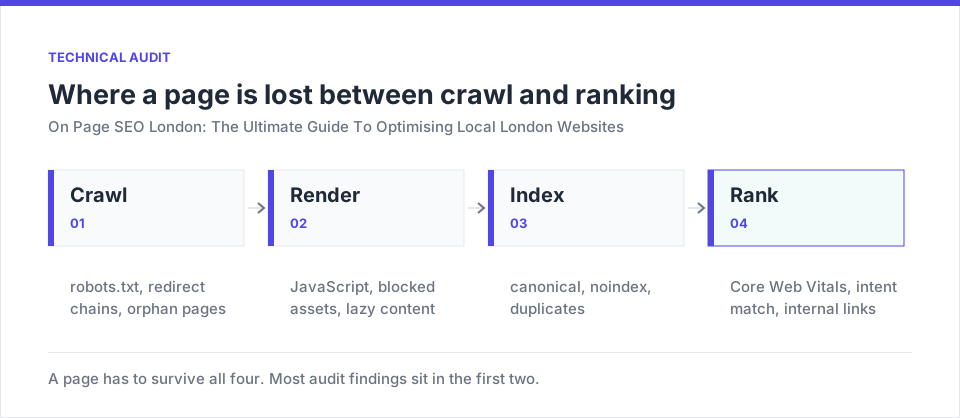
Key principles include: a) predictable crawl paths that prioritise borough pages after master topics, b) consistent breadcrumb trails to reinforce the spine-to-block flow, and c) a canonical strategy that preserves authority when similar content exists across Local Blocks and the Master Spine.
2. Designing a scalable two-locale navigation model
Structure navigation so users can move naturally from city-wide topics to borough-specific pages. Use a two-layer navigation that remains consistent as Local Blocks expand. The main navigation should feature clear paths for Locale A topics, while a secondary, district-focused navigation highlights borough pages, events and service areas. This dual-navigation system supports proximity signals and enhances Time-on-Page quality for local queries.
Practical steps include creating a district activation map that pairs each Local Block with its corresponding borough page and ensuring that internal links mimic the spine-to-block flow. Attach locale-context notes to major navigational updates so teams can replay decisions if regulatory reviews arise.
3. Internal linking patterns that energise Local Blocks
Internal links should distribute authority from Locale A to Locale B without creating cannibalisation. Use a consistent anchor-text strategy that reflects locality without over-optimising. For example, city-topic anchors might reference a borough as a natural extension, while district pages use locality-specific phrases that answer near-me queries. Maintain a logical depth where each borough page links to nearby districts and to overarching city topics where relevant.
Consider the following patterns: a) hub-and-spoke within each borough cluster, b) cross-linking between adjacent boroughs for proximity signals, and c) breadcrumb-driven navigation to support user orientation and regulator-ready trails.
4. URL structure and canonical governance
Establish clear, readable URLs that reflect the two-locale journey. Locale A should employ patterns like /topics/london-architecture/ while Local Blocks use borough-specific paths such as /borough/camden/local-services/. Apply canonical tags to prevent duplication across borough pages when content overlaps but ensure district pages still carry unique value. Breadcrumbs should mirror this architecture, reinforcing the hierarchy from the Master Spine to Local Blocks.
Governance artefacts should attach locale-context notes to major URL changes so regulators can replay the evolution of the site’s structure from discovery to activation.
5. Practical 90-day rollout for London site architecture
Phase 1: Audit existing architecture and map Locale A topics to Local Blocks, attaching locale-context notes to any proposed changes. Phase 2: Define URL patterns, canonical strategy and breadcrumb templates that reflect the two-locale journey. Phase 3: Implement a district activation calendar and begin publishing borough pages with proximity signals and local data. Phase 4: Update internal linking schema to reflect the spine-to-block flow and verify crawlability with a technical audit. Phase 5: Establish regulator-ready dashboards that show Spine A health beside Local Block momentum.
Throughout, ensure Core Web Vitals signals and accessibility standards are integrated into the governance cockpit so performance aligns with both user experience and local signalling requirements. For ongoing support, explore londonseo.ai’s SEO services and book a discovery to tailor a district-focused surface strategy that scales across Maps, knowledge panels and organic search across London’s boroughs.
6. Next steps: engaging with londonseo.ai
With a robust two-locale site architecture in place, you can drive more stable crawl, indexing and user engagement across London’s boroughs. For practical guidance, review the londonseo.ai SEO services and consider booking a discovery to tailor a district-focused surface strategy that scales from Maps to knowledge panels and organic search. Integrate Core Web Vitals and Google Local SEO Guidelines as benchmarks for regulator-ready reporting.
Speed, UX, Accessibility And Mobile Performance In London On-Page SEO
London’s search landscape rewards pages that deliver fast, accessible and delightful experiences across Maps, knowledge panels and organic search. This part of the London on-page SEO playbook focuses on speed, user experience (UX), accessibility and mobile performance within the two-locale governance model: Locale A represents the city-wide Master Spine, while Locale B activates district depth through Local Blocks in London’s boroughs. When pace, clarity and accessibility are intentional, user signals align with local intent, and regulators can see a coherent journey from discovery to conversion across multiple boroughs.
By embedding performance discipline into the publishing cadence, you ensure borough pages do not degrade the spine’s authority, while accelerating near-me and proximity queries that matter for local life in London. This section translates Core Web Vitals, UX best practices and accessibility standards into practical, borough-aware actions that scale with governance artefacts such as WhatIf baselines and Delta Provenance logs.
1. Why speed and UX matter for London surfaces
In a city with dense competition and diverse devices, every millisecond counts. Fast loading reduces bounce on borough pages that host proximity information, hours, events and service-area details. Visitors who arrive quickly are more likely to engage with local content, convert on enquiry forms, or book through GBP-enabled paths. Speed also influences crawl efficiency; search engines prioritise fast, render-friendly pages, which helps keep Local Blocks and the Master Spine synchronised in a scalable governance framework.
Beyond speed, UX quality signals—clear information architecture, intuitive navigation and meaningful content hierarchies—drive deeper engagement. For London users, this means presenting borough-specific value without breaking the city-wide narrative. A disciplined UX approach ensures that district pages feel local yet connected to the spine’s authority, enabling reliable proximity signals across Maps and knowledge panels.
2. Core Web Vitals in a two-locale London context
Core Web Vitals provide a north-star for user experience. The key metrics—Largest Contentful Paint (LCP), First Input Delay (FID) and Cumulative Layout Shift (CLS)—should be targeted on city-wide pages (Locale A) and borough-focused Local Blocks (Locale B). In practice, aim for LCP under 2.5 seconds, FID under 100 milliseconds and CLS under 0.1 on critical pages. London pages often combine rich local content with maps, event calendars and service-area data; optimising assets, deferring non-essential scripts, and adopting responsive images are essential for both surfaces.
A governance-forward approach uses WhatIf baselines to forecast performance changes before publishing borough activations. Delta Provenance logs capture locale context for performance decisions, ensuring regulator-ready replay if audits review page speed and UX evolution across Locale A and Locale B.
Practical tactics include prioritising above-the-fold content, implementing server-side rendering or hydration strategies for dynamic borough blocks, and caching strategies that deliver consistent performance for city-wide and district pages alike. Where possible, leverage AMP or progressive enhancements for mobile users to sustain strong LCP while maintaining feature-rich experiences for Maps and GBP interactions.
3. Testing, measurement and governance cadences
Adopt a disciplined testing cadence that mirrors the two-locale publishing calendar. Before any borough activation, run WhatIf tests to anticipate changes in load times, render paths and UX. After publishing, monitor Core Web Vitals, user engagement metrics and GBP health signals to confirm that localisation does not degrade spine performance. A regulator-ready dashboard should present Spine A health alongside Local Block momentum, with locale-context notes attached to major changes to preserve journey context for audits.
KPIs to track include LCP by borough and city-wide surfaces, CLS variations during district activations, Time On Page for district content, and engagement with local event pages. Regularly validate mobile performance, especially for pages with map interactions or above-the-fold content that relies on geolocation features.
4. A practical 90-day action plan
Phase 1: Audit core city-wide topics and borough pages for speed bottlenecks, unoptimised images and blocked render paths. Phase 2: Implement image optimisations, font loading improvements and script management to bring LCP and CLS improvements across Locale A and Local Blocks. Phase 3: Introduce accessibility improvements such as skip links, proper ARIA labelling, and keyboard-friendly navigation across borough pages. Phase 4: Roll out mobile-focused performance enhancements for critical boroughs with high near-me demand. Phase 5: Establish governance dashboards that merge Spine A health with Local Block momentum and include locale-context notes for auditability.
As borough activations scale, ensure a unified standard for Core Web Vitals, accessibility and mobile UX so that performance becomes a differentiator rather than a compliance box checked. Leverage londonseo.ai’s governance framework to attach WhatIf baselines and locale-context notes to every publish, enabling regulators to replay the journey from discovery to activation.
5. Regulator-ready dashboards and ongoing governance
Dashboards should present a cohesive picture: city-wide spine performance and district momentum in one view. WhatIf baselines forecast the impact of upcoming borough activations on load times and user experience, while Delta Provenance logs capture locale context and publishing rationales for audit replay. Accessibility signals should be visible alongside Core Web Vitals to demonstrate inclusive design as borough surfaces expand. Ensure every publish includes locale-context notes to document why changes were made and how they align with the two-locale strategy.
For practical benchmarks and standards, refer to Core Web Vitals guidance and Google’s Local SEO Guidelines. These sources help anchor London-specific performance expectations within regulator-ready reporting. To integrate these practices into your London strategy, explore londonseo.ai’s SEO services and book a discovery to tailor a two-locale approach that keeps speed, UX and accessibility in sync with Maps, GBP and organic search across London’s boroughs.
6. Next steps: engaging with londonseo.ai
With a mature approach to speed, UX and accessibility, you can accelerate two-locale growth in London while maintaining city-wide authority. Begin with londonseo.ai’s SEO services to understand governance tooling and how to operationalise a two-locale delivery. Consider booking a discovery to tailor a district-focused surface strategy that scales across Maps, knowledge panels and organic search across London’s boroughs. For benchmarking and signal standards, consult Core Web Vitals and Google Local SEO Guidelines.
By institutionalising performance, accessibility and mobile best practices within the governance framework, London campaigns can deliver durable improvements in user satisfaction, trust and conversions across the capital’s boroughs.
Structured Data, Schema And Local Signals
In London’s governance-forward on-page SEO model, structured data serves as a precise translator between human intent and machine interpretation. By implementing schema in a disciplined two-locale framework—Locale A (the city-wide Master Spine) and Locale B (Local Blocks that activate district depth)—you create a scalable, regulator-ready signal ecosystem. This Part 10 outlines practical strategies for London businesses to implement, audit and govern structured data, so that Maps, Knowledge Panels and organic results reflect both city-wide authority and borough-specific nuance.
Within londonseo.ai’s two-locale approach, structured data rows up content signals for search engines in a way that preserves spine credibility while energising district experiences. We’ll cover which schema types to deploy, how to map them to borough activations, how to validate and monitor them, and how to weave locale-context notes and delta provenance into governance artefacts so regulators can replay the journey if required.
1. Why structured data matters for London surfaces
Structured data enhances the visibility and richness of London pages on search, helping search engines understand content topics, proximity cues and local context. For Locale A, schema underpins durable authority across Maps, knowledge panels and broad service areas. For Local Blocks, schema makes borough pages visibly relevant for near-me queries, local events and district-specific services. When governance artefacts link schema decisions to locale-context notes and delta provenance, leadership gains auditable visibility into how data signals evolve as London’s boroughs expand.
The practical payoff includes more reliable sitelinks in Knowledge Panels, improved appearance in local packs, and better support for GBP-rich surfaces. In addition, well-structured data complements Core Web Vitals by enabling clearer content delineation and faster interpretation by search engines, contributing to a smoother user journey from discovery to conversion.
2. Core schema types to deploy in a two-locale London strategy
Priority schemas for London pages typically include: LocalBusiness, Organization, BreadcrumbList, NewsArticle or Article where appropriate, FAQPage for borough FAQs, and Event for district calendars. LocalBusiness and Organization markup anchor authority at the city level (Locale A) while LocalBlocks pages extract local relevance through address, hours, service areas and proximity-based attributes (Locale B). BreadcrumbList creates a transparent journey from the Master Spine to district pages, reinforcing the two-locale structure for users and search engines alike.
When applicable, you can extend with Restaurant, Hotel, or LegalService schemas to reflect sector needs, but always align with actual page content and existence of data such as hours, location and services. Validate each schema type with Google's Rich Results Test and monitor for any deprecation signals in updates from Google Search Central.
Important governance note: attach locale-context notes to schema decisions, so the rationale behind each markup choice is explicit and replayable during audits.
3. Local signals, proximity, and knowledge graph alignment
Structured data should be harmonised with local signals that search engines rely on for proximity and relevance. LocalBusiness markup enriched with borough-level data (address, hours, geocoordinates, service areas) strengthens proximity signals across Maps and local packs. Breadcrumbs should reflect the journey from Locale A topics to Local Blocks, while Event and FAQPage schemas tie local events and answers directly to borough pages. Integrating with knowledge graph signals helps ensure coherence across Knowledge Panels and associated entities for London’s boroughs.
To keep governance tight, create a two-locale schema ledger where each publish records the schema types used, the data fields included, and locale-context notes explaining why the markup was added and how it relates to the borough activation plan.
4. Validation, testing and regulator-ready governance
Validation begins with the Rich Results Test and the Structured Data Testing Tool to confirm correct data types and field values. Regularly re-test after borough activations, GBP updates and content revisions to ensure no markup drift. Link schema validation results to delta provenance logs and locale-context notes to maintain regulator-ready audit trails. Your governance cockpit should display schema health by locale alongside overall page performance, enabling executives to assess both structural integrity and user experience in one view.
Best practice includes documenting data sources for each field (NAP data, hours, coordinates) and maintaining a change log for schema updates so auditors can replay decisions from discovery through activation. Core references include Google’s Local SEO Guidelines and Schema.org documentation as benchmarks for quality and compliance.
5. Practical implementation steps for London teams
Step 1: Audit current schema usage on the site, focusing on Local Blocks and city-wide topics. Identify pages that lack LocalBusiness, BreadcrumbList, FAQPage or Event markup and prioritise borough activations where proximity signals are strongest.
Step 2: Build borough-specific schema templates that map to Local Block content. For Locale A, use city-wide core data; for Locale B, enrich with borough-specific hours, locations and service areas. Attach locale-context notes to each template to capture decisions for regulator replay.
Step 3: Implement a two-locale schema ledger within the governance cockpit. Each publish should record the schema types used, key data fields, and locale-context rationale. The ledger becomes a regulator-ready artefact for audits and demos of governance discipline.
Step 4: Validate with Google’s Rich Results Test and monitor the impact on visibility in Maps and Knowledge Panels. Include proximity signals and event data to maximise local relevance across boroughs.
Step 5: Integrate schema health into your regular publishing cadence. As Local Blocks expand, ensure schema templates scale in parallel and that all new borough pages align with the spine-to-block journey. For practical benchmarks and governance tooling, reference Core Web Vitals and Google Local SEO Guidelines to anchor quality and regulator-ready reporting.
6. Next steps: engaging with londonseo.ai
To embed a robust structured data programme within your London strategy, explore the londonseo.ai SEO services and consider booking a discovery to tailor a two-locale schema approach. The two-locale governance cockpit can be augmented with schema health dashboards that show how Locale A and Locale B signals combine to improve Maps visibility, knowledge panels and organic rankings across London’s boroughs. For benchmarks and practical guidance, review Core Web Vitals and Google Local SEO Guidelines as anchors for signal quality and regulator-ready reporting.
With disciplined structured data and governance, London campaigns can deliver clearer local signals, stronger authority and more reliable near-me conversions as boroughs grow.
Local and Local-Intent Optimisation for London
London's two-locale framework, with Locale A as the city-wide Master Spine and Locale B translating authority into district depth, demands careful vendor selection and governance discipline. This Part 11 spotlights practical risk awareness when hiring for two-locale delivery, outlining the common traps, artefacts you should expect, and how to safeguard regulator-ready governance while extending surface area across Maps, GBP and organic search in London’s boroughs.
Ground your decision-making in a transparent evaluation framework that prioritises auditable provenance, WhatIf baselines and locale-context notes. The aim is a credible, scalable approach that maintains city-wide credibility while delivering precise district relevance. In London, where proximity signals and regulatory expectations are complex, a governance-forward partner can translate strategic intent into durable borough-level growth.
1. Unrealistic promises: guaranteed rankings or instant results
Promises of guaranteed top rankings or overnight dominance are red flags in any market, but they are particularly suspect in London where local intent, proximity cues and regulatory considerations add layers of complexity. A credible consultant will acknowledge that SEO is a long-term, multi-surface discipline. They will present a transparent diagnostic, realistic timelines and measurable milestones rather than absolute guarantees. Beware rhetoric that discounts the need for ongoing governance, WhatIf baselines or district activations across boroughs.
Expect instead a staged plan with clearly defined success metrics, rolling quarters and a credible evidence trail showing progress from initial discovery to activation. The two-locale approach relies on city-wide authority supporting district depth, not a magic shortcut to instant rank inflation.
2. Opaque reporting and missing artefacts
A telltale sign of weak partnerships is the absence of governance artefacts. Look for a clearly defined WhatIf baseline, a delta provenance log (documenting locale-context notes and publishing rationales) and dashboards that connect Spine A health with Local Block momentum. If a proposal offers only raw keyword lists or generic traffic numbers without context or auditable traces, treat it as a red flag. In London, regulator-ready reporting depends on transparent artefacts that trace decisions from discovery to activation.
The ideal partner provides a live cockpit that merges city-wide signals with borough-level data, demonstrating how district activations map back to the spine's authority. A robust artefact suite also includes a district activation calendar, locale-context notes for publishes and a clear publishing governance timeline.
3. Skipping the two-locale model or failing to describe governance
London campaigns benefit from a two-locale framework that binds Locale A (city-wide Master Spine) to Locale B (Local Blocks that activate district depth). A red flag is a proposal that focuses on a single surface or treats spine content as interchangeable with district content. If governance gates are vague, if publishing calendars are absent, or if there's no plan to attach locale-context notes to every publish, the engagement is unlikely to scale cleanly and regulator-ready reporting becomes difficult.
Ask for concrete mappings between Local Blocks and the spine, a published governance charter, and examples of how WhatIf baselines will be used to forecast outcomes before any publish. The best London partners embed governance into every surface, ensuring a coherent city-wide message while delivering district-specific relevance.
4. Overemphasis on tooling without human oversight
Automated tools are valuable, but a lack of human oversight can lead to inconsistent outputs, misaligned messaging and weak regulatory compliance. A responsible London partner combines advanced tooling with seasoned SEO professionals who understand local market nuances, regulatory expectations and the need for locale-context notes. Be wary of proposals that rely solely on automated audits, or that cannot demonstrate human review of recommendations before publishing.
Assess the balance between automation and expert intervention. Request examples of human-authored locale-context notes and seen examples where WhatIf baselines were adjusted after expert review. A governance-forward approach is only as strong as the combination of technology and human judgement behind it.
5. Pricing red flags: scope creep and unclear inclusions
Unclear scope, vague deliverables or extreme price variations between proposals are common indicators of risk. A solid London partner will provide a transparent pricing model with clearly defined inclusions for Locale A and Locale B surfaces, the governance tooling required, and the cadence of WhatIf baselines, delta provenance logs and locale-context notes. Watch for projects that promise upfront fixes with no ongoing governance, or fees that cover only technical SEO without local strategy or GBP management.
To protect your budget, insist on a detailed scope of work, milestone-based payments tied to tangible outputs, and a variance process for any scope changes. The most credible bids present a realistic cost of governance tooling and ongoing district activations and show how investment scales as new boroughs are added.
6. Cultural and sector fit without city-specific experience
London's business mix—from financial services to hospitality and professional services—demands sector awareness and local market sensitivity. A consultant who cannot demonstrate sector-relevant examples or who lacks familiarity with London’s regulatory environment can struggle to deliver regulator-ready reporting. Look for evidence of sector-aligned strategies, district-specific case studies (even anonymised) and a clear understanding of London’s proximity signals, hours, events and borough dynamics.
If a candidate relies on generic templates or claims universality across markets, challenge them to adapt to London’s distinctive ecosystem and to provide locale-context notes showing how boroughs differ in customer behaviour and regulatory expectations.
A practical evaluation framework: shortlisting criteria
Use a concise, repeatable framework to compare proposals. The framework should assess governance maturity, two-locale alignment, stored artefacts, measurable ROI, and the ability to scale as boroughs expand. A well-structured shortlist asks for: a) district activation maps, b) WhatIf baselines and delta provenance templates, c) a two-locale publishing calendar, and d) regulator-ready dashboards that merge Spine A health with Local Block momentum. It should also request anonymised case studies that demonstrate measurable outcomes in similar London contexts.
- Evidence of a two-locale strategy with clear spine-to-block mappings.
- Availability of WhatIf baselines, provenance logs and locale-context notes attached to publishes.
- Dashboard examples that combine city-wide health with borough-level momentum.
- Transparent pricing and a detailed scope of work including GBP management and content calendars.
- Sector-relevant experience and regulatory awareness specific to London markets.
Next steps: engaging with londonseo.ai
To ensure you avoid common hiring pitfalls and select a governance-forward partner, start with a discovery on the SEO services on londonseo.ai and consider booking a discovery to tailor a district-focused surface strategy that scales across Maps, knowledge panels and organic search across London’s boroughs. For benchmarking and signal standards, consult Core Web Vitals and Google Local SEO Guidelines as anchors for regulator-ready reporting.
With a rigorous evaluation framework, you can confidently shortlist candidates who demonstrate governance maturity, measurable ROI and a proven ability to translate city-wide authority into district-depth results across London.
Measurement, Analytics and ROI
In a two-locale London framework, measuring success goes beyond chasing rankings. It requires a governance-forward approach that ties city-wide authority (Locale A) to district-depth momentum (Locale B) through auditable artefacts, WhatIf baselines and regulator-ready dashboards. This Part 12 outlines a practical measurement and analytics playbook for London pages, detailing measurable goals, attribution models, surface-specific KPIs, and governance cadences that keep near-me signals aligned with Maps, GBP health and organic search performance across the capital's boroughs.
The aim is to equip London teams with a repeatable, auditable framework that demonstrates ROI, justifies decisions, and scales as Local Blocks expand across boroughs. Where possible, insights are anchored in Core Web Vitals, Local SEO Guidelines and governance tooling from londonseo.ai to ensure consistency, transparency and regulatory readiness.
1. Defining measurable goals for London
Start with clear, two-locale objectives that connect spine authority to district results. Locale A goals focus on Maps visibility, GBP health and evergreen organic surface strength for the city-wide topics. Locale B goals translate that authority into borough-specific momentum, such as district page visits, event sign-ups, direction requests and service-area conversions. Each borough activation should tie back to a city-wide topic, ensuring 100% traceability from discovery to activation.
SMART goals provide discipline: specific, measurable, achievable, relevant and time-bound targets that can be tracked across quarters. For example, aim to increase borough-page visits by 15% quarter-over-quarter while keeping city-wide impressions stable or growing. Attach these goals to the publishing calendar and to WhatIf baselines so you can forecast outcomes before publishing.
artefacts you should maintain include a two-locale goal map, district activation briefs and a living dashboard that pairs Spine A health with Local Block momentum. These artefacts become regulator-ready evidence of governance and decision-making as London expands its borough surface map.
2. Attribution models for two-locale campaigns
Attribution in a London two-locale programme should credit both surfaces without diluting locality. A hybrid model works best: credit Local Blocks for district-specific touchpoints (borough-page visits, local events, proximity actions) and assign a portion of credit to the city-wide spine for the overarching intent that guided the user journey. This mirrors real user paths where a near-me query leads to a borough page but is inspired by a city-wide topic.
Practical approaches include weighted multi-touch attribution, sequence-based modelling and time-decay credits. Maintain delta provenance logs that capture locale-context notes explaining why a surface received credit and how what-if weights were decided. The WhatIf baselines should forecast how shifting weights affect Maps impressions, GBP interactions and district engagement before publishing.
Implement dashboards that show attribution by locale, with filters by borough, surface type and device. This visibility helps executives understand the real-world impact of district activations on overall London performance and regulator-ready reporting.
3. Key metrics to track across Locale A and Locale B
Tracking should cover signals on both surfaces and demonstrate how district depth supports city-wide authority. Important metrics include:
- Surface visibility: Maps impressions, average position, click-through rate for city-wide topics and borough pages.
- GBP health indicators: profile completeness, hours accuracy, categories, and proximity signals broken out by borough.
- District engagement: visits to borough landing pages, time on page, event ticketing or registrations, directions requests.
- Proximity actions: calls, messages and quote requests triggered from Local Blocks and GBP posts.
- Near-me conversions: qualified leads, form submissions and conversions by borough and service area.
Aggregate these in a two-locale dashboard, with lane-specific dashboards for Spine A and District B. Attach locale-context notes to unusual trends so auditors can replay the journey from discovery to activation.
4. Building auditable dashboards and WhatIf baselines
Dashboards must present a regulator-friendly narrative that blends Spine A health with Local Block momentum. WhatIf baselines are preflight checks that forecast indexing, UX impact and signal distribution for district activations. Delta Provenance logs capture locale context, authorship and publishing rationales to support journey replay in audits. The dashboard should allow executives to switch quickly between city-wide and borough perspectives, maintaining a clear audit trail for every publish.
Deliverables typically include a two-locale sitemap showing Local Blocks mapped to the Master Spine, a publishing calendar aligned with borough events and a regulator-ready dashboard designed for quarterly governance reviews. Where possible, align with Core Web Vitals and Google Local SEO Guidelines to anchor signal quality and regulator-ready reporting.
5. Data governance, privacy and compliance
Measurement and attribution must be underpinned by robust data governance. WhatIf baselines should incorporate privacy checks; Delta Provenance logs must capture consent states; dashboards should expose privacy signals alongside performance. London campaigns that embed privacy by design across Locale A and Locale B gain regulator confidence and smoother cross-border scaling as boroughs expand.
Key governance artefacts include: a data-source register, data retention schedules, access controls and a clear mapping between locale-context notes and dashboard visuals. Ensure all data handling aligns with GDPR and other applicable regulations, with auditable history that regulators can replay during audits.
6. Practical steps to implement with londonseo.ai
To operationalise measurement, start with a discovery on londonseo.ai to map two-locale priorities to district signals. Then adopt our two-locale measurement templates: WhatIf baselines, delta provenance logs, and a regulator-ready dashboard that presents Spine A health alongside Local Block momentum. Integrate Core Web Vitals benchmarks and Google Local SEO Guidelines as anchors for signal quality and regulator-ready reporting. Schedule regular governance reviews to refresh locale-context notes and update dashboards as borough priorities shift.
As you scale, ensure attribution models and dashboards evolve with borough activations, GBP updates and content calendars. The governance cockpit should remain the central source of truth for executives, demonstrating how city-wide authority expands into district-specific impact without losing coherence.
7. Next steps: engaging with londonseo.ai
To embed robust measurement and governance into your London strategy, explore the SEO services on londonseo.ai and consider booking a discovery to tailor a two-locale measurement framework. For benchmarks and governance guidance, review Core Web Vitals and Google Local SEO Guidelines as anchors for regulator-ready reporting. A disciplined measurement programme will help you prove ROI, sustain authority and scale borough-level growth across London.
Measurement, Analytics and ROI for London On-Page SEO
In London’s governance-forward on-page framework, measurement is the compass that keeps city-wide authority aligned with district-depth activation. This part of the guide translates the two-locale model into an auditable, numbers-driven approach: defining what to measure, how to present it in regulator-friendly dashboards, and how to model return on investment (ROI) as Local Blocks expand across the capital. The aim is to move beyond vanity metrics and deliver actionable insights that justify discipline in publishing, routing and content optimisation across Maps, GBP and organic search.
By tying metrics to both Locale A (the city-wide Master Spine) and Locale B (Local Blocks activating borough depth), London teams can observe how surface health translates into proximity signals, near-me searches and conversions. The reporting cadence should feed governance artefacts, including WhatIf baselines and Delta Provenance logs, so leadership can replay decisions if audits arise. This section provides practical guidance to implement measurement that is both rigorous and scalable for London’s diverse borough landscape.
1. The metrics that matter in a two-locale framework
A successful London on-page programme aggregates signals from Locale A and Locale B to reveal how content performs at scale, while remaining locally relevant. The key metrics span visibility, engagement and conversion, with a focus on proximity signals and district-level value. By tracking both surfaces, you can identify signal leakage, optimise resource allocation and accelerate borough-specific conversions without diluting city-wide authority.
Consider the following metric families as a practical compass for London audiences:
- Impressions and clicks for Locale A topics and Local Blocks, with attribution by borough where possible.
- Rank movement and visibility trends for city-wide themes versus district pages across Maps and organic search.
- Proximity and Maps signals, including local packs, proximity-based rankings and GBP engagement metrics.
- User engagement on borough pages, such as time on page, scroll depth and interactions with local data modules (hours, events, service areas).
- Conversion indicators, including form submissions, calls via GBP, and service-area requests that originate from district content or the city spine.
2. Dashboards, data sources and governance integration
Develop regulator-ready dashboards that present Spine A (city-wide) health alongside Local Block momentum in a single view. Integrate data from Google Search Console, Google Analytics 4, GBP Insights, Maps performance, page speed signals, and accessibility metrics. Attach locale-context notes to major changes so governance teams can replay the journey from discovery to activation if required.
Where possible, centralise data into a two-locale cockpit that feeds both executive reporting and operator-level dashboards. This structure ensures leadership can see how a borough page upgrade influences city-wide authority and how district activations alter Maps and local knowledge panels. Reference benchmarks such as Core Web Vitals and Google Local SEO Guidelines to anchor performance expectations and regulator-ready reporting.
3. ROI modelling for London on-page work
Quantifying value in a two-locale system requires a clear model that translates borough activations into measurable outcomes. Use a structured framework to estimate incremental impact, compare against baseline performance, and determine payback periods. The following framework helps London practitioners translate on-page optimisations into ROI terms without oversimplifying complexity.
- Establish a robust baseline for Locale A and Locale B surfaces, covering traffic, engagement, GBP interactions and conversion rates.
- Forecast uplift from planned district activations using historical data, seasonality considerations and proximity signals tied to borough events.
- Calculate incremental revenue and value from Local Blocks, considering both direct conversions and assisted conversions via Maps and GBP.
- Subtract governance, content creation, technical improvements and ongoing data hygiene costs to derive net ROI and payback timing.
For practical illustration, a district page that increases near-me queries by 12% and improves GBP call conversions by 8% could deliver a meaningful uplift when slotted into the two-locale framework. Use sensitivity analyses to stress-test scenarios across different boroughs and seasonality patterns. Refer to trusted guides such as Core Web Vitals and Google Local SEO Guidelines to contextualise performance expectations in your ROI model.
4. Audit cadence, reporting rhythm and regulator-ready artefacts
Establish a regular cadence for measurement reviews that aligns with publishing cycles and borough activations. A practical rhythm might include monthly dashboards focused on short-term signals and quarterly deep-dives that evaluate long-term impact and ROI. Attach locale-context notes and delta provenance to major changes so regulators can replay the decision journey from discovery to activation. Ensure dashboards expose both Spine A health and Local Block momentum coherently for executives and compliance teams.
Key reporting outputs should include a two-locale sitemap, a district activation calendar, WhatIf baselines for upcoming borough changes and a delta provenance log that records authoring decisions and publishing rationales. Keep external references current by aligning with Core Web Vitals and Google Local SEO Guidelines, and link to London-focused governance resources on londonseo.ai as needed.
5. Common pitfalls and remedies in London’s two-locale measurements
Avoid conflating city-wide and borough-specific metrics into a single, generic score. Maintain a clear distinction between Locale A and Locale B signals while ensuring the governance cockpit presents both in a unified narrative. Be wary of relying solely on traffic metrics; pair them with engagement and conversion data to reflect real user value. Regularly review data sources for accuracy and consent considerations, especially when integrating GBP and Maps data. Finally, document changes with locale-context notes to support regulator replay and audit trails.
6. Next steps: engaging with londonseo.ai
To translate measurement, analytics and ROI concepts into action, explore the londonseo.ai SEO services and consider booking a discovery to tailor a two-locale measurement and reporting strategy. For practical benchmarks and signal quality guidance, refer to Core Web Vitals and Google Local SEO Guidelines as anchors for regulator-ready reporting. A mature, governance-forward approach empowers London teams to demonstrate durable borough-level ROI while sustaining city-wide authority across Maps, GBP and organic search.
Partner with londonseo.ai to embed measurement discipline into every publish, ensuring WhatIf baselines, delta provenance and locale-context notes are standard parts of your on-page workflow for London’s boroughs.
Choosing and Working With a London On-Page SEO Partner
London’s two-locale framework—Locale A as the city-wide Master Spine and Locale B translating authority into district depth—demands a governance-forward partner who can operate with auditable artefacts, robust measurement and tight two-locale discipline. This Part 14 provides practical guidance on selecting an agency, defining scope, setting expectations, and establishing a transparent, value-driven collaboration that scales across Maps, GBP and organic search in London’s boroughs.
1. Define the partner profile you need for two-locale success
- Demonstrated experience delivering governance-forward SEO programmes in London, with clear two-locale implementations that tie city-wide authority to district depth.
- Ability to produce auditable artefacts: WhatIf baselines, Delta Provenance logs and locale-context notes that regulators can replay during audits.
- Proven integration with Google Business Profile, Local Packs, knowledge panels and GBP health dashboards in a single cockpit.
- Transparent governance processes supported by a two-locale publishing calendar and district activation map.
- Strong emphasis on local signals, proximity, and borough-specific content while preserving the Master Spine’s authority.
2. Assess portfolio quality and London relevance
Review case studies or anonymised briefs showing how a partner translated city-wide topics into borough-level pages that improved proximity signals and Maps visibility. Look for evidence of regulator-ready reporting, auditable decision trails and a scalable approach to Local Blocks as boroughs expand.
Ask for a lightweight two-locale blueprint: how Locale A would feed Locale B, how WhatIf baselines would be used pre-publish, and how locale-context notes would travel through the publishing workflow.
3. Require auditable artefacts as standard deliverables
- WhatIf baselines to preflight indexing, UX and signal distribution for borough activations.
- Delta Provenance logs capturing locale context, authorship and publishing rationales.
- Locale-context notes attached to major publishes to enable regulator replay.
- A two-locale publishing calendar and a district activation map that documents ownership and timelines.
- A regulator-ready dashboard that blends Spine A health with Local Block momentum in a single view.
4. Clarify deliverables, cadence and governance gates
Ask for a clearly defined scope with milestones tied to borough activations, GBP health milestones and spine updates. Require gates that must be cleared before publishing, such as WhatIf preflight approvals and locale-context notes attached to changes. The two-locale cockpit should be the central source of truth for executives, with dashboards that surface Spine A health beside Local Block momentum in one view.
Ensure the proposal integrates Core Web Vitals benchmarks and Google Local SEO Guidelines as anchor points for quality and regulator-friendly reporting.
5. Collaboration patterns that sustain momentum
- Weekly or bi-weekly cadence with a dedicated London-focused account manager to maintain governance discipline.
- Joint governance meetings to review WhatIf baselines, delta provenance and locale-context notes.
- Shared dashboards and artefacts that executives can interpret without needing to chase data silos.
- Collaborative planning for district activations that tie into borough calendars and proximity signals.
6. Practical steps to initiate a London discovery with londonseo.ai
- Prepare a district activation brief that outlines London topics and borough targets, plus an initial two-locale map showing how Locale A topics will surface in Locale B borough pages.
- Request a discovery with londonseo.ai to align governance tooling, WhatIf baselines and locale-context notes to your current site architecture.
- Agree on a two-locale publishing calendar, a regulator-ready dashboard format and an auditable change log process for all borough activations.
- Define success metrics and a staged ROI model that accounts for proximity signals, GBP health and organic performance across boroughs.
- Set a starter 90-day plan with clear milestones, deliverables and governance gates to accelerate learning and value delivery.
For practical benchmarks and governance standards, reference Core Web Vitals and Google Local SEO Guidelines as anchors for measurement and regulator-ready reporting. You can explore the londonseo.ai SEO services and book a discovery to tailor a two-locale surface strategy that scales across London’s boroughs.
