Introduction To SEO For London Clients
London represents one of the most dynamic and competitive local markets in the world. For businesses operating in the capital, visibility in local search isn’t just a tactic; it’s a foundational channel that influences footfall to physical locations, inbound inquiries, and online conversions. The scale of London means hundreds of neighbourhoods, dozens of councils, and a dense mix of industries—from retail and hospitality to professional services and B2B tech. A London-focused SEO approach must acknowledge this geography, harness city-wide authority signals, and translate them into district-level proofs that resonate with consumers in each borough.
This opening section explains why London clients prioritise search engine optimisation, outlining the competitive landscape, and the core outcomes commonly pursued by businesses based in or targeting London. We’ll establish the two-tier framework that underpins durable results: city-wide signals that establish credibility across Greater London, and borough-specific proofs that translate that credibility into proximity-based relevance. Built for London, LondonSEO.ai’s expertise blends practical action with rigorous measurement to deliver sustainable Local Pack visibility and meaningful locality proofs across the capital’s diverse communities.
Why Local SEO Matters In London
London’s search ecosystem rewards data accuracy, timely updates, and a coherent story that connects city-wide authority with local proximity. When a user in Shoreditch searches for a service, they expect results that not only reflect a broad London credibility but also demonstrate practical relevance to that neighbourhood. Similarly, a user in Ealing will react to depth pages that address local context, maps, testimonials, and proximity information. The London market therefore benefits from a disciplined approach that aligns GBP health, NAP consistency, and local content clusters across boroughs.
Crucially, the capital’s competitive intensity means quick wins must sit alongside durable, scalable strategies. A London-centric plan should address multi-location complexities, such as service-area pages for cross-borough reach, accurate business information across maps and directories, and borough-focused content that supports proximity-based intent. When executed well, this two-tier approach yields visible Local Pack presence city-wide and credible locality proofs in the depth pages that users trust when making decisions close to home.
Defining Success For London Clients
London clients typically define success through a mix of tangible outcomes: increased qualified traffic from nearby searches, higher conversion rates on location pages, more in-store visits or calls from near-me queries, and a demonstrable uplift in Local Pack visibility across target boroughs. A practical London KPI framework combines city-wide authority signals with district proofs, enabling reporting that shows how a single strategic change—like updating GBP health or refining borough landing pages—creates a measurable lift in proximity-based engagement.
To deliver clarity for stakeholders, establish dashboards that juxtapose London-wide surface metrics (Be London signals) with borough-specific performance (Ru London proofs). This parity view helps you demonstrate ROI, forecast resource needs, and sustain momentum as London’s landscape evolves with changes in consumer behaviour, transportation patterns, and local events.
What London Clients Want From SEO Services
Across sectors, London clients share a core set of priorities: durable Local Pack presence, reliable GBP health, coherent NAP management across multiple listings, and a content architecture that scales across boroughs without sacrificing clarity. They expect tangible ROI, transparent reporting, and a pragmatic governance model that keeps teams aligned as the city landscape shifts. A London-focused agency should deliver:
- City-wide keyword strategies and GBP health programmes that amplify Local Pack opportunities across Greater London.
- Borough-level content hubs and depth pages that translate city credibility into district proofs with practical local relevance.
- Robust technical foundations, including structured data, mobile usability, and page speed optimisations tailored to the London audience.
- Clear measurement of attribution from locality activities to conversions, with dashboards that make ROI transparent to stakeholders.
The London Engagement Model: Be London With Ru London
The two-tier approach—Be London (city-wide authority signals) and Ru London (borough-level proofs)—helps London marketers balance aspirational breadth with practical locality depth. This governance model guides content creation, metadata strategies, and internal linking so that Be London topics bolster GBP health while borough pages deliver proximity-backed credibility. Translation provenance notes ensure terminology remains consistent as the plan scales to more boroughs, ensuring a coherent user journey from discovery to locality-specific conversion.
In practice, you’ll develop a region-template framework that can be rapidly localised for Westminster, Camden, Hackney, Southwark, and beyond. A disciplined approach includes a Be London hub that anchors authority and a series of Ru London depth pages that showcase district proofs through maps, reviews, FAQs, and proximity content.
What This Part Covers And What Comes Next
This opening part sets out the London context and the practical, two-tier framework you can apply to your campaigns. Subsequent sections will drill into London-specific tactics: local keyword research methodologies that account for borough variations, on-page optimisation tailored to London users, technical SEO essentials for dense urban environments, and the governance artefacts that sustain long-term results. If you’re ready to start shaping a London strategy now, explore the services on LondonSEO.ai or begin a discovery via the contact page to tailor a plan to your sector and locations. For authoritative guidance on best practices, reference Google's Local Pack resources and Moz Local frameworks and adapt them to London’s distinctive market dynamics.
What London Clients Want From SEO
London is a labyrinth of boroughs, industries, and consumer behaviours. For SEO programmes this translates into a two-tier reality: city-wide authority signals that establish credibility across Greater London, and borough-level proofs that demonstrate proximity, relevance, and actionability in specific locales. London clients expect a predictable, auditable path from discovery to conversion, with both layers working in harmony to deliver Local Pack visibility and meaningful locality proofs across the capital. The approach championed by LondonSEO.ai blends rigorous data, pragmatism in execution, and transparent governance so marketing teams can see real ROI from day one and as markets evolve.
Why London Requires A Two-Tier Local SEO Approach
Local search in London rewards data accuracy, timely updates, and a coherent narrative that links city-wide credibility with local proximity. When a user in Canary Wharf searches for a service, they expect results that reflect metropolitan authority while still addressing the nuances of their specific district. Likewise, a shopper in Waltham Forest looking for a nearby provider will respond to depth pages that address local maps, proximity, testimonials, and district-specific FAQs. The capital’s density and diversity mean that a London-focused plan must manage multi-location complexity, service-area pages, and borough-specific content within a scalable architecture that remains easy to govern and measure.
In practice, the two-tier model delivers a stable city-wide signal scaffold (Be London) that supports robust borough proofs (Ru London). This arrangement enables rapid Local Pack opportunities city-wide while empowering depth pages to capture proximity-based intent, which translates into qualified traffic, inquiries, and conversions from nearby neighbourhoods.
The London Delivery Model: Be London With Ru London
Be London topics anchor city-wide authority, GBP health, and core service pages that establish a credible footprint across the metropolis. Ru London depth pages translate that credibility into district-level proofs, maps, FAQs, testimonials, and proximity content tailored to each borough. Translation provenance notes ensure terminology stays consistent as the programme scales across Westminster, Camden, Hackney, Southwark, and beyond. The governance artefacts you need—region templates, internal linking rules, and auditable dashboards—keep the user journey cohesive from discovery to locality-specific conversion.
In practice, develop a reusable region-template framework that can be quickly localised for target boroughs while preserving signal integrity. The hub-and-depth pattern should be explicit: Be London hub pages anchor authority and GBP health; Ru London depth pages deliver proximity credibility through maps, local testimonials, and borough FAQs.
Local Keyword Research For London
Effective London keyword research starts with city-wide seeds that reflect London’s broad authority, then branches into borough modifiers that capture local intent. The process recognises that different boroughs have distinct demand profiles, seasonality, and commuter patterns. A practical London plan maps Be London terms to Ru London depth pages, ensuring that city-wide topics naturally funnel readers toward district-specific content that answers proximity queries and supports local conversions.
- City-wide seed generation: identify core Be London terms reflecting metropolis-wide relevance and authority.
- Borough modifier expansion: add district names, neighbourhoods, and service-area phrases to capture locality specificity.
- Intent classification: tag terms as transactional, informational, navigational, or proximity-based to guide content planning.
- ROI-driven prioritisation: score opportunities by volume, difficulty, proximity potential, and Local Pack impact.
Market Mapping And Content Alignment In London
Be London hub content should cover city-wide authority gains, GBP health, and generic services, while Ru London depth pages illuminate district-specific proofs with maps, testimonials, and proximity content. Create a living content map that links Be London topics to Ru London proofs, ensuring intuitive navigation and a coherent internal linking structure that strengthens proximity signals across the capital’s boroughs. When borough-focused pages align with city-wide themes, you strengthen signal across Be London and Ru London.
As you scale, ensure each borough has its own depth pages that reflect its unique demand patterns, while keeping Be London hub pages up to date with latest authority signals. This balance secures Local Pack advantages city-wide and reinforces locality credibility in depth pages for nearby residents and commuters.
Measurement, Governance And Reporting For London Campaigns
Parity dashboards are the governance backbone of a London two-tier programme. They present side-by-side views of Be London signals (GBP health, hub content performance, Local Pack visibility) alongside Ru London proofs (depth-page engagement, district maps, proximity content). Establish clear KPIs for both surfaces and use governance cadences to manage drift, reallocate resources, and maintain ROI visibility for stakeholders across London’s boroughs. Heightened focus on Local Pack impressions by borough, proximity-driven clicks, and depth-page engagements ensures the two-tier architecture remains coherent as the city landscape evolves.
For authoritative context, reference Google’s Local Pack guidance and Moz Local frameworks, adapting them to London’s distinctive market dynamics. Integrate GBP Insights, Map interactions, GA4 on-site data, and CRM or call-tracking data for a complete attribution model, ensuring a single, auditable source of truth for Be London and Ru London surfaces.
Local SEO And Location Targeting In London
London’s local search ecosystem combines city-wide authority with intensely local proximity. A two-tier perspective helps London-based brands win visibility across the capital: Be London signals establish metropolitan credibility and GBP health, while Ru London depth pages prove district relevance with maps, reviews, FAQs, and proximity content. This part translates the Be London / Ru London framework into practical, scalable actions that capture Borough-level intent without sacrificing city-wide authority. With thousands of neighbourhoods, transport nuances, and diverse consumer behaviours, a London-focused approach must align data accuracy, locality proofs, and a narrative that travels smoothly from discovery to conversion.
As you begin, anchor your efforts on credible signals, precise business information, and a content architecture that scales across Westminster, Camden, Hackney, Southwark, and beyond. LondonSEO.ai combines city-wide governance with district-specific depth to deliver durable Local Pack visibility and meaningful locality proofs that resonate in real-world decision-making.
Local Keyword Research For London
Effective London keyword research starts by identifying seeds that reflect city-wide authority and broad intent, then refines them with borough-level modifiers that capture local demand, seasonality, and commuter dynamics. The process maps Be London terms to Ru London depth pages, ensuring readers encounter proximity-relevant content that helps them move from discovery to conversion.
- City-wide seed generation: identify core Be London terms that convey metropolitan credibility and broad relevance.
- Borough modifier expansion: add district names, neighbourhoods, and service-area phrases to capture locality specificity.
- Intent classification: tag terms as transactional, informational, navigational, or proximity-based to guide content planning.
- ROI-driven prioritisation: score opportunities by volume, difficulty, proximity potential, and Local Pack impact.
Content Architecture And Region Templates For London
Be London hub content anchors city-wide authority, GBP health, and generic services. Ru London depth pages translate that authority into district-level proofs, with maps, proximity FAQs, and local testimonials. Build a living content map that links Be London topics to Ru London proofs, ensuring intuitive navigation and a coherent internal linking structure. This alignment improves crawl efficiency and reinforces proximity signals across London’s boroughs. As you scale, give each borough its own depth pages while keeping Be London hubs up to date with the latest authority signals.
Key practice: implement region templates that can be rapidly localised for Westminster, Camden, Tower Hamlets, Islington, and others, preserving terminology and signal integrity as you expand.
Proximity Signals And Local Listings In London
Proximity and location signals sit at the heart of London’s Local Pack. Ensure a consistent NAP (Name, Address, Phone) across maps, directories, and your site. Keep GBP health current with complete attributes, hours, primary categories, and fresh visuals. Borough-focused content should be reinforced by proximity content such as maps, directions, and local reviews that substantiate locality proofs across Westminster, Camden, and beyond.
- NAP hygiene across London touchpoints to stabilise Local Pack surface signals.
- GBP health management: complete profiles, accurate hours, service areas, and updated photos.
- Localized citations from credible London outlets to reinforce district proofs.
- Region-aware landing pages that accurately reflect proximity intent and district needs.
Measurement, Governance And Reporting For London Campaigns
Parity dashboards are the governance backbone of a London two-tier programme. They present Be London signals (GBP health, hub content performance, Local Pack visibility) alongside Ru London proofs (depth-page engagement, district maps, proximity content). Establish KPIs for both surfaces and use governance cadences to manage drift, reallocate resources, and maintain ROI visibility for stakeholders across London’s boroughs. A heightened focus on Local Pack impressions by borough, proximity-driven clicks, and depth-page engagements ensures the two-tier architecture remains coherent as the city landscape evolves. For authoritative context, reference Google Local Pack guidance and Moz Local frameworks to corroborate your London playbook and tailor them to London’s geography.
Integrate GBP Insights, Map interactions, GA4 on-site data, and CRM or call-tracking data to support a complete attribution model, ensuring a single, auditable source of truth for Be London and Ru London surfaces.
Next Steps: Discovery And Contact
Ready to start a practical London rollout? Explore the London SEO services on LondonSEO.ai services and initiate a discovery via the contact page. The Be London and Ru London framework is designed to scale with your business, delivering durable Local Pack visibility and credible locality proofs across the capital’s boroughs. For authoritative guidance, consult Google Local Pack resources and Moz Local to tailor strategies to London’s geography, while maintaining Translation Provenance and governance as you grow.
Local Keyword And Geo-Targeting For London Campaigns
London’s market requires a disciplined approach to geo-targeting that mirrors the two-tier locality framework used by top SEO and PPC agencies in London. Be London signals establish city-wide authority and GBP health, while Ru London depth pages prove district relevance with maps, testimonials, FAQs, and proximity content. This part dives into practical methods for building geo-targeted keyword sets, aligning landing pages to boroughs, and ensuring signals scale cleanly from Greater London to individual districts. LondonSEO.ai combines rigorous data practices with regional sensitivity to deliver proximity-informed visibility across the capital.
Effective geo-targeting starts with a clear taxonomy that links city-wide themes to district proofs. It also demands precise alignment between keyword strategies, content architecture, and on-site experiences so readers encounter local relevance without sacrificing city-level authority. In a city as dense and diverse as London, the payoff is Local Pack visibility everywhere and credible locality proofs that convert nearby searchers into inquiries and visits.
City-Wide Seeds: The Be London Foundation
Begin with Be London seeds that encapsulate metropolitan credibility and broad service relevance. These terms form the backbone of Local Pack opportunities and establish the city-wide authority that informs all borough-focused activity. Typical Be London seeds include london seo, city-wide seo, local search london, GBP health, and London local services. The objective is to capture high-volume queries that signal broad intent and lay the groundwork for district-specific depth pages.
When selecting city-wide seeds, prioritise search volume, relevance to a broad audience, and the likelihood of triggering Local Pack features across Greater London. These seeds will drive the creation of Be London hub content that anchors authority and kick-starts the two-tier journey from discovery to locality-based conversion.
Borough Modifiers: Capturing Locality And Nuance
Borough modifiers refine Be London concepts with district-level specificity. Each borough name or locality context acts as a modifier that sharpens intent and signals proximity to users. Examples include Westminster seo, Shoreditch local services, Camden health clinics, Islington near me, and Hackney shops near me. These modifiers become anchors for Ru London depth pages, ensuring that proximity-focused content directly addresses the needs and questions of residents, workers, and visitors in each district.
Maintain balance: avoid over-diluting the taxonomy with too many boroughs at once. Start with a core set of high-potential districts and scale methodically, preserving signal integrity and navigational clarity. As you add borough pages, ensure the Be London hub topics continue to support GBP health and authority signals city-wide, while depth pages deliver unmistakable locality proofs.
Mapping Be London To Ru London: The Keyword Taxonomy
Develop a two-layer keyword taxonomy that mirrors the Be London hub and Ru London depth pages. The Be London layer houses city-wide authority topics and GBP health signals, while Ru London depth pages translate that authority into district-specific proximity content. A living mapping document should link each Be London term to one or more Ru London depth pages, ensuring readers move naturally from discovery to locality-based actions.
Practical steps include (1) creating a Be London keyword map, (2) generating borough modifiers and aligning them with corresponding depth pages, (3) implementing an intent classification system (transactional, informational, navigational, proximity-based), and (4) maintaining Translation Provenance notes to ensure terminology stays consistent as new boroughs are added.
For authority references, align with Google’s Local Pack guidance and Moz Local frameworks, but customise language and examples for London’s geography and transport dynamics. This ensures the taxonomy remains credible and actionable as the campaign scales.
Geo-Targeted Landing Pages And Content Clusters
Region templates are the practical mechanism for turning Be London seeds into district-ready content. Each borough should have depth pages that include proximity maps, district-specific FAQs, testimonials, and local events. Layer Be London hub content on core GBP health improvements and city-wide services, then deploy Ru London depth pages that address proximity-based queries and local decision drivers. A well-managed internal linking structure ensures users travel from Be London topics to Ru London proofs with a clear, intuitive journey.
As you scale to Westminster, Camden, Hackney, Southwark, and beyond, region templates should remain consistent in terminology and structure. Proximity signals grow stronger when maps, directions, and local business attributes are consistently presented across boroughs. Content clusters should cover core services while allowing for borough-specific case studies, local events, and proximity FAQs that resonate with residents and visitors alike.
Measurement, KPIs And Reporting For Local Keyword Strategy
Track Local Pack impressions city-wide and proximity-driven engagements by borough, alongside depth-page interactions and locality conversions. Parity dashboards provide a single view of how Be London topics influence Ru London proofs and how district content translates into local outcomes. KPIs to monitor include Local Pack impressions by borough, proximity map interactions, depth-page time on page, and conversions attributed to locality content paths. Integrate GBP Insights, map interactions, GA4 on-site data, and CRM or call-tracking data for a complete attribution model.
Reference Google Local Pack guidance and Moz Local as foundational, then tailor interpretation to London’s geography and transit realities. Publish regular governance updates to demonstrate ROI and guide future borough rollouts, ensuring Translation Provenance remains central to terminology as the city expands.
Core SEO Services London Agencies Should Offer For London Clients
London’s competitive SEO landscape demands a structured, results-driven set of core services that translate city-wide credibility into locality relevance. For London clients, the most durable value comes from a disciplined, two-tier approach: Be London, which anchors city-wide authority signals and GBP health, and Ru London, which proves locality-specific relevance through borough-focused depth content. LondonSEO.ai champions this framework, delivering scalable, auditable practices that drive Local Pack visibility across Greater London while building credible locality proofs across multiple boroughs.
In this part, we outline the essential service components London agencies should routinely offer to meet the expectations of Be London and Ru London surfaces. The aim is to create a clear, auditable pathway from discovery to locality-driven conversions, with governance that keeps teams aligned as London markets evolve.
Technical SEO Foundations For London Campaigns
Technical SEO forms the spine that supports both Be London and Ru London outputs. Begin with a robust site architecture that favours crawl efficiency, mobile-first rendering, and rapid indexation. Prioritise Core Web Vitals and server response times to ensure a smooth experience for London users on the move—whether commuting in Canary Wharf or shopping in Camden. Implement structured data across the site to clarify business type, location, and service areas, so search engines can assemble a coherent city-wide authority with district-specific proofs.
Key actions include a comprehensive crawl budget plan, canonicalisation discipline to prevent duplicate content across boroughs, and mobile optimisation that recognises London’s dense, varied device landscape. GBP health should be continuously monitored, with complete business profiles across maps and local listings to stabilise Local Pack surface signals.
On-Page Optimisation And Local Relevance
On-page optimisation translates Be London authority into borough-proof proximity. Meta titles and descriptions should weave city-wide relevance with district cues, while header hierarchies guide readers toward Ru London depth content. Local Business and Organisation schema should annotate each borough presence, hours, and primary categories. Ensure NAP consistency across the website and external listings so search engines perceive a unified local footprint that strengthens Local Pack signals city-wide and locality proofs in depth pages.
Maintain clear, user-focused copy that answers proximity queries, such as district-specific delivery windows, nearest landmarks, and borough-level FAQs. Internal links from Be London pages to Ru London depth pages must be deliberate, enhancing crawlability and clarifying the user journey from broad discovery to area-specific conversion.
Content Strategy And Localised Content Clusters
Content strategy for London hinges on a Be London to Ru London mapping. Start with Be London hub topics that establish metropolis-wide authority and GBP health, then develop Ru London depth pages that flesh out district proofs with maps, testimonials, and proximity content. Build a living content map that links Be London terms to Ru London proofs, ensuring intuitive navigation and a scalable internal linking network across Westminster, Camden, Hackney, and other boroughs. Each borough should have depth pages tailored to its unique demand patterns while remaining anchored to city-wide themes.
Content clusters should cover core services while allowing for borough-specific case studies, local events, and proximity FAQs. The governance around content must include translation provenance notes to preserve terminology as the program scales across London’s diverse communities.
Link Building And Online Authority In The Capital
London’s authority ecology rewards earned links, credible digital PR, and strategic partnerships with local institutions. Focus on high-quality, locally relevant backlinks that reinforce district proofs while supporting city-wide GBP health. Target London media, industry associations, and local business networks to secure placements that augment both Be London authority and Ru London proximity. Integrate these links into the content architecture so that Be London topics gain city-wide reach and Ru London depth pages gain district credibility through proximity signals.
Maintain a disciplined approach to anchor text, ensuring links remain natural and relevant. Regularly audit backlinks to prevent spammy or low-quality references from diluting signal quality. A well-structured link profile enhances Local Pack visibility and deepens locality proofs across the capital’s boroughs.
User Experience, CRO And Conversion Optimisation In Dense Urban Markets
London users expect fast, accessible experiences on any device. Optimise page speed, ensure readable typography, and design for quick task completion, particularly on mobile. Proximity-aware content should load quickly and present obvious next steps, such as locating the nearest branch, directions, and a straightforward enquiry form. Use A/B testing to validate borough-specific layouts and proximity content, ensuring that the user journey aligns with both discovery and conversion goals across Be London and Ru London surfaces.
Conversion rate optimisation should prioritise locality signals: clear proximity information, compelling borough testimonials, and maps with precise directions. The result is a higher likelihood of enquiries and conversions from near-me and proximity-based searches, reinforcing the two-tier model’s value for London clients.
Measurement, Attribution And Reporting For London Campaigns
Parity dashboards are the governance backbone of a London two-tier programme. They present Be London signals (GBP health, hub content performance, Local Pack visibility) alongside Ru London proofs (depth-page engagement, district maps, proximity content). Establish clear KPIs for both surfaces and use governance cadences to manage drift, reallocate resources, and maintain ROI visibility for stakeholders across London’s boroughs. A heightened focus on Local Pack impressions by borough, proximity-driven clicks, and depth-page engagements ensures the two-tier architecture remains coherent as the city landscape evolves. For authoritative context, reference Google Local Pack guidance and Moz Local frameworks to corroborate your London strategy, adapting the principles to London’s geography and transit patterns. Integrate GBP Insights, Map interactions, GA4 on-site data, and CRM or call-tracking data to support a complete attribution model, ensuring a single, auditable source of truth for Be London and Ru London surfaces.
Measurement, Reporting And Transparency For London Clients
In London’s fast-moving, borough-rich market, credible measurement and transparent reporting are not afterthoughts; they are the backbone of a durable Local Pack strategy. For a Be London framework, city-wide authority and GBP health must translate into proximity-led results, while Ru London proofs provide district credibility that converts nearby searches into meaningful actions. This part outlines practical governance and measurement disciplines to keep two-tier locality campaigns auditable, scalable, and aligned with real business outcomes across Greater London. When guidance aligns with Google Local Pack resources and Moz Local frameworks, teams gain a disciplined foundation that scales with confidence.
Parity Dashboards: The Two-Tier View In Action
Parity dashboards sit at the centre of the governance model, presenting Be London city-wide signals side by side with Ru London district proofs. This dual view makes it easy to see how improvements in GBP health and hub content drive Local Pack visibility city-wide, while district pages demonstrate locality credibility through maps, testimonials, and proximity content. The dashboard structure should be designed to reveal drift early, enabling rapid corrective actions before small issues become material problems for ROI.
- City-wide surface: GBP health, hub content performance, and overall Local Pack impressions across Greater London.
- District surface: depth-page engagement, proximity maps, local FAQs, and district testimonials that validate locality proofs.
- Cross-surface attribution: link city-wide activities to district outcomes to illustrate the end-to-end impact of Be London on Ru London pages.
- Resource allocation signals: identify which boroughs or regions deliver the strongest ROI to inform budgeting and roadmap decisions.
- Quality governance: audit trails for content changes, translation provenance, and data sources to ensure transparency and trustworthiness.
Data Sources And Attribution
Reliable attribution relies on integrating structured data streams that reflect both surface dynamics and real-world conversions. Primary inputs include Google Business Profile (GBP) insights and health flags, map interactions, on-site engagement (via GA4), and locality-driven conversions captured by your CRM or call-tracking system. External benchmarks from Google Local Pack guidance and Moz Local frameworks provide a learning baseline, but London teams must tailor interpretation to the capital’s geography and transport realities. A robust model ties these inputs into a single narrative of two-tier impact.
- GBP Insights and Health: monitor profile completeness, updates, reviews, hours, and attributes by borough.
- Map And Proximity Signals: track directions requests, route clicks, and proximity interactions that precede conversions.
- On-Site Engagement: GA4 metrics for depth-page visits, time on page, and engagement with locality content blocks.
- Conversions And CRM: attribute calls, form submissions, store visits, and other locality actions to the corresponding Be London and Ru London paths.
Ground the measurement in authoritative sources while maintaining Translation Provenance notes to ensure terminology remains consistent as the programme scales across London’s boroughs.
Reporting Cadence And Transparency
Regular governance cadences keep Be London and Ru London surfaces aligned and responsive to market shifts. Establish monthly dashboards that surface short-term progress and drift, paired with quarterly ROI reviews that validate resource allocation and strategic direction. The narrative should clearly explain how city-wide authority lifts locality outcomes, and how district depth pages translate credibility into proximity conversions. Publish outputs that combine Local Pack visibility with depth-page engagement and locality conversions, all tied back to GBP, GA4, and CRM data for complete attribution.
Practical Governance Artefacts
To sustain a high-performing London programme, establish artefacts that are easy to maintain and scale. Key components include a Be London to Ru London translation glossary, region templates for rapid borough localisation, parity dashboard templates, and an auditable data model tying GBP health to Local Pack and locality conversions. These artefacts ensure consistency across boroughs and support transparent decision-making for stakeholders in London’s complex market.
Next Steps: Discovery And Engagement
Ready to embed measurement discipline into a London rollout? Explore the LondonSEO.ai services and start a discovery via the contact page. The Be London and Ru London two-tier framework is designed to scale with your business, delivering durable Local Pack visibility and credible locality proofs across the capital’s boroughs. For authoritative guidance, reference Google Local Pack resources and Moz Local to tailor strategies to London’s geography, while keeping Translation Provenance and governance at the core.
PPC Strategy In London: Aligning SEO And PPC For Local Growth
London’s two-tier locality framework informs every paid search decision. Be London signals establish city-wide authority and GBP health, while Ru London depth pages prove district proximity through maps, testimonials, FAQs, and proximity content. This part translates that Be London / Ru London framework into a practical, scalable PPC playbook designed for the capital’s density, transport patterns, and diverse consumer needs. By integrating PPC with the broader SEO strategy, London brands can capture short-term demand while building durable locality credibility that feeds into organic visibility over time.
What follows is a concrete blueprint for structuring campaigns, selecting keywords, crafting localisation-rich ad copy, designing conversion-focused landing experiences, and implementing measurement and governance that keep two surfaces in sync. It’s designed for London-based teams seeking immediate impact in Local Pack terms and long-term proximity credibility across boroughs, all while maintaining auditable ROI.
Integrated PPC architecture for Be London and Ru London
Structure begins with a clear account architecture that mirrors the two-tier locality model. Create a central Be London campaign shell focused on city-wide authority signals, GBP health, and brand-led terms that drive mass awareness and top-of-funnel traffic. Parallel to this, deploy Ru London campaigns built around borough-level depth pages, proximity content, and location-specific conversion signals. The Be London hub serves as the anchor for GBP health, call-to-action prompts, and general service propositions; Ru London blocks translate that authority into district proofs, maps, directions, and quarter-mile relevance.
Within the Ru London layer, establish targeted campaigns for Westminster, Camden, Hackney, Islington, Southwark, and other priority boroughs. Each borough stack should include a dedicated set of ad groups, keywords, and ad copies tuned to local intent. This structure enables rapid localisation while preserving a coherent city-wide narrative. Regular cross-surface analyses ensure city-wide signals uplift district-focused conversions and that district activity feeds back into broader authority signals.
Campaign naming, segmentation and governance
Adopt a disciplined naming convention that makes Be London and Ru London intents immediately identifiable. Example: BeLondon-GBP-Health-Brand or RuLondon-Westminster-Proximity-Maps. Use borough prefixes for Ru London to create logical groupings (RuLondon-Camden-Maps, RuLondon-Hackney-Reviews, etc.). Establish governance gates that ensure every borough activation passes translation provenance checks, confirms GBP health status, and aligns with Be London topics before publishing. A concise escalation path should exist for sign-off, regional updates, and cross-borough dependencies.
Governance rituals matter. Schedule monthly cross-surface reviews that compare city-wide Be London metrics with borough-level Ru London outcomes, ensuring alignment between paid and organic activity. The objective is to maintain a single narrative where PPC data supports Local Pack visibility and locality proofs across the capital’s boroughs, while the SEO framework strengthens the underlying authority signals that PPC campaigns piggyback on.
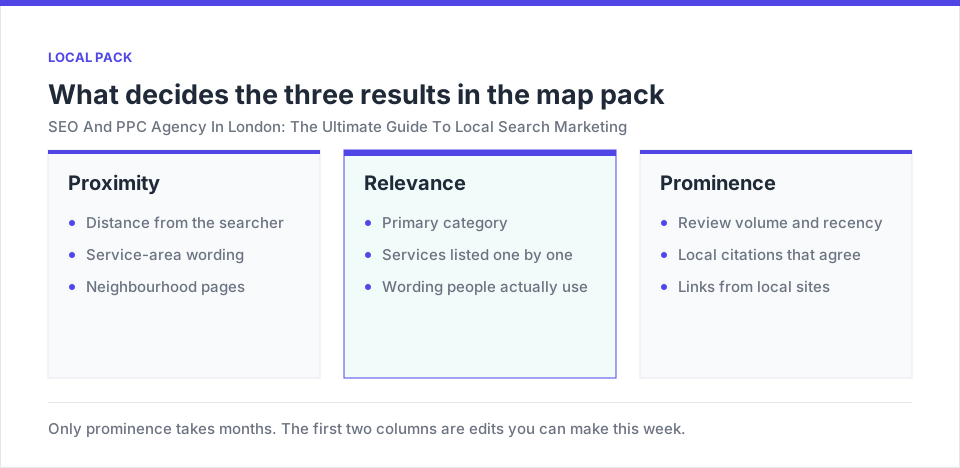
Local keyword strategy for London PPC
Keyword research should start with city-wide Be London seeds that reflect metropolis-wide relevance and broad intent, then branch into borough modifiers that capture local demand and proximity. Build a taxonomy where each Be London term maps to one or more Ru London depth pages. For example, london seo, local search london, and GBP health become anchors that feed proximity-focused borough terms such as Westminster SEO, Shoreditch near me, Camden health clinics, Islington shops near me, and Hackney hospitality. Tag terms by intent—transactional, informational, navigational, or proximity-based—to guide ad copy and landing-page messaging.
Prioritise opportunities by Local Pack impact, proximity potential, and estimated conversion value. Use a simple scoring rubric to balance volume, difficulty, and proximity signals. Maintain a rolling keyword journal to capture borough-specific terms as you expand your Be London-to-Ru London map, ensuring consistent alignment with translation provenance notes to preserve terminology across surface activations.
Ad copy strategy: localisation that converts
Craft ad copy that blends city-wide authority with district relevance. Be London ads should communicate GBP health advantages, central service capabilities, and credibility cues that work at scale. Ru London ads must spotlight proximity relevance, maps, directions, local testimonials, and borough-specific proofs. Include location insertions, distance-based CTAs, and district landmarks to make the ad resonate with local searchers. Use callouts to surface proximity benefits (e.g., near Westminster Station, by Camden Town, in Shoreditch) and include a strong, contextually relevant CTA that guides users to the borough landing page that best supports their intent.
Complement ad copy with tailored landing pages that mirror user expectations. Borough pages should open with concise proximity guidance, maps, and local trust signals, then channel visitors toward conversion paths such as consultation bookings, enquiry forms, or branch visit scheduling. Ensure consistency between ad promises and landing-page content to protect Quality Score and user experience across the Be London to Ru London journey.
Bidding, budget, and automation in a London context
London’s competitive landscape benefits from advanced bidding strategies and disciplined budget management. Employ a mix of automated bidding strategies such as Target CPA or ROAS at the Be London level for city-wide awareness, while using district-level Target CPA or ROAS variants for Ru London campaigns to optimise proximity-based conversions. Consider hybrid bidding approaches that allocate budget to high-potential boroughs during peak commute times and local events, when proximity searches spike. Use seasonality signals from London events calendar to adjust bids and budget allocations ahead of anticipated surges in demand.
Incorporate Performance MAX campaigns to consolidate reach across Search, Discovery, Display, YouTube, and Shopping into a single, goal-driven campaign with locality-specific audience signals. For boroughs that rely on footfall, experiment with local inventory-like signals or store visit goals to encourage physical visits. Always couple bidding with high-quality landing pages and accurate local data to sustain conversions and maintain a positive Quality Score across surfaces.
Measurement, attribution and governance
Measurement should mirror the two-tier framework. Create parity dashboards that juxtapose Be London city-wide signals (GBP health, hub-page performance, Local Pack impressions) with Ru London depth-page engagement (maps, proximity content, local testimonials) and locality conversions. Use data sources such as GBP Insights, map interactions, GA4 on-site data, and CRM or call-tracking data to build an end-to-end attribution model. Ground your interpretation in Google Local Pack guidance and Moz Local, but tailor the insights to London’s geography, transport patterns, and borough realities.
Establish a monthly governance cadence to review drift, adjust resource allocation, and confirm that proximity-driven actions translate into measurable ROI. Quarterly ROI reviews should synthesise paid and organic performance, ensuring PPC contributions feed back into the broader SEO strategy and vice versa. The governance artefacts should include region templates, translation provenance notes, and a clear owner matrix so teams can act quickly when market conditions shift.
Next steps: discovery and engagement
Ready to implement a London-focused PPC strategy that complements your SEO efforts? Explore the LondonSEO.ai services page and start a discovery via the contact page. The Be London and Ru London framework, enhanced by disciplined PPC practices, delivers durable Local Pack visibility and credible locality proofs across the capital’s boroughs. For authoritative guidance, reference Google Local Pack resources and Moz Local references, then adapt them to London’s geography, transit, and neighbourhood dynamics.
To begin a hands-on discussion about PPC and SEO integration for your boroughs, visit LondonSEO.ai services or contact us to tailor a plan aligned with your sector and locations.
PPC Strategy In London: Aligning SEO And PPC For Local Growth
London’s two-tier locality model translates seamlessly into paid search when the Be London city-wide authority signals and GBP health underpin broad visibility, while Ru London borough-focused depth pages capture proximity relevance. This section translates that framework into a practical, scalable PPC playbook designed for the capital’s density, commuter patterns, and diverse consumer behaviours. By weaving PPC into the broader SEO strategy, London brands can capture near-term demand while strengthening locality credibility that feeds organic visibility over time.
From account architecture to landing-page experiences and from bidding strategies to governance, every decision in London should reinforce a coherent Be London and Ru London narrative. Where possible, reference Google Local Pack guidance and Moz Local frameworks, then translate them to London’s distinctive geography, transit network, and neighbourhood dynamics.
Integrated PPC Architecture For Be London And Ru London
Structure PPC around a two-tier architecture that mirrors the SEO framework. Establish a Be London campaign shell focused on city-wide GBP health, brand terms, and broad service categories that generate mass awareness and top-of-funnel traffic. Parallel to this, deploy Ru London campaigns that are borough-specific, feature proximity content, and drive locality conversions. The Be London hub anchors GBP health, call-to-action prompts, and generic service propositions; Ru London blocks translate that authority into district proofs, maps, directions, and local testimonials.
Within Ru London, build campaign stacks for Westminster, Camden, Hackney, Islington, Southwark, and other priority boroughs. Each stack should include dedicated ad groups, borough-tailored keywords, and location-aware ad copies tuned to local intent. This enables rapid localisation while preserving a cohesive city-wide narrative. Regular cross-surface analyses ensure city-wide signals uplift district-focused conversions and that district activity feeds back into broader authority signals.
Ad Copy, Landing Pages And Local Relevance
Ad copy should blend Be London credibility with Ru London proximity. Be London messages emphasise GBP health, authority, and universal services, while Ru London messages highlight district landmarks, maps, directions, and testimonials. Location insertions and distance-based CTAs improve relevance for near-me queries and encourage clicks to borough-specific landing pages. Ensure landing pages align with ad promises, offering proximity guidance, clear conversion paths (book a consultation, request a callback, visit a branch), and locality-specific proofs that reinforce trust at the decision moment.
Develop a clear landing-page taxonomy that links Be London topics to Ru London depth pages. Use internal links that guide users from city-wide content to district proofs, reinforcing locality signals and improving crawlability for search engines.
Bidding Strategies And Budget Allocation Across Boroughs
Local demand patterns necessitate nuanced bidding. Apply district-aware bidding, with Target CPA or ROAS at the Ru London level to optimise proximity-based conversions, supplemented by a city-wide Target CPA/ROAS for Be London to protect overall volume. Consider time-based adjustments aligned with London commuters, city-wide events, and seasonal promotions, ensuring surge bidding aligns with local footfall and transit patterns. Performance Max campaigns can consolidate reach across multiple channels while respecting borough-specific signals, including proximity maps and district reviews.
Implement a hybrid approach: a steady Be London budget for brand visibility and GBP health, plus flexible Ru London allocations during peak periods or local campaigns. Always tie bidding decisions to landing-page quality and local data signals to preserve Quality Score and maximise ROI across the two surfaces.
Measurement, Attribution And Governance For London PPC
Parity dashboards should mirror the SEO two-tier view, presenting Be London signals (GBP health, hub content performance, Local Pack impressions) alongside Ru London proofs (depth-page engagement, maps, proximity content). Establish KPIs for both surfaces, including Local Pack impressions by borough, proximity-driven clicks, depth-page interactions, and locality-conversion metrics. Tie PPC data to GBP Insights, map interactions, GA4 on-site data, and CRM or call-tracking data to create a complete attribution model that links Be London activities to Ru London outcomes.
Institute a monthly governance cadence to review drift, reallocate budgets, and maintain a transparent ROI narrative. Quarterly ROI reviews should synthesise paid and organic performance to illustrate how PPC contributions feed back into the broader SEO strategy and vice versa. Governance artefacts should include region templates, translation provenance notes, and ownership matrices to ensure rapid, accountable action when market conditions shift.
Next Steps: Discovery And Engagement
Ready to implement a London-focused PPC strategy that integrates with your SEO efforts? Explore the LondonSEO.ai services and start a discovery via the contact page. The Be London and Ru London framework, combined with disciplined PPC practices, delivers durable Local Pack visibility and credible locality proofs across the capital’s boroughs. For authoritative guidance, reference Google Local Pack resources and Moz Local, adapting them to London’s geography and transit realities, with Translation Provenance and governance at the core.
To begin a hands-on discussion about PPC and SEO integration for your boroughs, visit LondonSEO.ai services or contact us to tailor a plan aligned with your sector and locations.
Analytics, Reporting And Attribution For London Campaigns
In London’s fast-moving, two-tier locality framework, credible measurement and transparent reporting are not luxuries; they underpin durable Local Pack visibility and meaningful locality proofs. Be London signals establish city-wide authority and GBP health, while Ru London depth pages prove district proximity. This part outlines a pragmatic approach to measurement governance, parity dashboards, data integration, and attribution modelling that keeps London campaigns auditable, scalable, and genuinely ROI-driven. Where relevant, we reference industry standards from Google and Moz Local to anchor practice while tailoring insights to London’s distinct geography and transport realities.
Parity Dashboards: The Two-Tier View In Practice
Parity dashboards sit at the heart of a London two-tier programme. They present Be London signals—GBP health, hub content performance, and Local Pack visibility—alongside Ru London proofs—depth-page engagement, maps, proximity content, and district testimonials. A well-constructed dashboard bundle makes drift visible early and enables rapid resource reallocation. The dashboards should enable stakeholders to see how city-wide authority translates into district credibility and, ultimately, locality-converted actions.
Key KPI domains to surface side-by-side include Local Pack impressions by borough, proximity map interactions, depth-page time on page, and locality conversions such as calls or form submissions. Parity dashboards also facilitate cross-surface attribution storytelling, showing how Be London activities contribute to Ru London outcomes and vice versa. For authoritative guidance, align with Google Local Pack resources and Moz Local frameworks, adapting them to London’s geography and transit realities.
Data Sources And Unified Attribution
Robust attribution relies on a curated, multi-source data architecture that captures both surface dynamics and real-world conversions. Core inputs include Google Business Profile (GBP) insights and health flags, map interactions and directions requests, on-site engagement from GA4, and locality-driven conversions tracked in your CRM or call-tracking system. External benchmarks from Google Local Pack guidance and Moz Local provide learning anchors, but London teams should tailor interpretation to the capital’s unique mobility and neighbourhood patterns.
Construct a unified data model that synchronises GBP health signals with on-site behaviours and locality conversions. A practical approach is to map GBP signals to Be London hub pages and tie district interactions to Ru London depth pages, enabling clean, end-to-end attribution from discovery to locality-based conversion.
Design the data pipeline so that every data point has a provenance trail, including source, date, and surface context. This transparency supports governance reviews and ensures auditable results across borough rollouts.
Governance Cadence And Reporting Protocols
Establish a governance cadence that keeps the Be London and Ru London surfaces aligned while accommodating city-wide changes in consumer behaviour and local events. A practical rhythm includes monthly drift checks on parity dashboards and quarterly ROI reviews to validate investment against locality outcomes. Governance artefacts should document data sources, translation provenance, and decision rights, ensuring teams can act decisively when market conditions shift.
Reporting should blend short-term momentum with long-term planning. Monthly reports prioritise Local Pack visibility and proximity-driven engagements, while quarterly summaries connect channel performance to business outcomes, including in-store visits, calls, and qualified lead generation. Reference Google Local Pack guidance and Moz Local as baselines, but tailor interpretation to London’s geography and transit realities.
Practical Tools And Artefacts For Be London And Ru London
To sustain a scalable measurement framework, assemble a toolkit of governance artefacts that travel with every borough expansion. Region templates encode locale-specific language and proximity cues; Translation Provenance notes preserve terminology consistency; parity dashboards provide ongoing visibility into both Be London and Ru London surfaces; and an auditable data model ties GBP health to Local Pack and locality conversions. These artefacts help teams scale confidently while maintaining a single source of truth for performance across Greater London.
When you need external benchmarks, reference Google Local Pack resources and Moz Local references to anchor strategies, but always localise insights to London's transport patterns, neighbourhood dynamics, and borough-specific realities.
Next Steps: Discovery And Engagement
Ready to embed a disciplined measurement and governance framework for your London campaigns? Explore the LondonSEO.ai services and initiate a discovery via the LondonSEO.ai services page, then book a discovery to tailor a plan to your sectors and locations. The two-tier Be London and Ru London model, reinforced by robust analytics, will deliver durable Local Pack visibility and meaningful locality proofs across the capital’s boroughs.
For authoritative context, consult Google Local Pack resources and Moz Local to ground your practices, while applying Translation Provenance and governance to keep terminology consistent as you scale.
Choosing The Right Agency In London For SEO And PPC
In a market as complex as London, selecting the right SEO and PPC partner is strategic, not incidental. A true two-tier locality framework—Be London and Ru London—requires an agency capable of governing city-wide authority while delivering district credibility. LondonSEO.ai approaches partner selection with a clear, evidence-based rubric and a proven governance model, designed to scale across Greater London and its boroughs. Below is a practical guide to evaluating agencies, with emphasis on alignment, transparency, data discipline, and delivery that mirrors Be London / Ru London.
Key criteria when choosing a London SEO and PPC partner
The right agency should demonstrate capability across strategy, execution, governance, and measurement. Look for evidence of multi-borough campaigns, robust GBP health management, and locality proofs that feed Local Pack and depth-page performance. A credible partner will show:
- Two-tier strategy alignment: Clear articulation of Be London and Ru London outputs, with region templates and Translation Provenance notes.
- Direct access to experts: Flat, accountable ownership with senior specialists available for workshops and strategy reviews.
- Governance and transparency: Regular parity dashboards, explicit SLAs, and a transparent ROI narrative tied to locality outcomes.
- Local London expertise: Demonstrated knowledge of London’s boroughs, transport patterns, and consumer behaviour; familiarity with Local Pack signals in the capital.
- Data-driven decision making: GBP insights, map interactions, GA4 on-site data, and CRM/phone attribution integrated into a single model.
- Scalability and roadmap: A staged growth plan showing how Region Templates and content maps extend from one borough to many.
- Pricing clarity: Transparent models, well-scoped deliverables, and a governance-friendly contract structure.
Practical steps to evaluate proposals
When you receive proposals, verify that they describe a Be London hub and Ru London depth strategy, include region templates, and address Translation Provenance. Confirm the governance cadence and the set of KPIs that tie to Local Pack visibility and locality conversions. Ask for onboarding details, data access, and a phased borough rollout plan. A credible proposal will present a coherent path from discovery to locality-based conversion, not a collection of disconnected tactics.
Pricing and engagement models that work in London
Pricing should reflect the two-tier locality model. Common options include a monthly retainer for ongoing GBP health and Be London hub content, milestone-based pricing for phased Ru London depth development, and hybrid or performance-linked arrangements aligned to Local Pack uplift or locality-driven conversions. Ensure pricing clearly maps to deliverables, includes change-control processes, and supports predictable budgeting as boroughs are added.
Due diligence questions to fast-track decisions
Prepare a concise checklist to guide evaluation. Essential questions include: How do you structure Be London and Ru London outputs within client engagements? Can you share parity dashboards and sample reports? How do you handle Translation Provenance and region templates? What is your approach to multi-borough content and internal linking? Do you have anonymised case studies demonstrating Local Pack uplift and district proofs? What are the SLA commitments for data access, reporting cadence, and deliverable turnaround?
Next steps: how to engage with LondonSEO.ai
If you’re ready to explore a two-tier locality programme in London, browse the services on LondonSEO.ai services and book a discovery via the contact page. Our emphasis on transparency, direct access to experts, and governance that scales with your borough footprint ensures clarity and confidence as you expand across Greater London. For benchmark guidance, reference Google Local Pack resources and Moz Local frameworks, and contextualise them with Translation Provenance as you grow.
How To Choose The Right Local SEO Consultant In Manchester
Manchester represents a vibrant, competitive local market where a two-tier locality framework can unlock durable visibility. While London remains a reference point for a city-wide Be London and borough-focused Ru London approach, Manchester campaigns benefit from a closely aligned methodology: a central set of authority signals that scale across the metropolis, paired with district-level proofs that prove proximity. When selecting a consultant, look for evidence of systemic governance, data discipline, and a proven ability to translate strategy into locality conversions across multiple boroughs. The team at LondonSEO.ai underpins these principles, and the same discipline can be localised to Manchester with auditable, repeatable results.
Key criteria for a Manchester-focused SEO and PPC partner
- Two-tier strategy competence: Demonstrated ability to deploy a Be Manchester hub of city-wide authority alongside Ru Manchester depth pages that address district-specific proofs, maps, and proximity content.
- Local market knowledge: Proven track record across Manchester boroughs, with understanding of transport patterns, demographics, and consumer behaviour unique to Greater Manchester.
- Governance and transparency: Regular parity dashboards, clear SLAs, and an auditable data trail linking activities to Local Pack and locality conversions.
- Data-driven leadership: Experience integrating GBP health, map interactions, GA4 on-site data, and CRM or call-tracking data for end-to-end attribution.
- Scalability and region templates: Ability to roll out region templates for new districts without signal drift, maintaining Translation Provenance for terminology consistency.
A practical evaluation checklist
Ask for concrete evidence that the practitioner can deliver a scalable two-tier approach. The checklist below helps separate theory from practice:
- Case studies across borough clusters: Look for measurable uplift in Local Pack visibility and depth-page engagement across multiple districts.
- Region templates and localisation speed: Request samples showing how Be Manchester topics map to Ru Manchester depth pages and how templates accelerate localisation.
- Translation Provenance: Require documented terminology guidelines that travel with every update as new boroughs join.
- Governance cadence: Ensure there is a defined monthly parity review, quarterly ROI assessment, and a transparent change-control process.
- Attribution architecture: Demand a single source of truth linking GBP health, map interactions, on-site metrics, and locality conversions.
What to ask during discovery calls
- Can you demonstrate a Be Manchester hub and Ru Manchester depth page set with live navigation between surfaces?
- How do you approach GBP health maintenance and NAP hygiene across Manchester locations?
- What is your governance cadence, and how do you report on Local Pack and locality conversions?
- Do you provide region templates and Translation Provenance notes for rapid borough localisation?
- Can you share anonymised case studies showing attribution from locality activities to conversions?
Pricing, contracts and engagement models to seek
A well-structured proposal should articulate how Be Manchester and Ru Manchester outputs are priced, with clear scope, milestones, and governance terms. Typical models include monthly retainers for ongoing GBP health and hub content, milestone-based borough deployments for depth pages, and hybrid arrangements with performance-linked incentives tied to Local Pack uplift and locality conversions. Ensure the contract specifies ownership of two-tier outputs, data access rights, and a transparent change-control process.
- Retainer with phased borough expansion: stable base services with scheduled locality rollouts.
- Milestone-based sprints: deliverables tied to specific districts and content clusters.
- Hybrid / performance-linked: base terms plus bonuses aligned to measurable locality outcomes.
Next steps: engaging with Manchester SEO services
If you’re ready to identify a Manchester partner who can deliver Be Manchester and Ru Manchester results, start with the two-tier framework and request a discovery. Visit Manchester SEO services to view capabilities, and book a discovery to tailor a plan for your boroughs. While the Manchester market benefits from practical, localisation-focused strategies, LondonSEO.ai remains a trusted knowledge source for governance, reporting, and localisation best practices that can be adapted to Manchester’s geography and transport realities.
Choosing The Right Local SEO Consultant In Manchester
Manchester represents a vibrant, competitive local market where a two-tier locality framework can unlock durable visibility. While London often serves as the reference for governance through Be London and Ru London, Manchester campaigns can adopt the same disciplined approach to achieve scalable Local Pack presence city-wide and credible locality proofs across numerous boroughs. Selecting the right consultant is not about one-off tactics; it’s about a partner who can govern the Be Manchester for city-wide authority and the Ru Manchester for district-specific proofs, with transparent measurement and auditable outcomes that survive market shifts.
In practice, look for a consultancy that demonstrates governance maturity, data discipline, and an ability to translate strategy into locality conversions across multiple districts. The objective is a practical, repeatable blueprint that preserves signal integrity while expanding your proximity footprint across Greater Manchester. This piece offers a practical lens for evaluating Manchester partners, aligned with the Be Manchester / Ru Manchester model and the measurable, ROI-driven expectations that modern local campaigns demand.
Core criteria for a Manchester-focused SEO and PPC partner
When assessing agencies, focus on capabilities that map cleanly to a Be Manchester hub of city-wide authority and Ru Manchester depth pages that prove locality relevance. The right partner should demonstrate:
- Two-tier strategy competence: A clear plan to activate a Manchester Be Manchester hub alongside Ru Manchester depth pages for district-specific proofs, maps, reviews, and proximity content.
- Local market knowledge: Demonstrated familiarity with Manchester’s boroughs, transport corridors, demographics, and distinct consumer behaviours across districts such as City Centre, Salford area, Stockport proximity (where relevant), and other key zones.
- Governance and transparency: Regular parity dashboards, explicit SLAs for data access, and a transparent workflow that ties activity to Local Pack visibility and locality conversions.
- Data-driven leadership: Proven ability to integrate GBP health, map interactions, GA4 on-site data, and CRM/call-tracking data into a single attribution model.
- Region templates and Translation Provenance: Structured templates for rapid borough localisation and a glossary that travels with updates to preserve terminology consistency as new districts are added.
- Case studies and references: Access to anonymised Manchester or similar-city outcomes illustrating Local Pack uplift and proximity-driven conversions.
Due diligence: a practical evaluation checklist
Ask prospects to demonstrate a coherent two-tier Manchester plan with governance artefacts. A solid evaluation should include:
- Be Manchester and Ru Manchester samples: Pair a city-wide hub with district-focused depth pages and proof of effective internal linking.
- Region templates and localisation speed: Examples of templates that enable rapid borough activation without signal drift.
- Translation Provenance: Clear language guidelines that travel with updates as districts grow.
- Governance cadence: A defined schedule for parity reviews, updates, and ROI reporting.
- Attribution architecture: A single source of truth that links GBP health, map interactions, on-site metrics, and locality conversions.
Questions to ask during discovery calls
- Can you demonstrate a Be Manchester hub and Ru Manchester depth page set with live navigation between surfaces?
- How do you maintain GBP health and NAP hygiene across multiple Manchester locations?
- What governance cadences do you use, and how do you report on Local Pack and locality conversions?
- Do you provide region templates and Translation Provenance notes for rapid borough localisation?
- Can you share anonymised case studies showing attribution from locality activities to conversions?
Pricing and engagement models for Manchester campaigns
A practical Manchester engagement plan typically offers three pricing paradigms, each with its pros depending on budget, speed of impact, and governance requirements:
- Monthly Retainer: Ongoing GBP health, Be Manchester hub content, and a fixed set of Ru Manchester depth pages with regular governance and reporting.
- Milestone-Based Projects: Fixed-price sprints for borough deployments, region-template rollouts, and depth-page expansions tied to explicit deliverables.
- Hybrid or Performance-Linked: Base retainer plus performance bonuses tied to Local Pack uplift or locality conversions, ensuring commercial alignment with outcomes.
Next steps: engaging with Manchester SEO services
If you’re ready to explore a two-tier Manchester approach, review the Manchester-focused SEO services on Manchester SEO services and book a discovery via the contact page. While the two-tier Manchester framework mirrors the Be Manchester and Ru Manchester model, LondonSEO.ai provides scalable governance and regional templates that can be adapted to Manchester’s geography and transport realities. For reference, consult external guidance on local signals and proximity from reputable sources such as Google Local Pack guidance and Moz Local to ground your strategy in industry standards.
Final Rollout Checklist For London SEO And PPC
Having established the Be London and Ru London two-tier framework across the capital, this final part codifies a practical rollout and governance playbook. It translates city-wide authority into district proofs, aligns paid and organic activities, and delivers auditable returns that stakeholders can trust. The focus is on scalable processes, transparent measurement, and governance rituals that sustain Local Pack visibility while growing credible locality proofs throughout Greater London.
For teams already applying the LondonSEO.ai approach, the following blueprint equips you to expand confidently into new boroughs, while maintaining Translation Provenance and a coherent user journey from Be London discovery to Ru London locality conversion. If you’re ready to act, explore the London SEO services on LondonSEO.ai services or start a discovery via the contact page to tailor a plan to your sector and locations.
90-Day Momentum Blueprint
Translate strategy into a concrete, three-month cadence that delivers early wins and scalable foundations. The aim is to stabilise GBP health, expand Be London hub content, and progressively activate Ru London depth pages across priority boroughs. A disciplined rollout reduces friction, preserves signal integrity, and creates a measurable bridge from discovery to locality conversions.
- Phase 1 (0–30 days): finalise governance charter, lock GBP health for priority locations, fix NAP inconsistencies, and publish the initial Be London hub updates that tie to high-potential Ru London pages.
- Phase 2 (30–60 days): accelerate Ru London depth-page expansion to additional boroughs, strengthen region templates, and embed proximity content such as maps and FAQs into live pages.
- Phase 3 (60–90 days): deploy parity dashboards for Be London and Ru London surfaces, begin light digital PR to secure local backlinks, and reallocate resources toward districts delivering the strongest locality ROI.
Governance, Parity Dashboards And Reporting
Parity dashboards sit at the heart of the two-tier framework. They present Be London signals (GBP health, hub content performance, Local Pack impressions) alongside Ru London proofs (depth-page engagement, maps, proximity content, local testimonials). Establish a cadence that surfaces drift early and supports rapid reallocation of resources to boroughs with the strongest locality impact. Governance should be explicit about data sources, translation provenance, and ownership so teams can respond quickly to market changes.
- City-wide surface: GBP health, hub-content performance, Local Pack impressions across Greater London.
- District surface: depth-page engagement, proximity maps, district testimonials, and maps-driven interactions.
- Cross-surface attribution: connect Be London activities to Ru London outcomes to illustrate end-to-end impact.
- Resource allocation signals: identify boroughs delivering strongest ROI to inform budget and roadmap decisions.
Measurement, Data Integrity And Attribution
Reliable attribution relies on a robust, multi-source data architecture. Core inputs include GBP Insights, map interactions, GA4 on-site metrics, and locality-driven conversions from your CRM or call-tracking system. Reference Google Local Pack guidance and Moz Local as baselines, but tailor interpretation to London’s geography and transport realities. Build a unified data model that links GBP health signals to Be London pages and ties district interactions to Ru London depth pages, enabling transparent, end-to-end attribution.
- GBP Insights and Health: monitor profile completeness, updates, hours and attributes by borough.
- Maps And Proximity Signals: track directions requests, route clicks, and proximity-related interactions leading to conversions.
- On-site Engagement: GA4 metrics for depth pages, proximity blocks, and locality content interactions.
- Conversions And CRM: attribute calls, form submissions, store visits to the relevant Be London or Ru London paths.
Next Steps: Discovery And Engagement
Ready to institutionalise two-tier governance for London campaigns? Start with the LondonSEO.ai services and book a discovery via the services page, then contact us to tailor a plan for your boroughs and sectors. The Be London and Ru London framework is designed to scale, delivering durable Local Pack visibility and credible locality proofs across the capital’s boroughs. For authoritative guidance, reference Google Local Pack resources and Moz Local frameworks to ground your approach in industry standards while applying Translation Provenance to keep terminology consistent as you grow.
A Practical Rollout Checklist
- Define the two-tier scope: confirm Be London hub topics, GBP health priorities, and Ru London depth pages for target boroughs.
- Establish Translation Provenance: document terminology guidelines and ensure they travel with updates as boroughs grow.
- Launch Region Templates: roll out reusable templates for rapid borough localisation without signal drift.
- Develop Parity Dashboards: build side-by-side views of city-wide and district signals with clear attribution paths.
- Set governance cadence: monthly drift reviews, quarterly ROI assessments, and a documented escalation process.
- Plan 90-day milestones: Phase 1 GBP health stabilisation, Phase 2 borough-depth expansion, Phase 3 parity deployment and local backlinks.
