Introduction: Why London Businesses Need An SEO Expert Consultant
London’s business ecosystem is among the most competitive in the world, with a constant churn of new ventures, international visitors and shifting consumer behaviours. For local brands aiming to grow online, visibility is not enough; relevance to London users is essential. An SEO expert consultant in London brings city-specific insight into how people search, what they value, and when they are most likely to convert. At londonseo.ai we specialise in translating local demand into measurable outcomes, helping businesses move from generic visibility to district-focused authority that compounds across Maps, the Google Business Profile (GBP) and the Shopify or non-Shopify storefronts they operate. This guide explains why a London-based specialist matters, what to expect, and how a structured, governable approach can deliver sustainable growth for your London business.
The unique London search landscape
Search behaviour in the capital is intensely localised. Shoppers frequently combine transactional intents with borough and neighbourhood knowledge, expecting delivery options, store availability and timely responses. Local packs, Maps results and GBP snippets often determine which brands win the initial click, while mobile-first experiences drive the final conversion. A London-focused SEO programme recognises this blend of long-tail locality, time-sensitive demand and high competition, harmonising technical optimisation with district-aware content strategies.
What an SEO expert consultant in London does differently
A dedicated London expert approaches SEO with a clear view of how London users search and how local signals interact with national and global ranking factors. In practice, this means prioritising district landing pages, borough-level content clusters, and a navigation structure that surfaces local intent quickly. It also involves managing the delicate balance between local content breadth and crawl efficiency, ensuring Google recognises your London focus without diluting your core brand message.
- Local intent mapping: translate borough priorities into district landing pages and content clusters that capture local queries.
- Technical readiness for London-scale content: robust site architecture, clean URLs and well-managed canonicalisation to prevent duplicate content from district filters and parameters.
- Content strategy grounded in geography: editorial blocks and FAQs that address common London questions and seasonal patterns.
- GBP and Maps alignment: synchronise GBP updates with on-site content to reinforce local authority and conversion signals.
- Measurement and governance: district dashboards, seed-term provenance and surface rendering governance to maintain consistency as you scale across boroughs.
Why London businesses should work with a local SEO expert
Local SEO involves more than plugging in a handful of keywords. It requires a governance framework that preserves seed terms while enabling locale-specific adaptation. A London-based expert brings access to regionally relevant data sources, relationships with local content creators, and a practical sense of how businesses in Islington, Hackney, Chelsea or Canary Wharf compete online. By engaging a trusted London consultant, you gain an accountable partner who can translate city-wide ambitions into district-level actions with measurable impact.
What you can expect to achieve with a London-focused approach
- Increased local visibility: improved rankings for district- and borough-specific queries, with stronger Maps presence.
- More relevant traffic: visitors who search with local intent are presented with content that mirrors their geography and delivery needs.
- Better conversion rates: district landing pages, GBP signals and local CTAs create a smoother path from discovery to action.
- Clear return on investment: governance and measurement frameworks tie SEO work to actual business outcomes, from phone calls to online orders.
Next steps: starting your London SEO journey
To translate these principles into tangible results, consider a London-focused collaboration with our team at Shopify SEO services, or book a discovery call via our contact page. For foundational understanding, review Google’s guidance on SEO starter practices and reputable Local SEO resources to align with best practices as you begin your London programme. Examples include the Google SEO Starter Guide and Moz’s Local SEO Guide. London businesses that partner with londonseo.ai gain access to a structured, district-aware playbook designed to scale in London’s dynamic market.
Shopify SEO Fundamentals for London Stores
London’s ecommerce scene is highly competitive, with a dynamic mix of high street brands and nimble independents. For Shopify stores serving the capital, speed, locality and a district-focused content strategy are not optional extras; they are prerequisites for competing effectively. This section outlines practical, actionable fundamentals that align with londonseo.ai’s approach: architecture that serves local intent, performance that satisfies mobile-first shoppers, and content that speaks to London audiences across boroughs. By applying these fundamentals, you establish a strong base for city-wide growth while remaining agile enough to expand into new districts as demand evolves.
Shopify architecture and its impact on SEO in London
Shopify organizes content around products, collections, pages and blogs. This clarity is powerful when you tailor product titles and collections to London-focused intents and borough-specific demand. In practice, you want a clean hierarchy that surfaces district landing pages, district hubs and product categories in a way that is crawl-friendly and user-centric. A London-centred SEO programme recognises the need to balance on-site structure with local signals so Google can understand where your propositions fit within the city’s geography and shopping patterns.
- Localised product and collection naming: create titles and meta descriptions that reflect London districts and neighbourhoods to improve relevance in local search results.
- Canonical and duplication control: manage district filters and parameter-based navigations to prevent indexation of low-value variants and ensure the right pages surface in search results.
- District content hubs: build district-level pages that consolidate local product selections, delivery information and borough FAQs to signal strong local intent.
- Structured data alignment: implement product, local business and FAQ schema to support rich results and Maps presence for district queries.
Shopify themes and performance considerations for London shoppers
Londoners expect fast, reliable experiences on mobile devices. Theme selection and app usage directly influence Core Web Vitals and user satisfaction. Practical steps include choosing a fast, well-optimised theme, auditing third-party apps for speed impact, and implementing image optimisation with lazy loading to improve LCP and CLS metrics. A London-specific approach also emphasises a content hierarchy that puts district-relevant information near the top of the page, so both users and search engines recognise local relevance quickly.
- Performance-first theme choice: select a theme with clean code, efficient asset delivery and built-in performance improvements.
- App impact assessment: remove or replace apps that add render-blocking scripts or large payloads.
- Media optimisation: compress images, serve next-gen formats, and implement lazy loading for non-critical visuals.
- Script management: minimise JavaScript and CSS that block rendering; defer non-essential assets until after initial load.
In parallel with technical speed, structure content so that the most important London-specific information loads first. This helps users and search engines understand local relevance rapidly while keeping the user journey smooth from discovery to action.
Local keyword targets and content mapping for London
Develop a city-wide keyword framework anchored to London’s distinctive geography. Start with borough clusters (Islington, Camden, Greenwich, Hackney, Westminster) and map transactional terms signalling local intent (for example, London delivery, Islington gifts, Camden cafe near me). Create district landing pages that aggregate relevant products or collections and pair them with district-level content that answers common local questions. This structure helps Google and users connect local intent with actionable content.
Key steps include:
- Keyword discovery by district, prioritising terms with local intent and seasonal London signals (events, markets, seasonal promotions).
- Content mapping that assigns each keyword cluster to a dedicated landing page, a district page and relevant GBP content where applicable.
- Local content that reflects London life and shopping patterns, with clear calls to action tailored to each district’s audience.
Basic optimisations to implement from the outset
From day one, apply practical optimisations that set up long-term success in London’s marketplace:
- Product and collection titles: craft unique, London-relevant titles and meta descriptions that reflect local intent and borough terminology.
- Clean URL structures: use descriptive, keyword-rich URLs that include district references where sensible (eg, /collections/london-islington).
- Header structure: use semantic H1 for page purpose, with H2–H6 sections to guide both users and search engines through content.
- Structured data: implement Product schema for products, LocalBusiness or Organisation schema for the store, and FAQ schema for district FAQs to improve rich results and Maps presence for London queries.
- Image optimisation: descriptive file names and alt text to support mobile speed without compromising quality.
- Internal linking: establish a logical path from district hubs to product pages and GBP content to pass authority across London-focused pages.
These practices, when applied consistently, create a solid technical baseline that supports more ambitious, district-focused optimisations later. For ongoing guidance, reference Google’s starter resources and industry best practices as you implement.
Next steps and resources
To advance, review our Shopify SEO services and book a consultation via our contact page to tailor a London-focused plan. Foundational references include Google SEO Starter Guide and Moz Local SEO Guide for the principles of local search and authority. For platform-specific insights, see Shopify's guidance on SEO and structure.
Shopify SEO Fundamentals for London Stores
London’s ecommerce scene is highly competitive, with a dynamic mix of established brands and agile independents. For Shopify stores serving the capital, speed, locality, and a district-focused content strategy are not optional extras; they are prerequisites for competing effectively. This section outlines practical, actionable fundamentals that align with the London-focused approach at londonseo.ai: architecture that serves local intent, performance that satisfies mobile-first shoppers, and content that speaks to London audiences across boroughs. By applying these fundamentals, you establish a solid base for city-wide growth while remaining agile enough to expand into new districts as demand evolves.
Shopify architecture and its impact on SEO in London
Shopify organises content around products, collections, pages and blogs. This clarity is powerful when you tailor product titles and collections to London-focused intents and borough-specific demand. In practice, you want a clean hierarchy that surfaces district landing pages, district hubs and product categories in a way that is crawl-friendly and user-centric. A London-centred SEO programme recognises the need to balance on-site structure with local signals so Google can understand where your propositions fit within the city’s geography and shopping patterns.
- Localised product and collection naming: create titles and meta descriptions that reflect London districts and neighbourhoods to improve relevance in local search results.
- Canonical and duplication control: manage district filters and parameter-based navigations to prevent indexation of low-value variants and ensure the right pages surface in search results.
- District content hubs: build district-level pages that consolidate local product selections, delivery information and borough FAQs to signal strong local intent.
- Structured data alignment: implement product, local business and FAQ schema to support rich results and Maps presence for district queries.
Shopify themes and performance considerations for London shoppers
Londoners expect fast, reliable experiences on mobile devices. Theme selection and app usage directly influence Core Web Vitals and user satisfaction. Practical steps include choosing a fast, well-optimised theme, auditing third-party apps for speed impact, and implementing image optimisation with lazy loading to improve LCP and CLS metrics. A London-specific approach also emphasises a content hierarchy that puts district-relevant information near the top of the page, so both users and search engines recognise local relevance quickly.
- Performance-first theme choice: select a theme with clean code, efficient asset delivery and built-in performance improvements.
- App impact assessment: remove or replace apps that add render-blocking scripts or large payloads.
- Media optimisation: compress images, serve next-gen formats, and implement lazy loading for non-critical visuals.
- Script management: minimise JavaScript and CSS that block rendering; defer non-essential assets until after initial load.
In parallel with technical speed, structure content so that the most important London-specific information loads first. This helps users and search engines understand local relevance rapidly while keeping the user journey smooth from discovery to action.
Local keyword targets and content mapping for London
Develop a city-wide keyword framework anchored to London’s distinctive geography. Start with borough clusters (Islington, Camden, Greenwich, Hackney, Westminster) and map transactional terms signalling local intent (for example, London delivery, Islington gifts, Camden cafe near me). Create district landing pages that aggregate relevant products or collections and pair them with district-level content that answers common local questions. This structure helps Google and users connect local intent with actionable content.
Key steps include:
- Keyword discovery by district, prioritising terms with local intent and seasonal London signals (events, markets, seasonal promotions).
- Content mapping that assigns each keyword cluster to a dedicated landing page, a district page and relevant GBP content where applicable.
- Local content that reflects London life and shopping patterns, with clear calls to action tailored to each district’s audience.
Basic optimisations to implement from the outset
From day one, apply practical optimisations that set up long-term success in London’s marketplace:
- Product and collection titles: craft unique, London-relevant titles and meta descriptions that reflect local intent and borough terminology.
- Clean URL structures: use descriptive, keyword-rich URLs that include district references where sensible (eg, /collections/london-islington).
- Header structure: use semantic H1 for page purpose, with H2–H6 sections to guide both users and search engines through content.
- Structured data: implement Product schema for products, LocalBusiness or Organisation schema for the store, and FAQ schema for district FAQs to improve rich results and Maps presence for London queries.
- Image optimisation: descriptive file names and alt text to support mobile speed without compromising quality.
- Internal linking: establish a logical path from district hubs to product pages and GBP content to pass authority across London-focused pages.
These practices, when applied consistently, create a solid technical baseline that supports more ambitious, district-focused optimisations later. For ongoing guidance, reference Google’s starter resources and Moz Local SEO Guide to align with best practices as you implement.
Next steps and resources
To advance, review our Shopify SEO services and book a consultation via our contact page to tailor a London-focused plan. Foundational references include Google SEO Starter Guide and Moz Local SEO Guide for the principles of local search and authority. For platform-specific insights, see Shopify's guidance on SEO and structure.
London Market Insights For SEO
London’s digital marketplace is renowned for its breadth and pace. Districts such as Westminster, Islington, Hackney and Chelsea each carry distinct search behaviours, consumer expectations, and competitive landscapes. A London-focused SEO approach from londonseo.ai grounds strategy in city-scale dynamics—then translates it into district-level actions that feed Maps, GBP and the storefront. By analysing how locals search, shop and convert across boroughs, you can prioritise high-value signals, optimise for local intent, and maintain a scalable, governance-driven programme that adapts as London evolves.
Local search dynamics across the capital
Local search in London blends transactional and informative intents with district-level context. Shoppers expect rapid delivery options, real-time stock visibility, and district-specific content that mirrors their daily neighbourhoods. GBP updates, Maps signals and district landing pages work together to surface relevant propositions quickly, particularly on mobile. A London-centred SEO programme weaves technical optimisation with geography-aware content, enabling fast, local decisions for Islington residents and Westminster visitors alike.
- District-level intent: queries that embed boroughs or neighbourhoods in the search string drive district landing pages and local collections.
- Maps and GBP coupling: local authority signals are reinforced when on-site content aligns with GBP listings and Maps data.
- Mobile-first expectations: fast load times and frictionless navigation are essential as London users frequently switch networks and devices.
- Seasonal and event-driven spikes: events in the city shift local demand and content relevance across districts.
District-led content mapping and topical authority
A district-led content map creates topical authority by clustering content around boroughs while maintaining a city-wide backbone. HUB pages act as central gateways, with each district page delivering localised content blocks, FAQs and district-specific product or service assortments. This hub-and-spoke model supports scalable growth, enhances crawl efficiency and strengthens geo-signals across Google’s index and Maps ecosystem.
- District hubs: central pages that scaffold all district content and link to product collections and GBP content.
- District pages: tailored content for Islington, Hackney, Chelsea, etc., with local CTAs and delivery details.
- Editorial blocks: borough-focused FAQs, seasonal guides and market insights that mirror local life.
Competitive benchmarks and measurement in London
Measuring success in London requires city-aware dashboards that blend district metrics with city-wide trends. Key indicators include local ranking progress for district terms, Maps impressions, GBP engagement (calls, directions, messages) and on-site conversion rates from district landing pages. By tying these signals to seed terms and district content, you can quantify ROI at a borough level while maintaining a unified London strategy.
- District ROI: evaluate traffic, engagement and revenue by borough to prioritise investment.
- Maps and GBP synergy: track changes in GBP interactions alongside Maps surface with district content.
- User journey metrics: monitor time-to-action, form submissions and local in-store pickups from district pages.
Partnering with a London-based expert consultant
Choosing the right partner matters. A London-based consultant from londonseo.ai brings city-specific benchmarks, district content playbooks and governance templates that support scalable growth while preserving brand integrity. When evaluating potential partners, look for demonstrable experience with Maps, GBP and borough-level optimisation, a clear governance framework, and accessible reporting that ties SEO activity to tangible outcomes such as in-store visits or online orders.
For practical next steps, explore our Shopify SEO services or book a discovery call via our contact page. Foundational resources from Google and Moz can complement the London-focused playbook we deliver, such as the Google SEO Starter Guide and Moz Local SEO Guide.
Next steps: actionable guidance for London-focused SEO
To translate these insights into results, start with a district-by-dorough audit of GBP, Maps signals and landing page content. Build a district content map that aligns with borough queries, then establish governance for seed terms, translations and surface rendering. By combining city-wide ambition with district-level discipline, you create a scalable framework that remains faithful to London’s local context. For ongoing support, consider our Shopify SEO services and schedule a consultation through the contact page.
Measuring success: KPIs and ROI
In London’s fast-moving ecommerce landscape, measuring success is not a luxury but a requirement. A structured KPI and ROI framework translates district-level optimisations into tangible business outcomes, enabling governance across Maps, Google Business Profile (GBP) and the storefront. This section outlines a practical approach to defining metrics, attributing impact, building district and city-wide dashboards, and validating the return on investment from a London-focused SEO programme powered by londonseo.ai.
Defining a KPI framework for London stores
Translate local intent into measurable signals. The KPI framework should cover three overarching domains: visibility and engagement, conversion and revenue, and efficiency and ROI. Each criterion below represents a complete idea and is designed to be actioned independently while contributing to the whole picture.
- Local visibility and engagement: impressions, clicks, click-through rate (CTR), Maps impressions, and ranking signals for district queries, plus GBP interactions and GBP views.
- On-site engagement: pages per session, average session duration, scroll depth, bounce rate and event completions on district landing pages and product catalog pages.
- Conversion metrics: transactions, revenue, average order value, form submissions, and any local actions such as store pickups or contact requests that originate from district pages.
- GBP and Maps signals: calls, directions requests and messages, plus engagement metrics from GBP insights that correlate with on-site activity.
- ROI and efficiency metrics: incremental revenue, return on investment (ROI), cost per acquisition (CPA) by district, and payback period for the SEO programme.
Attribution models for London SEO
A robust attribution approach recognises that district pages, GBP activity and Maps exposure often interact with organic search over multiple touchpoints. Use a data-driven multi-touch attribution framework as a baseline, rather than relying solely on last-click. This enables you to allocate value across district content, GBP interactions and on-site events in a way that mirrors the real customer journey.
- Data-driven multi-touch: assign credit across search, Maps, GBP and on-site interactions based on observed user paths and conversion events.
- Cross-channel integration: align GBP, Maps, organic search and, where used, paid search data to create a holistic view of contribution by district.
- Practical steps for implementation: tag campaigns with consistent UTM parameters, connect data streams in GA4, GSC and GBP Insights, and build district-aware dashboards in Looker Studio or Data Studio.
- Interpretation and action: use attribution insights to prioritise district content updates, GBP optimisations and conversion-focused landing page experiments.
Dashboard architecture for London
Design dashboards that reflect both city-wide ambitions and district-specific outcomes. Core data streams should include Google Analytics 4 (for user journeys), Google Search Console (keyboard performance), GBP Insights and Maps signals, plus Shopify store data for on-site transactions. Build two parallel but connected views: a city-wide SEO performance dashboard and district-specific dashboards for Islington, Hackney, Chelsea and others. Establish governance rules for data refresh, access control and report cadence.
- City-wide KPI dashboard: aggregates total traffic, conversions, revenue and ROI across all London districts.
- District dashboards: granular views per borough with local KPIs, GBP interactions, Maps impressions and district-on-page conversion metrics.
- Surface parity and governance dashboards: monitor DoBel provenance, AGO Bindings and PSRC conformance to ensure consistent rendering across surfaces.
A practical example: calculating ROI over 12 weeks
Assume a London SEO programme with an initial 12-week window. The plan costs £20,000 for the period. District-level uplift is modest but meaningful: Islington + Hackney + Chelsea contribute an incremental £60,000 in online revenue during the window. Add GBP-driven store pickups and local services, estimated at £15,000 incremental revenue. The total incremental revenue becomes £75,000. ROI is calculated as (incremental revenue – cost) / cost = (£75,000 – £20,000) / £20,000 = 2.75x. This simplified scenario demonstrates how district optimisation, Maps visibility and GBP synergy can compound into measurable business outcomes in London.
In practice, use attribution to apportion revenue across districts, surface types (Maps, GBP, organic), and on-site actions. Track lift in key actions such as telephone inquiries, directions requests and form submissions, and translate these into revenue estimates where possible. Always couple ROI calculations with a longer-term view: after initial establishment, continued optimisation typically yields compounding gains that improve the payback period over time.
Governance cadence and reporting cadence
Establish a repeatable rhythm that balances speed with accountability. A practical cadence for London stores includes weekly surface health sprints, monthly district ROI reviews, and quarterly seed-term audits. Regular regulator-friendly reporting should document seed decisions, Provenance notes, AGO Bindings and PSRC conformance to support auditability and future scaling.
- Weekly surface health sprints: fix crawl issues, refresh district blocks and validate interface parity across surfaces.
- Monthly ROI reviews by district: compare traffic, engagement and revenue contributions against targets, reallocate resources where needed.
- Quarterly seed-term audits: review the central glossary and bindings, adjust for evolving London market signals while preserving core semantics.
- regulator-ready reporting: maintain a publish-ready log that links actions to provenance and surface renders.
Next steps and resources
To embed this KPI and ROI framework into your London strategy, explore our Shopify SEO services and book a consultation via our contact page to tailor dashboards and governance for district-level growth. For foundational guidance, consult Google’s SEO Starter Guide and Moz’s Local SEO Guide to reinforce best practices for local search. These references complement the London-focused approach you will implement with londonseo.ai.
SEO Audit And Discovery Phase For London Stores
Launching a London-focused SEO programme begins with a rigorous discovery that establishes the baseline, reveals gaps across Maps and GBP, and identifies district-specific opportunities. For a seo expert consultant London engagement, the discovery phase translates city-wide ambitions into a practical, district-aware action plan that informs the entire programme. At londonseo.ai we emphasise a governance-led discovery, pairing technical insights with local intent to produce a measurable, repeatable roadmap for growth across boroughs such as Islington, Hackney, Chelsea and beyond.
Why a systematic discovery matters in London
London's search landscape blends high competition with strong local intent. A robust discovery process ensures your store surfaces for district queries, GBP and Maps signals are aligned with on-site content, and technical foundations support scale across boroughs. The outcome is a district-aware baseline that feeds a governance framework, enabling rapid prioritisation and disciplined execution. This approach helps mitigate crawl inefficiencies from district filters, avoids content dilution, and preserves brand integrity while expanding local relevance.
Core components of the audit
- Technical SEO audit: crawlability, indexation health, Core Web Vitals, and site speed across desktop and mobile. Identify blockers that impede district-level surface rendering or Maps visibility.
- Site architecture and canonicalisation: evaluate URL structure, parameter usage, and district pages to ensure a clean crawl path and prevent duplicate surface signals.
- On-page and content readiness: assess district landing pages, hub pages and product/collection pages for local relevance, schema usage, and content gaps tied to London districts.
- Local presence signals: GBP, Maps, and local citations alignment; stock and delivery information harmonised with on-site content where applicable.
- Keyword discovery by geography: identify district-level intents, seasonal patterns and event-driven spikes that drive locality-specific demand.
- Competitive benchmarking: map the Local SEO performance of nearby rivals, highlighting gaps in dual surfaces (Maps + organic) and content coverage by district.
- Data and measurement foundations: define the dashboards, data sources and attribution models that will track district ROI and city-wide progress.
What outputs you should expect
- Audit report and district backlog: a prioritised list of fixes, content gaps and quick wins that can be actioned in sprints.
- District content map: clusters that tie boroughs to editorial blocks, FAQs and local product assortments.
- Seed term glossary and AGO Bindings plan: stable terminology that travels across surfaces while allowing locale-specific adaptations.
- PSRC framework outline: Per-Surface Rendering Contracts to govern how metadata and prompts render on Search, Maps and GBP.
- Governance and dashboards blueprint: a repeatable reporting structure that ties SEO activity to district-level outcomes and city-wide growth.
District-focused keyword discovery and content planning
Begin with a city-wide keyword map anchored to London geography. Break down by boroughs and notable neighbourhoods, then translate those terms into district landing page topics and product content that address local delivery options, stock realities and neighbourhood-specific needs. The aim is to surface relevant content quickly for users at the moment they search within a district context, while enabling scalable expansion as new districts are added.
Practical steps include:
- Identify high-potential district terms and seasonal signals (e.g., deliveries in Islington during weekends or Hackney market events).
- Map each cluster to a dedicated landing page, with a clear on-page narrative and local CTAs.
- Plan editorial blocks and FAQs that reflect London's everyday life and shopping patterns across boroughs.
Technical and on-page readiness assessment
Assess how the current technical framework supports a London-centric content strategy. Questions to answer include: Is the URL structure friendly for district pages? Are district landing pages sufficiently content-rich to earn trust and rank for local intents? Do we have robust schema for LocalBusiness, Product, and FAQ on district pages? Are there duplicate or near-duplicate pages created by district filters or sorting parameters?
From this assessment you derive a practical backlog: technical fixes, content enhancements, schema additions, and an improved internal linking strategy that distributes authority to district pages without diluting the brand message.
Deliverables and governance alignment
Beyond the audit report, you receive a district-by-district action plan aligned with a city-wide governance framework. The plan includes district backlogs, an editorial calendar, seed term governance, and surface rendering rules (PSRCs). It also includes a suggested cadence for sprints, ROI reviews and regulator-friendly reporting to ensure transparency and accountability as you scale.
Measurement approach integrated with discovery
Link discovery outcomes to measurable business results from the outset. Define city-wide KPIs that track overall visibility and engagement, while establishing district-level metrics for local intent and conversion. A unified dashboard approach—combining GA4, Google Search Console, GBP Insights and Maps signals—helps translate London-specific actions into tangible ROI. Regular reviews ensure the discovery findings stay relevant as London’s market dynamics evolve.
Next steps: turning discovery into action
With the audit and discovery phase complete, translate findings into district landing pages, content clusters and a district-focused editorial calendar. Start with high-impact districts and align GBP and Maps signals with on-site content to accelerate early wins. For ongoing guidance, review our Shopify SEO services and book a discovery call via our contact page. Foundational references from Google and Moz—such as the Google SEO Starter Guide and Moz Local SEO Guide—can complement the district-focused playbook you implement with londonseo.ai.
Choosing the Right SEO Expert Consultant in London: Criteria And Process
In London’s highly competitive digital marketplace, selecting the right SEO expert consultant is a decision that determines not just rankings, but your ability to move traffic into tangible business outcomes. A London-based consultant from londonseo.ai brings city-specific insight, governance discipline and district-focused execution that aligns Maps, GBP and on-site content into a cohesive growth engine. This part outlines the practical criteria for evaluation, the questions to ask, the deliverables you should expect, and a realistic decision framework to ensure you invest in a partner who can sustain momentum across boroughs and seasons.
Key criteria to evaluate a London SEO consultant
- Proven local expertise: Demonstrable track record improving local visibility in London’s distinct districts, with case studies showing district-level lifts in Maps and GBP-driven actions.
- District governance capability: A clear framework for seed terms, translations, and surface rendering to maintain consistency as coverage expands across boroughs.
- District-focused strategy and phase planning: A practitioner approach that starts with district landing pages, hub content and glossary-driven terminology before city-wide scaling.
- Technical and content parity across surfaces: Experience delivering cohesive results across Search, Maps and GBP, using structured data and district content clusters to reinforce locality signals.
- Transparency and reporting discipline: Regular, regulator-friendly reporting that ties SEO activity to district metrics (traffic, GBP interactions, Maps impressions and on-site conversions).
- DoBel-compatible governance: Familiarity with Translation Provenance, Anchor Glossary Oracle Bindings (AGO Bindings) and Per-Surface Rendering Contracts (PSRCs) to safeguard seed integrity.
- Collaboration readiness: Ability to work with in-house teams, external agencies and content creators, with a clearly defined hand-off and decision rights.
- Ethical approach and long-term focus: Commitment to white-hat practices, risk management and sustainable growth over quick wins.
- Pricing clarity and engagement model: Transparent pricing, predictable timelines and options (retainer, project-based or blended) aligned to your needs.
What to ask during discovery calls
- How do you approach local vs. national vs. international SEO in a London context? Seek clarity on how district content, GBP and Maps are balanced and prioritised.
- Can you share district-level success metrics your clients have achieved? Look for tangible thresholds (improvements in district SERPs, Maps packs, GBP engagement, and on-site conversions).
- What governance templates do you employ to ensure surface parity? Expect references to seed-term glossaries, bindings and per-surface rendering contracts.
- How do you handle crawl budget and duplicate content when scaling across boroughs? Assess canonicalisation, parameter handling and district page architecture.
- What does your reporting cadence look like, and how do you translate data into action? Demand regulator-friendly artifacts and actionable next steps.
Deliverables you should expect from a London-focused engagement
- District content map and hub structure: a scalable architecture linking borough landing pages, product content and GBP-related assets.
- Seed term glossary and AGO Bindings plan: stable terminology that travels across surfaces with locale adaptations.
- PSRCs for Per-Surface Rendering: documented rules for titles, metadata, and media rendering across Search, Maps and GBP.
- Governance cadences and dashboards: city-wide and district dashboards that show ROI, Maps interactions and on-site conversions.
- Regulator-ready audit trails: transparent change logs, provenance notes and surface rendering evidence.
What a practical 90-day plan looks like
- Month 1: Discovery and district lighthouse pages: audit GBP and Maps signals, establish district hubs and publish initial district landing pages with core product clusters.
- Month 2: Governance and surface parity: implement AGO Bindings, PSRCs, and seed-term translations; align metadata across surfaces.
- Month 3: Scale and optimise: expand to additional boroughs, optimise landing pages for local intent, and commence district-level ROI tracking.
Internal alignment and next steps
When evaluating partners, request a concise, customised proposal that includes district targets, a governance framework, and a transparent pricing schedule. Confirm how the consultant will integrate with your team and how frequently you’ll review progress. For actionable next steps, explore our Shopify SEO services and book a discovery call via our contact page to begin tailoring a London-focused plan. Foundational references from Google and Moz remain valuable aids to understanding best practices as you assess potential partners for your London growth agenda.
Why London-specific expertise matters
The capital’s unique mix of districts, schedules, and consumer behaviours means that a generic SEO strategy rarely yields sustainable advantage. A consultant who lives and works in London brings nuanced knowledge of how boroughs interact with national signals, how GBP updates influence local intent, and how district content can be scaled without diluting brand integrity. That local fluency combined with governance discipline is what consistently translates into long-term growth for London stores.
Six-Step Workflow And Automation For Content Production
Effective content production for a London-focused SEO programme requires a governance-driven, repeatable workflow. This six-step framework transforms seed topics into surface activations across Search, Maps, GBP and related surfaces, while preserving seed identity as you scale across boroughs. It leverages DoBel Translation Provenance, Anchor Glossary Oracle Bindings (AGO Bindings) and Per‑Surface Rendering Contracts (PSRCs) to ensure consistency as districts expand, helping londonseo.ai clients maintain quality, relevance and measurable growth.
Step 1: Seed Concept Definition And Ownership
Every activation begins with a clearly defined seed concept. The seed must be language-neutral, surface-agnostic and owned by a named individual who is accountable for its cross-surface integrity. The seed includes a concise rationale, the intended user outcome, and the core terminology that must remain stable across locales through AGO Bindings. This stability enables editors, localisation specialists and developers to collaborate without semantic drift as new boroughs and districts are added.
Practical guidance for Step 1 includes:
- Document ownership and outcomes: appoint a product owner and articulate the expected user journey linked to the seed.
- Capture provenance rationale: attach Translation Provenance notes that justify locale adjustments and regional expectations.
- Lock core terms: establish AGO Bindings to protect seed semantics as phrasing evolves across surfaces.
- Define surface-specific goals: outline how the seed concept will render on Search, Maps, GBP, video captions and voice prompts.
Step 2: Locale Inventory And Dialect Mapping
London’s linguistic and cultural diversity requires a robust locale inventory. Build dialect libraries and district-specific terminology that reflect authentic user speech while preserving seed identity. The inventory should cover major boroughs (Islington, Hackney, Chelsea, Westminster) and notable neighbourhoods, ensuring seed terms render correctly in GBP and Maps alongside district landing pages.
Key activities include:
- Build regional dictionaries: catalogue terms, phrases and accessibility variants for London’s districts.
- Link to governance artefacts: attach translations and locale notes to seed concepts via Translation Provenance and AGO Bindings.
- Validate with stakeholders: run regional reviews to confirm cultural resonance and regulatory alignment.
Step 3: AGO Bindings For Term Stability
AGO Bindings lock core terms and entities across languages, ensuring seed identity travels intact as surface phrasing adapts for London’s boroughs. This creates a reliable linguistic nucleus editors can depend on when translating, localising and expanding content surfaces.
Core practices include:
- Catalogue core terms: list brand terms, product names and common actions that must remain recognisable.
- Apply bindings across locales: ensure every language variant references the same seed terms.
- Document drift thresholds: define acceptable terminology drift with rollback options if regional language shifts occur.
Step 4: PSRCs For Per‑Surface Rendering
Per‑Surface Rendering Contracts (PSRCs) codify exactly how metadata, titles, descriptions, media and prompts render on each surface. PSRCs guarantee surface parity by detailing how seed concepts appear on Search results, Maps cards, GBP entries, video captions and voice prompts. This precision supports regulator‑friendly audit trails and reduces drift as content scales within London’s diverse markets.
Practical PSRC elements include:
- Rendering rules for titles and headers across surfaces.
- Metadata and structured data guidelines aligned to the knowledge graph.
- Media and caption guidelines that preserve seed identity in regional contexts.
Step 5: Gatekeeping And Publish
Publish gates are checkpoints ensuring seed alignment, locale integrity and surface parity before assets go live. Each gate verifies seed adherence, Translation Provenance justification, AGO Bindings stability and PSRC conformance. A regulator-friendly publish record is created as part of the governance cockpit, linking owner, rationale and the exact surface rendering at publish time.
Gate activities include:
- Pre-publish validation: automated checks confirm PSRCs and bindings are applied consistently.
- Consent and privacy checks: ensure consent states and privacy constraints are honoured for signals.
- Rollback preparedness: have a clear rollback plan if any surface diverges post-publish.
Step 6: Continuous Auditability And Regulator‑Ready Reporting
Auditable trails and regulator‑ready dashboards close the loop. Every publish action should be traceable to a seed concept, its Translation Provenance notes, AGO Bindings and PSRCs. Governance should provide owners, rationales and data sources, enabling regulators to replay decisions with full visibility. Ongoing monitoring should flag parity drift, consent shifts and dialect accuracy, with dashboards summarising seed health and surface parity across London surfaces.
In practice, audits become an integrated discipline rather than a separate exercise. Pair this with external references such as Google’s structured data guidelines and accessibility standards to strengthen compliance. For practical governance templates, explore our Shopify SEO services and book a consultation via our contact page.
Next steps and resources
To operationalise this six-step workflow, start by appointing a surface owner for each borough, then publish a seed‑driven district hub with maps and GBP elements. Set up regulator‑ready dashboards that merge GBP Insights, Maps interactions and on‑site analytics to deliver a city‑wide view with district granularity. For further guidance, review Google’s SEO Starter Guide and Moz Local SEO Guide to reinforce best practices for local search. These resources complement the six‑step workflow we implement at londonseo.ai. Explore our Shopify SEO services or book a consultation to tailor the framework for your London store.
SEO Audit And Discovery Phase For London Stores
The discovery phase in a London-focused SEO programme is the bridge between high-level business goals and executable, district-aware optimisation. When working with londonseo.ai, the audit translates city-wide ambitions into a pragmatic roadmap that recognises the unique search behaviours of Islington, Hackney, Chelsea and the rest of the capital. This phase establishes the baseline, uncovers gaps across Maps and GBP, and sets governance for scalable growth across boroughs while preserving brand integrity.
Objectives of the discovery phase
The discovery exercise aims to answer three core questions: where are the priority district opportunities, how well are Maps and Google Business Profile (GBP) signals aligned with on-site content, and what governance is required to scale district coverage without diluting the brand. A London-centric audit recognises the interaction between local intent, district-specific content and technical readiness, delivering a precise action plan that aligns with the city’s pace and diversity.
- Baseline and opportunity mapping: establish current visibility by district, surface gaps in Maps and GBP, and identify high-potential boroughs for immediate action.
- Technical and content readiness: evaluate site architecture, canonical controls, and the alignment of district landing pages with local intent.
- Seed terms and governance needs: define the seed vocabulary, translations provenance, and surface rendering rules to support scalable localisation.
Audit components and how they fit the London context
The audit combines several interdependent strands to build a cohesive London playbook. Each component feeds district-specific improvements while preserving the integrity of the overall brand strategy.
- Technical SEO health: crawlability, indexation, Core Web Vitals, and mobile performance across all district pages.
- Site architecture and canonicalisation: verify district page hierarchy, parameter handling, and consolidation of locale variants to avoid crawl waste.
- On-page and content readiness: assess district landing pages, hub content, FAQs and product content for local relevance and structured data coverage.
- Local signals alignment: GBP consistency, Maps data accuracy, NAP legality, and local citations across boroughs.
- Seed terms and glossary governance: establish a central glossary and translation provenance that travels across surfaces with minimal drift.
District-focused keyword discovery and content mapping
London’s districts each carry distinct search patterns. The discovery phase begins with a district-led keyword programme, prioritising queries that embed boroughs or neighbourhoods and reflect local delivery, stock availability, and time-sensitive demand. The outcome is a district content map that links landing pages, hub content and GBP assets so that Google can recognise the full local intent and surface the most relevant propositions quickly.
Key steps include:
- Identify high-potential district terms and seasonal London signals (events, markets, local promotions).
- Assign clusters to dedicated district landing pages and ensure on-page narratives include clear local CTAs.
- Develop editorial blocks and FAQs that reflect district life and shopping patterns, integrating district-level schema where appropriate.
Outputs: audit reports, backlog and governance artefacts
From the discovery phase, you receive a structured set of outputs that drive disciplined execution. These include a district-by-district audit report, a district content map, a seed-term glossary, AGO Bindings plan, and a Per-Surface Rendering Contracts (PSRC) blueprint. Together, they establish a governance framework that supports rapid experimentation while ensuring seed integrity across surfaces.
- Audit report and district backlog: a prioritised, sprint-ready list of fixes and opportunities for each borough.
- District content map: clusters that tie boroughs to editorial blocks, FAQs and local product assortments.
- Seed term glossary and AGO Bindings plan: stable terminology that travels across surfaces with locale adaptations.
- PSRC blueprint: governance rules outlining how metadata, titles and media render on each surface to preserve parity.
Roadmap: translating discovery into district-scale action
With outputs in hand, the roadmap translates insights into district landing pages, hub content and local content calendars. The plan prioritises districts by potential ROI, aligns GBP and Maps signals with on-site content, and sets a cadence for governance that scales across the capital. The London playbook emphasises a balance between rapid wins in strategic boroughs and sustainable expansion to additional districts as demand evolves.
Governance, measurement and regulator-ready reporting
A robust governance framework ensures transparency and accountability. Regular regulator-ready reporting documents seed decisions, provenance notes, bindings and rendering rules. Dashboards consolidate district metrics with city-wide progress, enabling you to see how district optimisations contribute to overall growth while staying auditable and compliant.
- Governance cadence: weekly surface health sprints, monthly ROI reviews by district, quarterly seed-term audits, and regulator-ready reporting.
- Dashboards and data sources: GA4, Google Search Console, GBP Insights, Maps signals and Shopify metrics feed city-wide and district views.
- Actionability: attribution insights drive district content updates, GBP optimisations and landing page experiments that improve local conversions.
Next steps: initiating your London discovery with londonseo.ai
To begin the discovery phase, contact our team via the contact page or explore our Shopify SEO services to tailor a district-focused discovery plan. Foundational resources from Google and Moz, including the Google SEO Starter Guide and Moz Local SEO Guide, can complement the London-centric framework you’ll implement with londonseo.ai.
Implementation, Collaboration And Governance For London SEO Campaigns
Once a London-focused SEO strategy is defined, the practical work of implementation begins. This section outlines a repeatable, governance-led process that translates district-led concepts into live pages, Maps signals, and GBP activations. The approach emphasises clear ownership, modular rollout, and rigorous measurement to ensure momentum is sustained across boroughs and seasons, without compromising brand integrity.
How implementation unfolds in practice
The implementation phase follows a controlled, sprint-based rhythm. Start with a district lighthouse set of pages that demonstrate core patterns: district landing pages, hub content, and GBP-aligned assets. This baseline validates taxonomy, canonical rules and data feeds before broader scaling to additional boroughs. Regularly synchronise with Maps signals and GBP updates to ensure surface parity as local content expands.
Key steps include:
- District enablement sprints: publish initial district hubs, link product and service content, and embed local CTAs that surface GBP actions.
- Data feeds and surface parity checks: ensure title and metadata templates render correctly on Search, Maps and GBP; verify structured data coverage across district pages.
- Incremental expansion: extend to new districts in controlled waves, applying AGO Bindings and PSRCs to guard seed integrity.
Collaboration models and responsibilities
Successful London deployments hinge on complementary working agreements between in-house teams, freelancers and partner agencies. Define explicit roles so that every surface activation has a clear owner and accountable decision rights. Typical roles include:
- Surface Owner: accountable for district pages, GBP content and Maps signals within a borough.
- DoBel Steward: oversees Translation Provenance and ensures locale adjustments stay traceable to seed concepts.
- AGO Custodian: maintains seed terms and ensures translations stay bound to the approved glossary.
- Content and UX Lead: drives district content, FAQs and editorial blocks with local user needs in mind.
- Data & Analytics Lead: manages dashboards, data quality, attribution models and ROI reporting.
Tooling and technology stack
Leverage a cohesive stack that supports district scaling without fragmenting data. Core components typically include:
- Google Analytics 4 (GA4) for user journeys on district landing pages.
- Google Search Console (GSC) for keyword performance at district level.
- Google Business Profile Insights and Maps signals to monitor GBP engagement and local visibility.
- Looker Studio or Data Studio for city-wide and district dashboards.
- Shopify analytics alongside store data to connect on-site actions with district content improvements.
Governance artefacts and templates
Three core artefacts keep the London surface stable as you scale. These enable auditable trails and regulator-friendly reporting across surfaces:
- DoBel Translation Provenance: records localisation decisions and approval history behind every language adaptation.
- Anchor Glossary Oracle Bindings (AGO Bindings): lock seed terms and entities so translations preserve core semantics.
- Per-Surface Rendering Contracts (PSRCs): codify how titles, metadata, media and prompts render on each surface (Search, Maps, GBP, video captions, voice interfaces).
Cadence of reporting and review
Adopt a disciplined cadence that balances speed with accountability. A practical governance rhythm includes:
- Weekly surface health sprints: address crawl issues, refresh district blocks and verify PSRC conformance.
- Monthly ROI reviews by district: compare traffic, engagement and revenue contributions, reallocating resources where needed.
- Quarterly seed-term audits: review the glossary, assess drift risks and update AGO Bindings as markets evolve.
- regulator-ready reporting: maintain an auditable log linking actions to seed concepts and surface renders.
Deliverables and stakeholder alignment
From implementation you should expect clear, tangible outputs that support ongoing execution:
- District landing pages and hub structure with GBP integration.
- Seed term glossary and AGO Bindings repository.
- PSRC blueprint covering all surfaces.
- Governance cadences, dashboards and regulator-ready artifacts.
Next steps: engaging a London SEO expert consultant
To turn this framework into action, initiate contact to discuss governance templates, district rollouts and dashboard design. Explore our Shopify SEO services or book a consultation via our contact page to tailor a London-focused implementation plan. For practical reference, review Google’s guidance on SEO foundations and local strategy to complement the London approach we deliver at londonseo.ai.
Pricing, Engagement Models And Timelines With A London SEO Expert Consultant
When selecting a London-based SEO partner, pricing clarity is essential to make informed decisions. This section outlines common engagement models, realistic timelines, and what you should expect from a seo expert consultant london working with londonseo.ai. A governance‑driven approach helps you forecast ROI, manage budgets and align activity with the city’s seasonal cycles, district priorities and competitive landscape.
Engagement models explained
London businesses typically choose from a few well‑defined engagement structures. Each model offers different degrees of flexibility, risk, and predictability, so align the choice with your growth stage and district ambitions.
- Retainer with monthly deliverables: A steady, ongoing arrangement that covers discovery, technical fixes, content planning and reporting, with governance that scales as you expand across boroughs.
- Project-based engagement: A fixed scope for a defined objective (for example, an initial district launch or a comprehensive technical audit) with a clear end date and milestone reviews.
- Hybrid or milestone-based model: Combines fixed deliverables for key phases (discovery, district hubs, GBP alignment) with ongoing optimisation and expansion as outcomes materialise.
- Value-based pricing: Fees linked to measurable outcomes such as incremental revenue or ROI targets, suitable for mature campaigns where risk and reward are closely aligned.
Typical timelines and milestones
A London SEO programme typically follows a phased timeline, with tangible milestones that map to district rollouts and Maps signals. The cadence may vary by client size and scale, but a representative 12‑week rhythm helps bring structure to complex, district‑driven programmes.
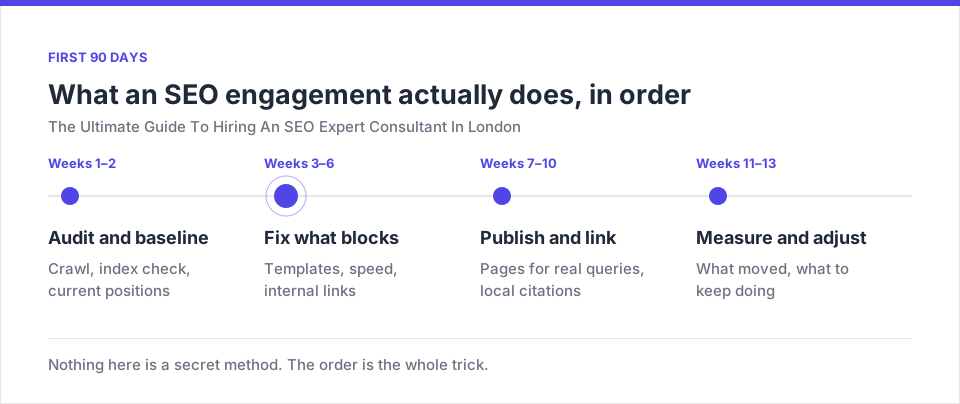
- Weeks 1–2: Discovery and baseline assessment. Establish current visibility, Maps surface interactions, GBP health, and district priorities to inform the roadmap.
- Weeks 3–4: Strategic roadmap and governance setup. Finalise seed terms, AGO Bindings and PSRCs, and align on district content architecture.
- Weeks 5–8: District lighthouse pages and initial GBP alignment. Publish central district hubs, surface local content, and test local signals against Maps and GBP insights.
- Weeks 9–12: Expansion and optimisation. Scale to additional districts, refine content maps, and begin ongoing ROI tracking with dashboards.
Deliverables you should expect
A London-focused engagement delivers a structured set of artefacts that support repeatable growth while preserving seed integrity across boroughs. The core outputs include district content maps, seed term glossaries, AGO Bindings, PSRCs, and governance dashboards that combine GBP, Maps and on‑site analytics.
- District content map and hub structure: a scalable architecture linking borough landing pages, product content and GBP assets.
- Seed term glossary and AGO Bindings plan: stable terminology that travels across surfaces with locale adaptations.
- PSRC blueprint (Per‑Surface Rendering Contracts): documented rules for how metadata and media render on Search, Maps and GBP.
- Governance cadences and dashboards: city-wide and district views that illustrate ROI, Maps interactions and on‑site conversions.
- regulator-ready audit trails: provenance notes and surface rendering evidence to support compliance and future scaling.
Pricing ranges for London SEO work
Pricing in London reflects district coverage, volume of surface activations and the level of governance required. The ranges below are intended as guidance to help compare proposals, not as fixed quotes. They depend on district breadth, data integrations, and the depth of reporting you expect.
- Basic/Starter packages: typically £2,000–£4,000 per month for smaller stores focusing on a couple of districts and essential on‑page optimisations.
- Growth packages: £4,000–£8,000 per month, suitable for mid‑sized London stores expanding across several boroughs with district hubs, GBP alignment and more detailed dashboards.
- Scale packages: £8,000–£15,000 per month for larger campaigns covering many districts, comprehensive technical fixes and full governance frameworks.
- Enterprise or bespoke engagements: £15,000+ per month, where a mature London programme requires advanced PSRCs, DoBel governance, and regulator-ready reporting across multiple surfaces and channels.
Exact pricing depends on district count, surface complexity (Search, Maps, GBP, video captions, voice prompts), and the level of ongoing optimisation and reporting you require. London’s competitive market typically commands premium pricing, but governance and ROI visibility should justify the investment over time.
What to look for in a contract
- Clear scope and milestones: a detailed description of deliverables, district targets and an agreed timetable for reviews.
- Defined governance and reporting cadence: specify how dashboards are updated, who has access, and how insights drive action.
- Data ownership and privacy terms: confirm data control, access rights and compliance with privacy regulations.
- Change control and risk management: a process for revising scope, budgets and timelines as markets evolve in London.
- Termination and renewal terms: exit options, transition support and knowledge transfer procedures.
Next steps: getting started with londonseo.ai
To explore appropriate pricing and engagement structures, contact our team for a discovery call. You can review our Shopify SEO services and book a consultation to tailor an approach that fits your London store’s scale and district ambitions. Foundational references from Google and industry bodies can supplement your evaluation, such as the Google SEO Starter Guide and Moz's Local SEO resources.
Finally, a note on value
In London, a well‑priced engagement that delivers district‑driven growth, Maps visibility and GBP conversions often yields a higher ROI than generic SEO programmes. The goal is not just rank; it is predictable, measurable business growth across the capital’s diverse districts. With londonseo.ai, you gain a partner who combines local expertise with scalable governance to help your store perform where it matters most in London.
Ethics, Compliance And Risk Management For London SEO Campaigns
In London’s fast-moving digital landscape, ethical governance, data protection and risk management are not afterthoughts; they are foundational. A London-based seo expert consultant from londonseo.ai operates within strict regulatory expectations while navigating the city’s diverse markets, districts and cultural nuances. This final part of the guide focuses on the governance framework, the safeguards you should implement, and the practical steps to ensure your SEO programme remains compliant, trustworthy and resilient as you scale across boroughs and surfaces.
Regulatory and data protection considerations
UK and EU data protection principles apply to how you collect, store and analyse customer data for SEO and local marketing efforts. A responsible framework requires minimising data collection, securing consent where appropriate, and ensuring that analytics, GBP interactions and Maps signals are handled in a privacy-conscious way. Prioritise data minimisation, access controls and encryption for sensitive logs. Where third‑party data or automation processes are used, document data flows and ensure you have a lawful basis for processing under applicable laws.
- Privacy-by-design: embed privacy considerations into every surface activation, from seed concepts to landing pages and GBP integrations.
- Consent management: implement clear consent prompts for data collection tied to user journeys in London districts, with easy opt-out options and granular preferences.
- Regulatory alignment: maintain an auditable trail of data handling decisions, consent states and data retention schedules for regulator-ready reporting.
Quality control and governance architecture
A robust governance model coordinates DoBel Translation Provenance, Anchor Glossary Oracle Bindings (AGO Bindings) and Per‑Surface Rendering Contracts (PSRCs) to ensure seed integrity while scaling district coverage. DoBel artefacts capture why translations exist, AGO Bindings lock core terms so semantics stay stable across languages, and PSRCs prescribe how metadata, titles and media render on each surface. This trio provides regulator‑friendly documentation and repeatable audit trails that surgeons of surface deployment can follow with confidence.
- DoBel Translation Provenance: records why locale adjustments were made and who approved them, supporting traceability and accountability.
- AGO Bindings: protect seed concepts and ensure translations carry identical semantic weight across surfaces and languages.
- PSRCs: codify rendering rules for title, description, media and prompts across Search, Maps, GBP, video captions and voice interfaces.
Accessibility, inclusivity and quality standards
London’s audiences are diverse, including residents, commuters and visitors with varying accessibility needs. Your ethical SEO practice must respect WCAG guidance, ensure readable typography, alt text for images, semantic HTML, and navigable page structures. Language variants should not impede accessibility; provide language toggles that are obvious and easy to control. Equally important is guaranteeing that district content remains meaningful for all users, including those using assistive technologies, while preserving seed identity across locales.
- Alt text and media: write descriptive alt attributes that convey context and purpose for images used in district pages.
- Text alternatives for non-text content: supply captions, transcripts and accessible equivalents for videos and rich media.
- Semantic structure: maintain logical heading order (H1, H2, H3) to aid screen readers and search engines in understanding page relevance.
Risk identification and mitigation planning
Identify and address risks that could undermine trust, data integrity or brand reputation. Typical risk families include data leakage, seed drift, content misalignment across districts, and dependencies on third‑party platforms. For each risk, define a mitigation plan, early warning indicators and a quick‑response protocol to prevent or contain issues before they escalate. Maintain a living risk register that informs governance decisions and aligns with regulator‑ready reporting requirements.
- Data risk: ensure authentication, access controls and auditing for analytics and GBP data; implement data masking where necessary.
- Seed drift risk: monitor AGO Bindings and translations drift; schedule regular glossary reviews and rollback options.
- Surface parity risk: enforce PSRC conformance across all surfaces; use gating to prevent publishing without parity validation.
- Regulatory risk: keep abreast of changes to privacy and advertising rules; document regulatory considerations in governance artefacts.
Ethical decision-making and vendor relationships
Ethical practice extends to how you work with vendors, freelancers and content creators. Establish contracts that reflect your DoBel governance, include data protection addenda, and ensure all contributors adhere to your seed identity. Require transparent reporting, timely disclosures of conflicts of interest and a clear process for approving changes that affect seed terms or translation provenance. A trusted London partner will align with your values, maintain data sovereignty and protect user trust throughout the lifecycle of the campaign.
As you select partners, look for documented commitments to white-hat practices, transparent pricing, and a demonstrated history of accountable SEO work in London’s local markets. This collaborative, principled approach enhances long-term growth while mitigating risk exposure across Maps, GBP and on-site surfaces.
Next steps: embedding ethics and compliance with londonseo.ai
To embed these safeguards into your London strategy, initiate conversations about governance templates, DOBel artefacts, and regulator-ready dashboards. Our Shopify SEO services offer a governance-first framework you can adapt, while our contact page enables a discovery discussion to tailor compliance and risk management for your district roadmap. For further guidance, reference Google’s and industry best practices on accessibility and data privacy to complement the London-specific governance we promote at londonseo.ai.
Closing safety net: regulator-friendly, scalable growth
Ethics, compliance and risk management are not barriers to growth; they are enablers of sustainable, scalable growth. By integrating DoBel governance, PSRCs and AGO Bindings into every surface activation, you create a transparent, auditable and resilient framework that supports district‑level expansion without compromising brand integrity. London’s diverse districts reward careful governance that respects user rights, delivers clear value, and remains adaptable to evolving search ecosystems. This is the cornerstone of a trusted, high‑performing SEO programme powered by londonseo.ai.
Internal references and external guidance
For ongoing reference, consult Google’s developer‑level SEO starter guidance and reputable Local SEO literature to align with established practices while you implement the London‑specific governance we describe. Useful resources include Google SEO Starter Guide and Moz Local SEO Guide. These resources complement the DoBel framework and the regulatory‑minded approach championed by londonseo.ai.
