What Is A London SEO Expert?
London’s search landscape is intensely localised, competitive, and characterised by rapid shifts in consumer behaviour and transport patterns. A London SEO expert brings more than technical know‑how; they combine city‑wide credibility with borough‑level proximity, ensuring visibility in Local Pack results while delivering highly relevant experiences to readers across Westminster, Islington, Camden, Kensington and beyond. This Part 1 introduces the core mindset of a true London specialist, explains why a city‑specific approach outperforms generic SEO, and outlines the governance framework that a practising London SEO expert at LondonSEO.ai relies on to sustain momentum as London grows.
Be London: Capital‑Wide Authority
Be London represents the capital‑wide credibility engine. It is not a single-page tactic but a hub‑and‑spoke architecture designed to signal expertise, trust, and breadth. The Be London layer establishes GBP health, city‑level topics, and governance standards that search engines recognise as credible. This is essential groundwork because it creates a stable signal set from which proximity strategies can scale without appearing incoherent. Practically, Be London entails governance artefacts, content maps, and terminology that travels well when localisation begins. Region templates standardise how proximity cues are embedded in pages that sit above the borough layer, enabling rapid, consistent localisation without signal drift.
In practice, Be London is about establishing a reliable backbone: a formal content map, a living glossary aligned to London terminology, and a cadence of approvals that keeps the core narrative intact as new boroughs join the programme. This governance layer is what makes subsequent Ru London depth pages feel like natural extensions rather than separate islands of content.
Ru London: Proximity And Borough Depth
Ru London translates capital‑wide authority into district‑level proximity signals. Each borough deserves dedicated depth pages or a cluster of assets addressing local intent, neighbourhood questions, maps and proximity content blocks. Westminster, Camden, Islington, Kensington, Hackney and surrounding districts should feel addressed by locale‑focused detail while remaining part of a cohesive London narrative. Region templates ensure uniformity of proximity blocks, while Translation Provenance preserves terminology so readers trust the deeper information they encounter in each borough.
Governance artefacts underpin this architecture: a Be London–Ru London content map, a glossary aligned to current London terminology, and a cadence of reviews that guards signal integrity as content expands. The aim is to ensure readers experience a coherent journey from broad capital themes to district‑level specifics without losing sight of the overall London framework.
What A London‑Based SEO Programme Delivers
A London‑focused programme brings operational excellence across technical health, on‑page optimisation, local signals, and governance. It starts with GBP health and capital‑wide authority, then tunnels into borough depth pages that address proximity concerns. A disciplined WordPress framework often proves practical due to its flexible taxonomy and region‑ready plugins, enabling Be London hub content and Ru London depth pages to remain coherent as the capital expands. A well‑governed content map connects hub topics to district proofs, creating a navigable architecture that supports discovery and conversion across the capital.
- Technical SEO foundations tailored to London’s scale and diversity.
- On‑page optimisation that blends Be London authority with Ru London proximity in titles, headers and internal links.
- Structured data to clarify locations, proximity signals, and local intent.
- GBP health management and local signals through accurate NAP data, hours, and proximity content blocks.
- Content strategy and calendars that couple Be London themes with Ru London district proofs.
From Local Signals To Borough‑Focused Content
The journey begins with seeds of capital authority and grows into borough‑level assets. Keyword research should map Be London themes to Ru London depth pages, ensuring readers encounter proximity‑relevant content at every stage. Region templates enable rapid localisation for priority boroughs, while Translation Provenance preserves chairing terminology so readers experience consistent language as the London footprint expands. Governance artefacts underpin the architecture: Be London–Ru London content maps, glossaries, and cadence reviews that guard signal integrity as pages scale. This disciplined approach reduces drift, accelerates localisation, and supports Local Pack dominance by presenting readers with a credible capital framework that recognises their locality.
- City‑wide seed topics reflecting London’s broad intent.
- District modifiers capturing proximity demand in each borough.
- Content clusters linking hub topics to district proofs with clear internal pathways.
- Governance artefacts to sustain consistency as new boroughs join.
The London Series: What You’ll Learn In This Part
This opening section previews a 12‑part journey that reveals how a London‑focused WordPress programme is organised, how local keyword research is conducted, how content is structured for proximity, and how governance and measurement sustain long‑term results. You’ll see practical artefacts, region templates, and workflows that scale as London expands to additional boroughs. For practical help now, review the LondonSEO.ai services on LondonSEO.ai services or initiate a discovery via the contact page to tailor a borough‑focused plan.
Why London-Focused SEO Matters For Local Businesses
London’s search ecosystem rewards proximity as much as authority. A two-tier framework, Be London’s capital-wide credibility and GBP health, combined with Ru London’s borough-focused proximity, creates a powerful engine for local visibility. This part explains why city-wide strategy matters in practice, how proximity signals optimise real-world outcomes, and what local businesses can do today to start winning in Local Pack and map results across Westminster, Islington, Camden, Kensington and beyond.
The London Local Market Is Highly Localised
While London benefits from broad credibility, the real competitive edge comes from aligning content with local intent. Be London hub content establishes capital-wide authority and GBP health, creating a stable backbone that search engines recognise as credible. Ru London depth pages translate that authority into district-specific signals, answering residents’ questions with maps, local knowledge and proximity content blocks. The effect is a seamless journey from general London themes to deeply relevant borough-level detail, without signal drift or disjointed messaging.
Practically, this means starting with city-wide topics that unite multiple boroughs and then branching into locality proofs that address distinct neighbourhoods. When you maintain consistent terminology through Translation Provenance and enforce region templates, new boroughs can join the programme without breaking the narrative. The governance layer keeps Be London and Ru London aligned, so readers experience a coherent journey as your London footprint grows.
City-Wide Authority Drives Local Proximity
City-wide authority acts as the magnet for Local Pack visibility, but proximity wins attention at the street level. The two-tier approach ensures readers encounter credible, city-wide guidance before they encounter location-specific details. For businesses, this translates into more reliable click-throughs from broad London queries to borough-focused pages and maps, and fewer abandoned journeys caused by inconsistent terminology or signal drift. A well-governed Be London – Ru London framework supports scalable localisation because each borough page inherits the same core architecture while adding locality-specific cues.
In practice, plan your content calendar so Be London topics feed Ru London depth pages with consistent internal linking. Use Translation Provenance to keep terminology aligned as you expand to Islington, Hackney, Chelsea, and other districts. This ensures that the proximity signals in depth pages are coherent extensions of capital-wide themes, improving reader trust and search engine comprehension.
Practical Steps For Local Businesses
To translate this framework into tangible results, start with a clear governance plan and region templates that standardise proximity blocks across borough pages. Ensure Translation Provenance is populated with current London terminology, so every new page experiences the same language and signals. Local signals should be anchored by robust GBP health, accurate NAP data, and proximity content blocks such as maps, FAQs and neighbourhood context.
- Map Be London pillar topics to Ru London depth pages to create a coherent navigation path.
- Apply region templates to maintain consistent proximity blocks across boroughs.
- Localise titles and H2s to reflect district intent while preserving the London-wide framework.
- Update Translation Provenance with every publish to guard terminology integrity.
Getting Practical Help Now
For teams starting from scratch, review the LondonSEO.ai services to understand how Be London and Ru London can be deployed in your organisation. To tailor a borough-focused plan, begin by booking a discovery via the contact page or explore the LondonSEO.ai services. A disciplined two-tier approach, reinforced by region templates and Translation Provenance, provides a scalable path to durable Local Pack visibility and credible locality signals across London.
Core Services Offered By A London SEO Consultant
London's two-tier proximity framework requires more than strong content; it requires a scalable, crawl-friendly, fast, and locally intelligible site architecture. Be London hub content establishes GBP health and capital-wide authority, while Ru London depth pages translate that authority into borough-level proximity signals. This part focuses on technical SEO foundations and site architecture patterns that sustain Local Pack leadership as the London footprint grows, without compromising clarity for readers in Westminster, Camden, Islington, Kensington, Hackney and beyond. For North London businesses, the same two-tier approach translates to targeted depth pages for districts such as Islington, Wood Green, Finchley and Harringay, ensuring local intent is captured alongside city-wide signals.
Be London And Ru London: The Two-Tier Blueprint In Practice
The two-tier model begins with Be London hub content that signals city-wide authority and GBP health, then routes readers to Ru London depth pages that deliver borough-specific proximity. This structure supports Local Pack visibility across central zones and outlying boroughs alike, while ensuring readers encounter credible, locally relevant information at every stage of their journey. A practical London programme aligns technical health with local signals, using region templates to standardise proximity cues and Translation Provenance to maintain terminology consistency as London expands. Governance artefacts include a Be London–Ru London content map, region templates for borough pages, and a glossary aligned to current London terminology. These artefacts keep your proximity narrative coherent as you scale from Westminster to outer boroughs.
Ru London: Proximity And Borough Depth
Ru London translates capital-wide authority into district-level proximity signals. Each borough deserves dedicated depth pages or a cluster of assets that address local intent, neighbourhood questions, maps and proximity content. Westminster, Camden, Islington, Kensington, Hackney and beyond should feel addressed by local-language detail while still sitting within a cohesive London narrative. Region templates guarantee uniformity of proximity blocks, while Translation Provenance safeguards anchoring terminology so readers trust the deeper information on each borough page.
Governance artefacts underpin the architecture: a Be London–Ru London content map, a glossary aligned to current London terminology, and a cadence of reviews that guards signal integrity as content expands. This approach reduces drift, accelerates localisation, and supports Local Pack dominance by presenting readers a credible capital framework that recognises their locality.
What A London-Based SEO Programme Delivers
A London-focused programme delivers operational excellence across technical health, on-page optimisation, local signals, and region-wide governance. It begins with GBP health and central authority, then tunnels into borough-level depth pages that address proximity concerns. A disciplined WordPress framework often proves practical due to its flexible taxonomy and region-ready plugins, making Be London hub content and Ru London depth pages coherent as the capital grows. A robust governance structure—region templates, Translation Provenance, and a cadence of reviews—keeps localisation coherent year after year.
- Technical SEO foundations tailored to WordPress, including site structure, caching, and Core Web Vitals.
- On-page optimisation that blends Be London authority with district proximity in titles, headers and internal links.
- Structured data to clarify locations and proximity signals, improving rich results and local discovery.
- GBP health management and local signals through accurate NAP data, hours, and proximity content blocks.
- Content strategy and calendars that couple Be London themes with Ru London district proofs.
Region Templates And Translation Provenance For London Localisation
Region templates standardise layout and proximity cues used on borough pages, enabling rapid localisation without signal drift. Translation Provenance acts as a living glossary that travels with content updates, preserving terminology as London expands. This combination makes it feasible to deploy Be London hub topics alongside increasingly sophisticated Ru London depth pages, ensuring readers encounter familiar structure and location-specific signals across Westminster to potential future expansions.
- Reuse regional blocks where appropriate to accelerate localisation across boroughs.
- Develop district-specific content blocks (maps, FAQs, testimonials) without compromising consistency.
- Update glossaries with new borough terminology before publication.
Borough-Level Optimisation Tactics
Apply localisation in a disciplined sequence. Start with Be London topics that logically map to Ru London depth pages, ensuring every borough has a clear path from hub to neighbourhood details. Use region templates to deliver consistent proximity blocks, such as maps, FAQs and testimonials, which travel with the content as new boroughs join the programme. Translation Provenance ensures terminology remains aligned across surfaces during expansion.
- Map each Be London pillar topic to relevant Ru London depth pages for coherent navigation.
- Deploy region templates to maintain consistent structure and signal placement across boroughs.
- Localise page titles and H2s to reflect district intent while preserving the London-wide framework.
- Incorporate proximity blocks (maps, FAQs, testimonials) on depth pages and connect them to hub topics via internal links.
Local SEO Fundamentals In The London Market
London's search environment rewards proximity as much as authority. A robust local SEO approach combines capital-wide credibility with borough-level proximity signals. This part covers practical fundamentals for UK businesses aiming to appear in Local Pack, map results, and knowledge panels across Westminster, Islington, Camden, and beyond. We'll outline the essential signals, the role of GBP health, NAP hygiene, and how Be London and Ru London work together to deliver cohesive localisation.
The London Local Search Landscape
Be London hub content builds capital-wide authority and GBP health, while Ru London depth pages translate that authority into borough-level proximity signals. London remains highly local, with demand shaped by transport routes, commuters, and neighbourhood realities. A practical London SEO programme standardises a core hub-to-borough journey: Be London hub topics underpin the capital-wide narrative, while Ru London depth pages deliver locality-specific proofs, maps and FAQs. Translation Provenance and region templates are the governance backbone that keeps the two layers aligned as new boroughs are activated.
In practice, this means designing a scalable taxonomy, where Be London covers cross-borough intents (e.g., "restaurants in London", "London business services") and Ru London pages address specific districts (e.g., Islington, Camden, Kensington). The result is a coherent journey for readers and a clearer signal for search engines that glues locality to the capital narrative.
Local Signals That Matter In London
Key signals focus on both accuracy and proximity. GBP health must be kept current for every London location, with complete profiles, accurate hours, and timely posts. NAP consistency across all borough pages prevents map fragmentation and helps search engines unify listings with depth content. Proximity blocks on Ru London pages – such as maps, FAQs and neighbourhood context – anchor readers in their locale while the hub signals stay recognisable across the city.
- NAP consistency across the capital to prevent fragmentation and confusion in local results.
- Complete Google Business Profile listings with regular proximity posts and accurate hours.
- Localized maps, FAQs and testimonials on Ru London depth pages to support proximity.
- Structured data (LocalBusiness) to clarify locations and proximity signals to search engines.
Nap, Citations And Local Listings
Consistent, high-quality local citations across London help support map rankings and proximity data. Build citations in relevant London directories, cross-check with GBP locations, and maintain alignment of business names, addresses and phone numbers across all boroughs. Use structured data to mark LocalBusiness locations and add proximity content blocks on Ru London pages to reinforce the local context.
- Coordinate citations with GBP presence for each borough.
- Maintain consistent NAP data across all listings and pages.
- Leverage London-specific directories and local media outlets for neighbourhood signals.
Be London And Ru London: Localisation Governance
Be London provides capital-wide credibility; Ru London delivers borough-level proximity. Region templates standardise proximity blocks on depth pages, and Translation Provenance preserves current London terminology as the footprint grows. Governance cadences govern publishing and reviews, ensuring signal integrity remains stable across Westminster, Islington, Camden and beyond. This governance framework enables scalable localisation while maintaining a coherent London narrative.
Getting Practical Help Now
To translate these fundamentals into action, review the LondonSEO.ai services to understand how Be London and Ru London can be deployed in your organisation. To tailor a borough-focused plan, begin by booking a discovery via the contact page or explore the LondonSEO.ai services.
Technical SEO And Site Audits In The London Market
London’s two-tier proximity programme demands more than compelling content. It requires robust technical health that scales across Be London (capital-wide authority and GBP health) and Ru London (borough-focused proximity). This part delves into practical technical SEO and site auditing practices that sustain Local Pack leadership as the London footprint grows. By focusing on crawlability, indexing, mobile performance, structured data, and ongoing site health auditing, a London SEO expert can deliver durable proximity signals without sacrificing speed or clarity for readers in Westminster, Islington, Camden, Kensington and beyond.
Technical Health Foundations For A London Programme
At scale, technical SEO must be a living discipline. Start with a crawlable, indexable architecture that supports the Be London hub while enabling Ru London depth pages to inherit clean signals. Core areas include a fast, reliable hosting environment; secure connections (HTTPS); efficient asset delivery; and a streamlined URL structure that mirrors the Be London to Ru London navigation. In practice, this means designing a sitemap and internal linking scheme that reflects the two-tier model, with hub pages feeding district proofs through clearly delineated paths. Translation Provenance and region templates then safeguard terminology and layout as boroughs join the programme.
- Audit the site architecture to ensure Be London hub pages are accessible and indexable, with Ru London depth pages properly crawled via logical links.
- Verify Core Web Vitals across devices common to London commuters, including mid- to low-bandwidth conditions on mobile transit routes.
- Confirm HTTPS everywhere, proper redirects, and consistent canonical tags to prevent duplicate content across hub and depth surfaces.
- Ensure an optimised sitemap that prioritises borough pages with high proximity demand and timely updates.
- Guard against broken links and 404s through regular automated health checks and a rapid remediation workflow.
Crawlability, Indexing And Canonical Governance
Be London and Ru London require a governance model that keeps crawl budget focused on the most valuable pages. Develop canonical patterns that prevent content cannibalisation between hub and depth pages, while still allowing district-level assets to be discoverable. Use robots.txt to prioritise crucial borough pages during initial indexing phases and rely on advanced sitemaps to guide crawlers through the proximity pathway. Ensure that every borough page signals proximity through localised blocks (maps, FAQs, neighbourhood context) without diverging from the overarching London narrative.
Practical care includes keeping a tight leash on duplicate content, avoiding thin pages, and ensuring pagination is properly managed. Regularly review indexing coverage in Google Search Console, watching for crawl anomalies or unexpected blocks that could hinder discovery of Ru London depth assets.
- Audit crawl paths from Be London hub pages to Ru London depth pages, confirming there are no dead ends.
- Monitor indexing status for borough-depth content, adjusting crawl priorities as needed.
- Apply canonical strategies to prevent cross-surface duplication while allowing proximity signals to remain strong.
- Ensure robots.txt allows essential borough assets to be crawled while restricting low-value pages.
Structured Data And Local Signals
Structured data acts as a translator between London’s two-tier structure and search engines. Implement LocalBusiness, Organisation, and LocalBusinessLocation schemas to clarify location data, opening hours, and proximity cues. BreadcrumbList markup reinforces navigational context from the Be London hub to Ru London depth pages. FAQPage blocks on borough pages answer local questions directly in SERPs, reinforcing proximity relevance. All structured data should be aligned with Translation Provenance so terminology remains consistent as new boroughs activate.
- Adopt LocalBusiness and LocalLocation schemas for every active London location, including hours and contact information.
- Implement BreadcrumbList to mirror hub-to-depth navigation and improve contextual breadcrumbs.
- Use FAQPage markup on depth pages to capture common borough questions and maps-related queries.
- Synchronise all structured data changes with Translation Provenance to maintain terminology consistency across surfaces.
Auditing, Monitoring And Continuous Improvement
Audits should run on a regular cadence to catch drift early. Establish a baseline audit of crawlability, indexing, structured data, and page speed, then schedule quarterly health checks that include testing under real-world London conditions (commuting times, mobile network variability). Use a unified dashboard that pulls GA4 for on-site behaviour, Google Search Console for crawl/index signals, and GBP insights for proximity health. Translation Provenance updates should accompany any glossary or taxonomy changes to guard consistency as boroughs expand.
- Baseline audit covering crawlability, index coverage, canonical tags, and page speed across key boroughs.
- Quarterly health checks that test Core Web Vitals, structured data validity, and internal linking integrity.
- Regular GBP health reviews to maintain accurate hours, categories and proximity updates.
- Parit y dashboards comparing Be London hub signals with Ru London depth signals to detect drift early.
Common Pitfalls To Avoid In London
- Allowing hub-to-depth signals to drift due to inconsistent internal linking or terminology changes.
- Underestimating mobile speed and Core Web Vitals in busy London environments, impacting user experience and rankings.
- Neglecting to keep GBP health and NAP hygiene aligned across all borough pages, leading to fragmented map appearances.
- Inaccurate or misaligned structured data that creates conflicting signals for search engines.
- Using generic locality content that fails to address borough-specific questions and local intent.
Getting Practical Help Now
To implement the robust technical framework described here, review the LondonSEO.ai services and book a discovery to tailor a borough-focused plan. A London SEO expert can guide the integration of Be London and Ru London with a disciplined auditing cadence, region templates, and Translation Provenance. Visit the services page at LondonSEO.ai services or contact us at contact to start a technical audit and rollout plan tailored to your borough strategy.
Keyword Research And Content Strategy Tailored To London Audiences
London’s search landscape rewards proximity and authority in equal measure. A two-tier framework that places Be London – capital-wide authority and GBP health – alongside Ru London – borough-focused proximity signals – creates fertile ground for keyword research and content strategy. This part outlines a practical approach to audience research, intent-driven keyword selection, and topical mapping that aligns with the Be London / Ru London architecture. The objective is to identify terms that seamlessly scale from city-wide ambitions to borough-specific realities, while maintaining a coherent London narrative across Westminster, Islington, Camden, Kensington and beyond.
Understanding London’s Search Intent Landscape
London searches are driven by transport patterns, commuter behaviours, and neighbourhood realities. Local intent often follows a two-step journey: first, readers seek capital-wide guidance (Be London topics) to establish credibility, then they drill into district-level specifics (Ru London) for locality proofs, maps, and FAQs. Keywords therefore fall into Be London themes (e.g., “London restaurants”, “London business services”) and borough modifiers (e.g., “Islington restaurants”, “Chelsea hairdressers near me”). Incorporating Translation Provenance ensures terminology stays consistent as you localise across districts. In practice, this means prioritising queries that express intent in natural language and aligning them with London’s two-tier structure to avoid signal drift.
Strategic Keyword Methodology For Be London And Ru London
Develop a disciplined workflow that treats keywords as a structured asset, not a one-off task. Start with city-wide seed topics, then refine through borough-level modifiers, and finally map them to content clusters that feed hub and depth pages. The process should produce a hierarchy where each Be London topic has one or more Ru London depth pages, each enriched with proximity blocks such as maps, FAQs, and neighbourhood context.
City-Wide Seed Topics: Identify Be London topics that cover broad London intent, such as “London restaurants”, “London offices for rent”, and “London digital marketing agencies”. These seeds establish the credibility backbone and GBP health signals that search engines recognise as authoritative.
Borough Modifiers: Layer borough-specific modifiers onto seed topics, for example “Islington restaurants near me”, “Hackney coworking spaces near transit”, or “Chelsea dental clinics open now”. This creates proximity-anchored signals that map neatly to Ru London depth pages.
Content Cluster Mapping: Group related keywords into clusters that link hub topics to district proofs. Each cluster should form a navigable content path from Be London to Ru London surfaces, reinforcing proximity signals through internal linking.
Long-Tail, Question-Based And Local Entities: Prioritise natural-language questions and locally relevant entities (neighbourhoods, landmarks, transit lines) to capture SERP features like FAQPage, Knowledge Panels and Local Pack elements.
Governance Alignment: Tie keyword outcomes to Translation Provenance and region templates to ensure terminology and signal placement remain stable as London expands.
Topical Mapping And Content Clusters For London
Topical maps should reflect the Be London / Ru London dynamic. Hub topics establish capital-wide authority, while borough depth pages address locality proofs with maps, FAQs and neighbourhood context. Content clusters connect hub and depth pages through a clear internal linking architecture, enabling readers to move from general London themes to district-specific insights without signal drift. Translation Provenance ensures consistent terminology as content scales, and region templates provide a repeatable structure for proximity blocks across borough pages.
- Be London Topics As Anchor Themes: Build clusters around broad London intents that can service multiple boroughs (e.g., “London restaurants”, “London events”, “London real estate”).
- Ru London Depth Proofs: For each borough, create depth pages that answer local questions with maps, FAQs, and local data blocks.
- Internal Pathways: Create explicit navigation paths from hub topics to district proofs, supported by region templates for consistent layout.
- Terminology Governance: Use Translation Provenance to maintain consistent London terminology across pages and boroughs.
Content Calendar For Borough Launches
Translate the keyword strategy into a practical, staged rollout. Start with the Be London hub and a core set of Ru London depth pages for priority boroughs, then expand to additional districts while maintaining consistent terminology and proximity blocks. A practical calendar keeps region templates and Translation Provenance aligned with publishing cycles, enabling steady growth without signal drift.
Measurement Signals For Content Strategy
Define success through proximity-driven outcomes rather than raw page counts. Track Local Pack impressions by borough, depth-page engagement, and maps interactions to quantify the reader journey from search results to localised content. GBP health and NAP hygiene remain foundational credibility signals, supplemented by region-template adherence and Translation Provenance consistency. A parity dashboard comparing Be London authority signals with Ru London locality proofs provides a live view of drift and opportunity, enabling timely optimisation as boroughs activate.
- Local Pack impressions and maps interactions broken down by borough.
- Depth-page engagement (time on page, scroll depth, repeats) for proximity blocks.
- GBP health metrics and NAP hygiene across London locations.
- Backlink quality and locality relevance to reinforce proximity signals.
Getting Practical Help And Next Steps
To translate this keyword research and content strategy into action, review the LondonSEO.ai services to understand how Be London and Ru London can be deployed in your organisation. To tailor borough-focused plans, begin by booking a discovery via the London SEO services page or contact us through the contact page. A disciplined two-tier programme ensures your keyword research scales gracefully from capital-wide intent to district-level relevance, backed by Translation Provenance and region templates.
Link Building And Digital PR For London Brands
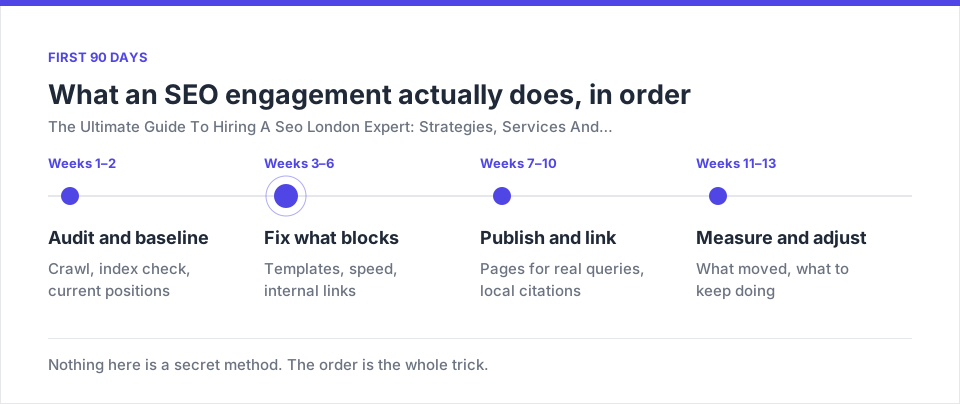
In London’s two-tier proximity programme, high-quality backlinks and thoughtful digital PR are not optional add-ons; they are essential signals that reinforce Be London’s capital-wide authority while energising Ru London’s borough-level proximity. This part outlines ethical outreach practices, how to secure links that are genuinely relevant to London readers, and how to monitor and maintain link quality over time. It also explains how to align link-building activities with the governance, region templates, and Translation Provenance framework that underpin LondonSEO.ai’s approach.
Foundations: Be London And Ru London In Link Strategy
Backlinks must support the two-tier structure. Be London anchors the capital-wide authority and GBP health, while Ru London deepens the signal with district-level relevance. A coherent link strategy starts with identifying authoritative London-facing domains that naturally intersect with borough interests, such as local business journals, industry associations, chambers of commerce, and credible regional outlets. Links should help readers trust the Be London hub as a credible source and then navigate to Ru London depth pages that address specific neighbourhood questions, maps, and practical details.
To stay aligned with governance, every outreach plan should map back to the Be London dusting of capital-wide authority and the Ru London depth pages it supports. Region templates guide where link-worthy assets live, and Translation Provenance ensures terminology and anchor text remain consistent as London expands into new boroughs.
Ethical Outreach And Link Quality
London-focused link-building thrives on ethical outreach that prioritises relevance, user value, and long-term trust. Focus on outcomes such as referrals from reputable local publications, business directories with strong editorial standards, and community-focused media that serves readers across Westminster, Islington, Camden, and beyond. Avoid manipulative tactics, spammy directories, or purchased links that breach Google's guidelines. A disciplined approach combines outreach templates with personalised pitches that demonstrate value to both the publisher and readers.
Anchor text should be natural and reflective of reader intent. Prefer branded anchors, exact-match where appropriate but not excessive, and ensure the surrounding content provides real context for the link. Translation Provenance plays a key role here; maintain consistent terminology across boroughs so readers and search engines interpret the link in the same way no matter where it appears.
Link Targets That Suit London
Prioritise links that offer tangible proximity value. Examples include:
- Local business journals and industry publications with London-wide and borough-specific sections.
- Chambers of commerce and regional business networks with credible editorial standards.
- Neighbourhood-focused blogs and community portals that address London readers’ questions.
- University, cultural, or event sites tied to London’s geographic and transit realities.
- Local PR coverage tied to events, launches or community initiatives that align with Ru London depth pages.
Links earned through these channels tend to deliver more durable referral traffic and stronger proximity signals for Local Pack and depth pages across London.
Maintaining Quality And Avoiding Toxicity
A robust link-building programme includes ongoing toxicity checks. Routinely audit the backlink profile for relevancy, authority, and potential spam signals. Disavow or remove links from low-quality sources, non-relevant domains, or links that could jeopardise GBP health or Local Pack credibility. Use sensitivity tests to understand how new boroughs influence link opportunities and ensure that added links reinforce the Be London to Ru London narrative rather than creating signal drift.
Maintain a policy of transparency with publishers and avoid practices that could be interpreted as manipulation. The Translation Provenance framework helps ensure that anchor text and surface language remain coherent when boroughs join the programme, reducing the risk of misinterpretation by search engines.
Monitoring, Reporting And Measurement
Link-building impact should be tracked with a focus on proximity outcomes. Monitor metrics such as the number of high-quality local backlinks earned, topical relevance of linking domains, anchor text diversity, and the correlation with Local Pack impressions and depth-page engagement. Use parity dashboards to compare Be London authority signals with Ru London proximity signals, enabling early detection of drift and opportunities to re-balance outreach. Regular reporting should align with governance cadences and translate link activity into concrete business results, including referral traffic, brand visibility, and improved map rankings.
Tools and sources to inform measurement include Google Analytics 4 (GA4) for on-site behaviour, Google Search Console for indexing and link signals, and GBP insights to observe how local listings benefit from improved authority and proximity signals. External resources such as Google Local SEO guidelines and Moz Local can complement internal measurements when interpreted through the London two-tier framework.
Practical Next Steps
To begin elevating your London link-building programme, explore the LondonSEO.ai services and book a discovery to tailor a borough-focused plan. A disciplined Be London and Ru London approach—guided by region templates and Translation Provenance—delivers scalable proximity signals while maintaining the integrity of your link profile. Use the London SEO services page to review structured engagement options and talk to us about a borough-focused outreach plan. If you’re ready to discuss your specific needs now, reach out via the contact page.
Local Citations And Google Business Profile Optimisation
Local citations and Google Business Profile (GBP) optimisation are foundational to the two-tier London proximity framework. Be London establishes capital-wide authority and GBP health, while Ru London translates that credibility into borough-focused proximity. This part outlines practical, scalable steps to build consistent local signals across London’s many boroughs, from Westminster to Hackney, ensuring that every GBP listing and directory mention reinforces the Be London backbone and feeds Ru London depth pages with trustworthy proximity cues.
Be London And Ru London: The Local Signals Interface
GBP health and local citations act as the two-tier system’s confirmation signals. When GBP profiles are complete, up-to-date, and accurately categorised, they reinforce Be London’s capital-wide credibility. Simultaneously, well-structured Ru London depth pages reflect proximity by aligning borough data blocks, local FAQs, and maps with GBP signals. The governance layer, including Translation Provenance and region templates, ensures that changes in one borough do not ripple out as inconsistency in another, preserving a coherent London-wide narrative as the footprint grows.
In practice, this means mapping GBP categories to Be London topics and linking borough pages to GBP locations through a standardised content map. A disciplined cadence of GBP updates, proximity posts and verified NAP data supports a stable signal set across London’s transit-driven search landscape.
NAP Hygiene And Local Listings Across London
NAP consistency is non-negotiable for map and local results. Create a central NAP policy covering all London locations and enforce it across GBP profiles, borough pages, and third-party directories. Regular audits detect duplications, inconsistent addresses, or mismatched phone numbers that can fragment Local Pack rankings. Align business hours and service areas across all surfaces so readers and search engines see a single, authoritative footprint for each borough.
As you expand, use region templates to keep NAP data aligned while enabling efficient localisation. Translation Provenance should capture any terminology nuances between central and local surfaces, so a reader in Islington encounters terminology that feels local without breaking the London-wide framework.
Optimising Google Business Profile For London Boroughs
A complete GBP profile is the foundation for Local Pack visibility. Ensure every London location has accurate address data, primary category, secondary categories where appropriate, and correct hours. Regular proximity posts should reflect local events, promotions, or changes in transport patterns that impact readers’ ability to reach the business. Upload high-quality photos, add a virtual tour if possible, and encourage recent, locality-specific reviews from customers in each borough. Use Translation Provenance to maintain consistent, authentic language in responses across boroughs, so readers experience a uniform tone regardless of where they engage with the business.
Link GBP with your site through structured data. The LocalBusiness schema should mirror the GBP details, including address, hours and geolocation, to improve the likelihood of appearing in Local Pack knowledge panels and map results that readers encounter when searching within London.
Structured Citations: Building A London-Wide Yet Localised Lattice
Local citations complement GBP by anchoring your business in credible, contextually relevant directories and community resources. Prioritise London-facing outlets with editorial standards and borough-specific visibility. Maintain a master citation ledger by borough, and regularly verify that NAP data remains aligned with GBP and on-site location pages. Use Translation Provenance to ensure terminology in citation mentions mirrors the language used on Be London and Ru London assets, so readers see a consistent London narrative across directories.
Seek citations from reputable London directories, local business journals, chambers of commerce, and community portals that align with readers’ boroughs. Avoid low-quality or spammy directories which can dilute signal and risk GBP health. A well-managed citation strategy strengthens proximity signals and supports robust Local Pack performance across Westminster, Islington, Camden, Kensington and beyond.
Measurement, Reporting And Continuous Improvement
Track GBP health indicators alongside Local Pack impressions by borough. Monitor NAP consistency and the velocity of new citations that support proximity. Use parity dashboards to compare Be London authority signals with Ru London proximity signals, enabling rapid detection of drift and timely optimisation. Include external benchmarks from Google Local SEO guidelines and Moz Local to contextualise London practices within broader industry standards, then apply these insights within the two-tier architecture to maintain a coherent city-wide narrative while expanding borough reach.
- Local Pack impressions by borough and maps interactions to reveal proximity opportunities.
- GBP health metrics including profile completeness, reviews, hours accuracy and proximity updates.
- NAP consistency across GBP, directories and borough pages to prevent fragmentation.
- Citations velocity and domain relevance to reinforce locality signals.
Getting Practical Help Now
To implement these local citation and GBP strategies at scale, explore the LondonSEO.ai services and book a discovery via the London SEO services page. If you’re ready to tailor a borough-focused plan and ensure GBP and citation discipline across London, contact us via the contact page. A structured approach to GBP optimisation and local citations supports durable Local Pack visibility and credible locality signals across Westminster, Islington, Camden, Kensington and beyond.
Reviews, Reputation Management And Social Proof
In London’s two-tier proximity framework, reviews and social proof are not optional add-ons; they are credibility signals that boost Local Pack visibility, inform reader trust, and influence conversion paths. LondonSEO.ai emphasises how Be London’s capital-wide authority pairs with Ru London’s borough-focused proximity, and reviews sit at the intersection where trust accelerates local engagement. This part explains how to generate, manage, and leverage reviews and social proof to reinforce proximity signals across Westminster, Islington, Camden, Kensington and beyond.
The Local Trust Engine: Why Reviews Drive Local Pack Performance
Reviews contribute to GBP health by signalling user satisfaction, consistency, and real-world value. When Be London topics anchor city-wide authority, authentic reviews validate both the Be London backbone and the proximity stories on Ru London depth pages. Positive sentiment improves click-through rates from Local Pack results, while diverse, high-quality reviews reinforce proximity cues on borough pages with local context, maps, and FAQs. In practice, a disciplined reviews programme acts as a scalable trust engine that travels from the capital-wide hub to district-level proofs without diluting the London narrative.
Strategies For Managing Reviews Across Boroughs
Develop a centralised, transparent approach to collecting and aggregating reviews from customers across London’s many locations. Tie GBP health to the volume and recency of reviews, ensuring that Westminster, Islington, Camden, and other boroughs display timely feedback that mirrors real local experiences. Avoid duplicative or incentivised reviews, and establish a policy to verify reviewer authenticity. A unified review process supports the two-tier framework by feeding credible social proof into both hub and depth pages and reinforcing local relevance.
- Map borough locations to review collection points and integrate with Google Business Profile updates.
- Encourage recent, locality-specific feedback after service interactions to enhance proximity signals.
- Monitor sentiment per borough and prioritise responsive actions where scores dip.
- Maintain a single source of truth for review data to prevent signal drift across Be London and Ru London surfaces.
Responding To Reviews: Tone, Speed And Substance
Responses should be timely, courteous and constructive. Acknowledge the customer’s experience, apologise where appropriate, and outline concrete steps you will take to address the issue. Maintain a consistent tone aligned with London terminology and Be London’s credibility, so readers across Islington or Camden receive the same respectful treatment as readers in Westminster. For negative reviews, offer a private follow-up channel and a clear resolution path; for positive reviews, express gratitude and surface a ready-made proximity cue, such as linking to a nearby borough page or map.
- Respond within 24–48 hours where possible to demonstrate attentiveness.
- Personalise replies with location context (borough and service) without exposing private details.
- Escalate unresolved issues to operations for rapid remediation, then close the loop publicly when appropriate.
- Document common themes and update knowledge blocks on Ru London pages where relevant.
Social Proof Beyond Reviews: Testimonials, Case Studies And UGC
Reviews are powerful, but additional social proof strengthens proximity signals. Feature local testimonials, short video clips, and written case studies on Ru London depth pages to illustrate district-level impact. Curate user-generated content from borough audiences, such as neighbourhood stories or transit-friendly customer experiences, and weave these insights into Be London hub topics where appropriate. This approach broadens the signal set and makes proximity tangible for readers in Islington, Camden, or Chelsea alike.
Schema, Rich Results And Content Optimisation For Reviews
Structured data helps search engines interpret reviews and social proof more effectively. Implement Review and AggregateRating markup for relevant pages, and consider embedding LocalBusiness and Place schemas alongside breadcrumb navigation. On Ru London depth pages, annotate reviews by borough where possible to signal locality relevance. Central governance via Translation Provenance ensures terminology remains consistent as you expand to new districts.
- Annotate borough pages with Review and AggregateRating structured data where applicable.
- Use LocalBusiness schemas to align GBP data with on-site proximity cues.
- Mirror terminology across Be London and Ru London surfaces to avoid signal drift.
Governance, Measurement And Continuous Improvement
Track review activity, sentiment, and response quality as part of a broader proximity dashboard. Break out metrics by borough to identify where social proof is strongest and where it needs amplification. A parity view that contrasts Be London authority signals with Ru London locality proofs helps spot drift between the capital-wide hub and district-level content. Tie review performance to GBP health and Local Pack impressions, showing how reputation management translates into real-world proximity gains.
- Review volume, sentiment and response times by borough.
- Local Pack impressions and maps interactions correlated with review signals.
- GBP health indicators and NAP hygiene alignment across locations.
- Content updates inspired by review themes to close gaps in proximity blocks.
Getting Practical Help Now
To implement a robust reviews and social proof programme, review the LondonSEO.ai services and book a discovery to tailor a borough-focused plan. A disciplined Be London and Ru London approach—supported by region templates and Translation Provenance—delivers scalable proximity signals while maintaining credible locality narratives. Explore the London SEO services page at LondonSEO.ai services or start a conversation via the contact page to align on review generation, reputation management and social proof strategy for your boroughs.
Measuring Success: Metrics, KPIs And ROI
London's two-tier proximity framework relies on measurable outcomes that translate activity into business value. Be London establishes capital-wide authority and GBP health, while Ru London translates that credibility into borough-focused proximity signals. This part presents a practical framework for tracking, reporting, and forecasting return on investment (ROI) so teams can optimise budgets and scale proximity without compromising signal integrity as the London footprint expands. Translation Provenance remains central to keep terminology aligned as London grows across Westminster, Islington, Camden, Kensington and beyond.
Key Metrics For Proximity And Local Pack
To demonstrate proximity-driven outcomes, track metrics that reveal both visibility in search results and real-world reader intent. A disciplined approach combines Be London authority signals with Ru London proximity signals, creating a cohesive picture of performance across the capital and its boroughs.
- Local Pack impressions and visibility broken down by borough, highlighting proximity opportunities.
- Maps interactions and route requests from Local Pack clicks to depth pages, indicating actionable local intent.
- Depth-page engagement metrics (time on page, scroll depth, repeat visits) that reflect locality relevance on Ru London pages.
- GBP health and NAP hygiene across London locations, ensuring consistent listings and proximity signals.
- Backlink velocity and locality relevance to reinforce proximity signals for borough-focused assets.
Data Sources And Tooling
Maintain a robust analytics stack that supports two-tier proximity governance. Use GA4 for on-site behaviour and conversion journeys, Google Search Console for crawl and index signals, and GBP Insights for local listings health. Couple these with Looker Studio or similar dashboards to present a unified view for stakeholders. Translation Provenance and region templates ensure terminology consistency as boroughs activate.
- GA4: events, conversions, and cross-surface user journeys.
- Google Search Console: indexing status, crawl errors, and ranking trajectories by borough.
- GBP Insights: profile completeness, reviews, hours accuracy, and proximity updates.
- Looker Studio (or equivalent): centralised dashboards that juxtapose Be London authority with Ru London proximity.
- External references for benchmarking: Google Local SEO guidelines and Moz Local as context, interpreted through the Be London / Ru London framework.
ROI Modelling And Budget Allocation
Translate proximity activity into tangible business value with a clear ROI model. A straightforward formula is ROI = (Incremental Local Pack conversions × Average value per conversion) – Programme Costs. Use a conservative scenario to plan budgets and expectations. For example, if a borough delivers 60 Local Pack conversions in a quarter and the average value per conversion is £150, that yields £9,000 of incremental value. If the programme costs £6,000 for that period, the ROI would be £3,000. This approach scales with boroughs and over time, as proximity content blocks, GBP health, and district-depth pages mature.
- Define Incremental Local Pack conversions by borough based on historical lift from Local Pack visibility.
- Estimate Average value per conversion using typical product or service margins and lead quality.
- Sum programme costs, including content production, governance overhead, tooling, and backlink activity.
- Apply parity dashboards to compare Be London authority signals with Ru London locality proofs for drift detection.
Measurement Cadence And Reporting
Establish a transparent rhythm that aligns with decision-making across teams. Monthly dashboards should report Local Pack impressions by borough, maps interactions, depth-page engagement, and GBP health indicators. Quarterly reviews should assess drift between Be London and Ru London signals and drive budget realignment toward high-potential boroughs. Translation Provenance updates should accompany glossary changes to maintain terminology coherence as London expands.
- Monthly: surface-level metrics by borough and surface-to-surface journey analytics.
- Quarterly: strategic reviews for ROI realignment and expansion opportunities.
- Dashboards should highlight drift between Be London and Ru London and trigger governance interventions.
Getting Practical Help And Next Steps
To implement the ROI and measurement framework, review theLondonSEO.ai services and book a discovery to tailor a borough-focused plan. A disciplined two-tier approach, reinforced by region templates and Translation Provenance, provides a scalable path to durable Local Pack visibility and credible locality signals across London. For practical guidance, explore the London SEO services page or contact us to discuss your borough priorities.
Internal links: LondonSEO.ai services | contact.
Working With A London SEO Expert: Process, Reporting And Communication
Partnering with a London SEO expert means building a structured, auditable path from initial discovery to ongoing optimisation, all within the city’s two-tier proximity framework. The Be London hub establishes capital-wide authority and GBP health, while Ru London depth pages translate that credibility into borough-level proximity. This part outlines the onboarding process, baseline audits, governance cadence, and how transparent reporting and collaboration foster sustained Local Pack leadership across Westminster, Islington, Camden, Kensington and beyond. The goal is a pragmatic, scalable approach that keeps terminology consistent through Translation Provenance and region templates as London expands.
Baseline Audit And Discovery
A rigorous baseline audit anchors every London-based optimisation programme. Start by validating GBP health across all London locations, ensuring profiles are complete, categories are correct, and proximity posts are current. Assess NAP hygiene to prevent fragmentation between central Be London pages and borough-level Ru London assets. Catalogue existing Be London hub topics and map them to the corresponding Ru London depth pages to confirm there is a coherent, navigable path from city-wide intent to neighbourhood-specific conclusions.
For North London businesses, establish a borough-by-borough snapshot: which pages exist, how well proximity blocks (maps, FAQs, neighbourhood context) are implemented, and where gaps limit Local Pack visibility. The baseline should capture Local Pack impressions by borough, current index coverage, and the density of internal links connecting hub topics to depth pages. This first pass informs prioritisation, content mapping, and governance cadences that will scale as more boroughs join the programme.
- Verify GBP health status across all London locations, including updates, categories and proximity posts.
- Audit NAP consistency and align listings with on-site borough pages to prevent fragmentation.
- Catalogue Be London hub topics and identify the Ru London depth pages that support locality proofs.
- Assess Local Pack impressions by borough to identify priority areas with the strongest proximity opportunity.
- Document current content architecture and note where region templates and Translation Provenance are already in use.
Defining The Scope: Goals, KPIs And Roadmap
With baseline insights in hand, codify the programme’s objectives in concrete terms. Establish KPIs that reflect proximity outcomes as well as capital-wide credibility, such as Local Pack impressions by borough, maps interactions, and depth-page engagement. Align these metrics with business goals—new inquiries, bookings, or sales—so the SEO activity can be directly tied to revenue. Create a milestone-based roadmap that accommodates London’s pace of expansion, ensuring Translation Provenance and region templates are updated at each borough activation.
A practical governance plan should define publishing cadences, sign-off responsibilities, and escalation paths for issues affecting GBP health or Local Pack visibility. The aim is to ensure every team member understands how Be London and Ru London signals interact, and how content, data, and stakeholder communications stay aligned as new boroughs are added.
- Set borough-specific targets for Local Pack visibility and map engagement.
- Define a budgeting plan that ties content production, governance overhead, and link-building activities to expected proximity gains.
- Specify a publishing cadence that keeps Translation Provenance current and terminology consistent.
- Agree on reporting formats and cadence to ensure clear, actionable pauses and pivots for the team.
Governance And Cadence: How We Work With LondonSEO.ai
The two-tier Be London – Ru London architecture requires disciplined governance. Region templates standardise proximity blocks on borough pages, while Translation Provenance preserves current London terminology across surfaces. A clear publishing cadence, with quarterly reviews and monthly touchpoints, keeps signal integrity intact as the footprint grows. The governance artefacts—Be London to Ru London content maps, glossaries aligned to London terminology, and a cadence of approvals—make it possible to scale localisation without creating disjointed experiences for readers across different boroughs.
In practice, the collaboration unfolds as follows: a discovery session to align business goals, a baseline audit as described earlier, a formalised content map linking Be London topics to Ru London proofs, and ongoing reviews to guard for drift between hub and depth pages. Translation Provenance ensures terminology remains consistent, while region templates guarantee uniform layout and signal placement across every borough page.
Monthly Reporting And Collaboration Cadence
Monthly reports should combine qualitative insights with quantitative metrics. Expect a dashboard view that shows Local Pack impressions by borough, maps interactions, depth-page engagement, and GBP health indicators. A narrative section explains drift or opportunities, supported by data visualisations that illustrate how Be London authority signals interact with Ru London proximity signals. Quarterly reviews, with stakeholders from content, technical, and local market teams, should recalibrate priorities based on performance and business needs. Translation Provenance updates should accompany any glossary changes to sustain terminology consistency across the London footprint.
Effective collaboration hinges on transparent communication channels, a shared toolset, and clear ownership. Establish a single source of truth for borough data, maintain an updated content map, and ensure internal links reflect the Be London to Ru London journey. Use the LondonSEO.ai services page for guidance on governance frameworks and collaboration models, and contact us to initiate a bespoke discovery that aligns with your organisation’s reporting needs.
- Monthly dashboards detailing proximity metrics and GBP health per borough.
- Weekly updates on critical issues affecting Local Pack and index coverage.
- Quarterly governance reviews to refine region templates and Translation Provenance usage.
- Strategic planning sessions to align content roadmaps with business objectives.
Common Pitfalls To Avoid In London Onboarding
- Allowing drift between Be London and Ru London signals due to inconsistent terminology or broken internal linking.
- Underestimating the importance of GBP health and NAP hygiene during the onboarding phase.
- Neglecting Translation Provenance updates when boroughs join, leading to terminology misalignment.
- Overloading borough pages with generic content that fails to address neighbourhood-specific questions.
Getting Practical Help Now
To implement a robust onboarding, baseline audit, and reporting framework, explore the LondonSEO.ai services and book a discovery to tailor a borough-focused plan. A dedicated London SEO expert can guide the integration of Be London and Ru London with disciplined governance, region templates, and Translation Provenance. Visit the London SEO services page to review available engagement models or contact us to start a customised discovery for your organisation.
Choosing The Right London SEO Expert: Questions To Ask And Red Flags
Selecting a London SEO expert is a decision about governance, proximity strategy, and measurable outcomes. A true London specialist operates within the Be London and Ru London two‑tier framework, ensuring capital-wide credibility while delivering borough‑level proximity. This final part of the series provides a practical hiring toolkit: the right interview questions, warning signs, what a high‑quality agency delivers, and how LondonSEO.ai can help you move from selection to scalable Local Pack leadership with confidence.
What To Look For When Hiring A London SEO Expert
A capable candidate should demonstrate a deep understanding of London’s two‑tier proximity model, plus the governance and operational discipline needed to scale across multiple boroughs. Look for evidence of a clearly defined Be London hub and Ru London depth approach, with region templates and Translation Provenance as living artefacts that travel with content.
- Clear alignment with the Be London and Ru London framework, including demonstrable governance cadences and a content map that links capital-wide themes to district proofs.
- A proven track record of delivering Local Pack visibility across multiple boroughs, not just a single district.
- Strong technical foundations paired with an ability to scale within WordPress or a comparable CMS, ensuring hub and depth pages stay coherent as the footprint grows.
- Robust measurement capability, including parity dashboards that compare Be London authority signals with Ru London locality proofs and quantify proximity outcomes.
- Structured collaboration practices, clearly defined SLAs, and transparent reporting cadences that keep stakeholders informed and engaged.
- Content strategy experience that translates UK/local terminology into borough-specific proofs while preserving a consistent London narrative.
- Experience with GBP health management, accurate NAP data, proximity content blocks (maps, FAQs, neighbourhood context), and local data integrity.
- Commitment to ethical outreach, high‑quality links, and governance‑driven outsourcing that avoids signal drift.
Key Interview Questions To Assess Fit
Use concise, real‑world questions designed to reveal practical competence in the two‑tier framework, governance, and locality execution. Aim for answers that describe outcomes, not just theory.
- Can you describe a London‑based two‑tier SEO programme you have managed, including Be London hub topics and Ru London depth pages? What measurable outcomes did you achieve?
- How do you ensure Translation Provenance and glossary consistency across boroughs during localisation?
- Give an example of a site architecture change you implemented to support proximity signals across multiple boroughs. What were the results?
- How do you prioritise borough activations when ROI signals differ between districts? Describe a decision process you used.
- Explain how you would deploy region templates and GBP signals to preserve signal integrity as new boroughs join the programme.
- What tools do you rely on for parity dashboards and KPI tracking in a London programme, and why?
- How do you integrate GBP health management with on‑site proximity blocks on Ru London depth pages?
- Describe how you would monitor and prevent governance drift between Be London and Ru London as the London footprint expands.
- Share a case where you improved Local Pack performance through ethical link building and Digital PR within a city framework.
Red Flags To Watch For
- Vague responses that lack concrete examples or measurable outcomes in London contexts.
- No evidence of a two‑tier approach (Be London and Ru London) or a governance framework with region templates and Translation Provenance.
- Inability to articulate how GBP health, NAP hygiene and Local Pack signals are managed at scale across multiple boroughs.
- Reliance on generic localisation without borough‑level depth or proximity blocks, maps or FAQs to support local intent.
- Promises of page‑one rankings without a credible, testable plan or clear attribution model.
What A Quality London Agency Will Deliver
A top London SEO partner should provide a packaged, scalable delivery that mirrors the Be London to Ru London architecture. Look for these deliverables as evidence of maturity and stability:
- A formal Be London and Ru London governance charter with defined cadences and escalation paths.
- Region templates and a living Translation Provenance glossary that travels with every publish across boroughs.
- Be London hub content that establishes capital-wide authority and GBP health, plus Ru London depth pages delivering proximity cues (maps, FAQs, neighbourhood context).
- Parity dashboards and monthly reporting that reveal drift and opportunities across the two layers.
- Ongoing technical SEO health, Core Web Vitals, structured data, and an auditable content map linking hub topics to district proofs.
Next Steps And How LondonSEO.ai Can Help
Ready to evaluate candidates or engage an agency with a proven London framework? Start by exploring LondonSEO.ai services to understand how Be London and Ru London can be deployed in your organisation. For a tailored borough‑focused plan, book a discovery via the London SEO services page or contact us through the contact page. A disciplined two‑tier approach, reinforced by region templates and Translation Provenance, provides a scalable path to durable Local Pack visibility and credible locality signals across London.
If you’d like a quick starting point, request a complimentary audit of GBP health and Local Pack potential for your priority boroughs and we’ll outline a practical rollout plan aligned with Be London and Ru London governance. Tooling and dashboards can be prepared to track Local Pack impressions, maps interactions and proximity‑driven engagement from day one.
