The Global Opportunity For London Brands: International SEO
London stands as a premier gateway to global markets. For brands based in the capital, international search optimisation is not merely a channel tactic; it is a strategic framework that unlocks cross-border revenue, diversifies risk, and accelerates growth in a world where consumer journeys span languages, cultures, and devices. This first part of our 12-part series introduces the core concepts of international SEO and outlines why a London-based agency specialising in global visibility can be a critical partner for ambitious businesses. You will learn how to align language, geography, and technology to create scalable visibility that transcends borders, while maintaining brand integrity across markets. The guidance here draws on established industry best practice and is naturally aligned with the expertise you can expect from londonseo.ai.
Why now? The cross-border digital commerce imperative has never been stronger. Consumers in new markets expect content that speaks their language, reflects their culture, and loads quickly on their devices. Technical finesse—such as correct language and regional targeting, fast performance, and robust crawlability—must be paired with culturally resonant content. An international SEO programme in London can blend local-market sensitivity with a scalable, central governance model, ensuring consistency while permitting rapid adaptation to regional nuances. To capitalise on this opportunity, brands need a roadmap that covers market selection, site architecture, content localisation, and measurement across multiple territories.
At the heart of a successful international approach lies three pillars: (1) a technically sound foundation that supports multi-regional indexing and fast experience for users worldwide; (2) culturally attuned content that respects language and localisation needs; and (3) a governance framework that makes decisions auditable, reproducible, and easy to scale as new markets are added. This triad enables a London-based agency to deliver not just visibility, but measurable business outcomes such as higher engagement, increased qualified traffic, and stronger cross-border conversions.
Core concepts you should know
- International SEO defined: Optimising a website to appear in search results across multiple countries and languages, combining technical SEO, localisation, and local market relevance.
- Geo-targeting and language targeting: Implementing strategies such as hreflang, country-specific pages, and appropriate URL structures (ccTLDs, subdirectories, or subdomains) to signal intent to search engines and users alike.
- Content localisation vs translation: Transcreation and culturally aligned content typically outperform literal translation in terms of consumer resonance and conversions.
- Site architecture for scale: A thoughtful model that accommodates new markets without creating content debt, enabling efficient content governance and consistent user experience.
- Measurement and ROI: Cross-border attribution models, KPIs by market, and clear reporting to demonstrate value and guide ongoing optimisation.
The practical framework for London brands combines robust technical foundations with market-aware content strategies and a governance layer that keeps decisions transparent and auditable. For brands ready to scale globally, London-based experts bring a nuanced understanding of both local market dynamics and the global search ecosystem. See how londonseo.ai can tailor a global expansion plan by visiting our International SEO services page or reaching out through Contact.
This Part 1 lays the groundwork. In Part 2, we’ll dive into the London-specific context: how local expertise intersects with global strategy, how UK regulatory and privacy considerations shape international campaigns, and how to map markets to a practical phased roadmap. The aim is to help London brands design an international SEO blueprint that is both ambitious and implementable, with governance practices that enable steady, auditable progress across markets.
Practical steps to get started
identify the initial set of countries and languages that align with your product or service lines, plus a plan to expand once foundations are solid. assess crawling, indexing, site speed, mobile performance, and the structure of international pages to support scalable growth. distinguish translation from localisation, and plan for culturally appropriate content, currency handling, and local promotions. establish a framework for decision-tracking, provenance, and cross-market dashboards that demonstrate ROI and guide iteration.
For guidance tailored to your business in London, explore the Services section and consider booking a consultation via Contact. London-based international SEO is not merely about ranking in more places; it’s about ranking with relevance, across markets, and with a level of auditable control that lets leadership see the value of each decision.
As a foundation, we highlight credible sources for best practices. Google’s Search Central guidance on international SEO and hreflang is essential reading for every cross-border programme. Equally valuable are industry benchmarks from Moz and HubSpot, which provide practical frameworks for localisation, content strategy, and measurement. For further insights, you can consult these reputable sources to align your internal processes with established standards.
In the coming parts, we’ll build on these concepts with a concrete London-focused roadmap: audience research, keyword strategy across locales, content localisation workflows, and governance playbooks. The objective is to equip you with a repeatable framework that your internal teams and external partners can adopt and scale, delivering consistent, credible, and measurable growth across markets.
To learn more about how a dedicated international SEO partner can help you navigate complex markets from London, visit Services or book a consultation via Contact. This series from londonseo.ai will continue with practical frameworks, market-entry strategies, content localisation playbooks, and actionable metrics to drive cross-border success.
What Is International SEO? Core Concepts And Scope
International SEO is the discipline of optimising a website to perform in search results across multiple countries and languages. It blends rigorous technical foundations with culturally resonant localisation and market-specific relevance, ensuring brands can be found by diverse audiences while maintaining a consistent brand experience. For London-based organisations, this means translating global ambitions into a scalable framework that respects local privacy, market nuances, and regulatory requirements. The team at londonseo.ai champions a holistic approach: aligning language, geography, and technology to support sustainable, cross-border growth.
Five core concepts define International SEO and form the backbone of any programme that aims to scale beyond national boundaries:
- International SEO defined: Optimising for search across multiple countries and languages by integrating technical SEO, localisation, and country-specific market relevance.
- Geo-targeting and language targeting: Signalling intent through hreflang, country-optimised pages, and suitable URL structures (ccTLDs, subdirectories, or subdomains).
- Content localisation vs translation: Localisation, including cultural adaptation and transcreation, generally outperforms literal translation in driving engagement and conversions.
- Site architecture for scale: A scalable model that supports new markets without creating content debt, enabling efficient governance and a consistent user experience.
- Measurement and ROI: Cross-border attribution, market-specific KPIs, and auditable reporting to demonstrate value and guide ongoing optimisation.
The London practice integrates these pillars into a governance framework that supports auditable decision-making, robust data handling, and transparent progress tracking. By combining local-market intelligence with global signals, international programmes in London can achieve meaningful increases in qualified traffic, engagement, and cross-border conversions. For further reference, explore our International SEO services page or reach out via Contact.
Geo- and language-targeting decisions sit at the heart of how search engines understand where your content should appear. A well-planned international strategy considers the most suitable domain structure for each market, the correct application of hreflang annotations, and the sequencing of international sitemaps to ensure efficient crawling and indexing across regions. These signals are not merely technical; they shape user expectations by delivering content that aligns with local language, time, and cultural context.
Distinguishing localisation from translation is essential. Localisation may involve adapting currency, units of measure, date formats, idiomatic expressions, and sector-specific terminology to the target market. In practice, transcreation often yields higher engagement and conversion rates than straightforward translation, particularly for services and brand storytelling that rely on cultural resonance. London-based teams bring native or near-native language expertise to ensure copy feels natural in each locale while preserving brand voice.
Site architecture for global reach typically involves one of three models for each market: country code top-level domains (ccTLDs), country-specific subdirectories, or dedicated subdomains. Each model has trade-offs in crawl efficiency, authority distribution, and maintenance burden. The right choice depends on your existing site, target markets, and the level of localisation required. London-based practitioners assess long-term scalability, cross-market governance, and the ease of adding new territories when recommending a structure that aligns with your business goals.
Practical framework: domain structures, signals, and governance
- Domain structure selection: ccTLDs for strong market sovereignty, subdirectories for straightforward management, or subdomains for flexible regional experimentation.
- Hreflang implementation: precise pairing of pages to languages and regions to prevent content duplication and ensure correct regional targeting.
- International XML sitemaps: include country-specific and language-specific entries to guide search engines in discovering and indexing regional content.
- Cross-border analytics: align attribution models to measure impact by market, while maintaining a unified data framework for dashboards and executive reporting.
- Governance and provenance: document the rationale behind structure decisions, track changes, and enable reproducibility as new markets are added.
To implement these practices at scale, London agencies often couple technical excellence with culturally aware content and clear governance. For guidance tailored to your portfolio, see our International SEO services page and consider a mapping workshop with our London-based team. If you’re ready to explore collaboration, you can book a discovery through Contact.
Measuring success across markets requires a clear framework for cross-border attribution, market-specific KPIs, and consistent reporting. Typical metrics include page depth by market, GBP engagement, localisation accuracy of content, and conversion lift attributed to district or country-level optimisations. By linking these signals to a central governance model (with CORA Trails and Translation Provenance), organisations can demonstrate ROI and sustain improvements as brands grow across borders.
In the next part of this 12-part series, we zoom in on the London context: how local expertise intersects with global strategy, and the regulatory and privacy considerations that shape international campaigns for UK brands. To begin aligning your strategy today, review our International SEO services page or arrange a consultation with londonseo.ai.
The London Context: Local Expertise With Global Reach
London-based brands operate at the intersection of world-class commerce and international consumerism. An international SEO agency London can translate local market intelligence into scalable, cross-border visibility. The approach leans on rigorous technical foundations, culturally attuned content, and a central governance model that keeps decisions auditable as markets expand. At londonseo.ai, we emphasise how London’s unique business ecosystem — from fintech to hospitality and luxury — informs a disciplined, repeatable framework for global growth while preserving brand integrity across territories.
Why London-first matters for international SEO isn’t merely geography; it’s governance, compliance, and the sophistication of measurement. UK and EU data-privacy expectations shape how campaigns collect signals, attribute impact, and report ROI across markets. A London-based partner brings with it a deep understanding of GDPR-compliant data handling, cross-border data transfer considerations, and transparent reporting that stakeholders can trust. This is not about chasing rankings alone; it is about delivering credible, measurable outcomes across markets with auditable processes and clear ownership — the value proposition you gain when choosing londonseo.ai as your international SEO partner.
Operationally, London agencies offer a scalable model for multi-market expansion. The core tenets include: a technically sound foundation to support multi-regional indexing; culturally resonant localisation that respects local language norms and consumer expectations; and a governance framework that captures decisions, rationale, and results so leadership can trust and replicate progress as new markets are added. This triad enables not just broader visibility, but superior quality signals — engagement that translates into qualified traffic, higher conversion lift by market, and clearer cross-border ROI.
When evaluating potential partners, London-based teams should be able to articulate a phased international road map. Key components include market prioritisation, domain and URL structure options (ccTLDs, subdirectories, or subdomains), precise hreflang implementation, international XML sitemaps, and bespoke cross-border analytics. The right partner wires these elements into a cohesive operating model so every market adds value without creating content debt or governance risk. At londonseo.ai, we routinely integrate Local Pages behind Canonical Local Pages (LP behind CLP) with GBP signals, ensuring a fluent handoff between local relevance and global authority.
London’s ecosystem also means proximity to innovation. A London-based international SEO agency is well positioned to adopt cutting-edge practices, from multilingual keyword research and content localisation that respects idiomatic nuance to AI-assisted reporting that remains compliant and transparent. By combining native or near-native language expertise with rigorous data handling and cross-market benchmarking, a London partner helps international campaigns achieve not only broader reach but smarter reach — content that resonates in each language, site architecture that scales cleanly, and dashboards that clearly reveal ROI by market.
Getting started with an international expansion plan backed by London expertise involves a practical, collaborative process. A typical engagement begins with a discovery workshop to map target markets, assess technical readiness, and align on a district-aware content calendar. It then moves to architecture design, localisation workflows, and governance cadence — all documented in a transparent, auditable manner using CORA Trails for change provenance and Translation Provenance for terminology consistency. if you’re ready to explore how a London-based agency can unlock global visibility for your brand, explore londonseo.ai’s International SEO services or book a consultation via International SEO services and Contact.
This Part 3 lays the groundwork for our ongoing journey. In Part 4, we’ll dive into market-entry playbooks, prioritisation methods, and practical examples of scaling international efforts from a London base, so you can begin to translate global ambition into measured, repeatable growth across markets.
Market-entry Playbooks: Prioritising Opportunities From A London Base
Having established a London-centric vantage point in the previous sections, this part translates ambition into a practical, repeatable playbook. It lays out how to prioritise markets, size opportunities, and orchestrate cross-border launches from a central London hub. By combining rigorous market science with disciplined governance, brands can move from scattered experiments to a cohesive, auditable expansion programme. The framework leverages the governance and data practices you’d expect from International SEO services at londonseo.ai and emphasises collaboration, localisation pragmatism, and scalable delivery across markets.
Core questions drive prioritisation: where is demand strongest, where is competition manageable, what regulatory or linguistic barriers exist, and how sustainable is localisation effort across different regions? The aim is to produce a ranked, action-ready pipeline with short-, mid- and long-term milestones. A London-led team can anchor this pipeline in clear governance, ensuring new markets are added with auditable provenance and consistent brand voice.
Market prioritisation framework
- Demand and addressable market: evaluate search volume, purchase intent, and total addressable market for each locale relevant to your products or services. Prioritise markets with meaningful revenue potential and existing channel readiness.
- Competitive landscape and fragmentation: map local competitors, indexable content quality, and the strength of local brand signals. Target markets where you can outperform with distinctive localisation and offers.
- Operational feasibility: consider payments, shipping, localisation cost, regulatory constraints, and data privacy requirements. Score markets on how easily you can operate compliantly and at scale.
- Localization complexity: assess language coverage, cultural alignment, and the depth of content needed to succeed. Rank markets by the effort-to-impact ratio.
- Strategic fit and speed to value: prioritise markets that align with your product-market fit and allow rapid wins that can be scaled to additional locales.
Use a simple scoring model to translate these dimensions into a ranked list. A robust London-based programme should document the rationale behind each score, creating a transparent path from insight to action. For reference, explore our International SEO services page to see how governance artefacts like CORA Trails and Translation Provenance underpin auditable decisions.
Phased rollout model
The rollout should unfold across four pragmatic phases, each with measurable outcomes and clear governance. This approach minimises risk, accelerates learning, and provides a repeatable template for future markets.
- Phase 1 — Discover and assess: compile market signals, assess regulatory constraints, and validate localisation scope. Deliver a district-ready plan that aligns with your UK data governance and global privacy practices.
- Phase 2 — Localisation readiness: establish language hierarchies, local payment methods, and localised content templates. Build hub pages for central services and spokes for district-specific proofs of proximity.
- Phase 3 — Pilot launch: run controlled pilots in a small set of markets to validate the hub-and-spoke model, content translation approaches, and GBP integration. Capture ROI and operational learnings for broader rollout.
- Phase 4 — Scale and optimise: extend to additional markets, refine governance dashboards, and standardise reporting to demonstrate cross-market impact and reproducibility. Maintain brand consistency with Translation Provenance to ensure terminology remains stable as you expand.
Each phase is supported by a governance cadence: CORA Trails for change provenance and Translation Provenance for terminology consistency ensure every decision is auditable and repeatable. When you’re ready to apply this framework, you can review our International SEO services and arrange a discovery via Contact.
Practical market-entry playbooks
Market-entry playbooks translate theory into action. Each playbook combines technical readiness, content localisation strategies, and step-by-step execution plans tailored to market context. A London-based agency can provide templated workstreams, responsible owners, and decision logs to keep momentum and ensure cross-border consistency.
- Technical groundwork: synchronise hreflang, canonical relationships, and international sitemaps to support multi-market indexing from day one.
- Content localisation strategy: distinguish translation from localisation with a focus on cultural resonance, unit conventions, and market-specific value propositions.
- Operational playbooks: align payment, delivery, and customer service practices with local expectations, ensuring a smooth customer journey across markets.
- Measurement framework: define market KPIs, cross-border attribution, and dashboards that demonstrate ROI by market and by stage in the funnel.
Case study sketches illustrate how this plays out in practice. A London-headquartered retailer might pilot in Ireland and the Netherlands first, then progressively add Germany and France, validating content localisation, GBP enrichment, and hub-spoke effectiveness before moving into North America. Across all cases, CORA Trails and Translation Provenance provide the backbone for accountability and consistency as you scale.
Budgeting, resourcing, and governance
Budgeting should reflect both the scale of markets and the maturity of localisation. A prudent plan allocates upfront strategic work, followed by staged investment as markets prove value. Resourcing blends central, London-based governance with local market specialists, ensuring cadence, quality, and timely decision-making. Governance must be explicit: who approves what, what data sources back decisions, and how results feed into dashboards for leadership review. For practical guidelines, see our Services section and schedule a discovery call via Contact.
Finally, a scalable London playbook hinges on continuous learning. Regular reviews, documented learnings, and iterative refinements keep your international expansion aligned with brand standards, market realities, and evolving consumer behaviour. If you’re ready to ship a concrete market-entry plan, consult our International SEO services and book a strategy session through Contact.
International Keyword Research And Multilingual Content Strategy
Effective international SEO starts with a rigorous, locally informed keyword research process. For a London-based international SEO agency like londonseo.ai, discovery across markets combines native language insights with regional search behaviours, ensuring that keywords resonate on a local level while aligning with global brand objectives. The aim is to move beyond literal translations and build a multilingual content framework that captures intent across languages, scripts, and cultural contexts. This section outlines a practical workflow for international keyword research and explains how to plan multilingual content that performs from day one.
Crafting an effective international keyword strategy begins with a clear map of target markets and languages. Start by listing the core markets you intend to enter and identify the primary language variants used by customers in those regions. This top-down alignment anchors your content strategy in region-specific intent rather than in-house assumptions about language or culture.
From this foundation, develop a robust seed keyword set that includes local terminology, colloquialisms, and regionally relevant product or service terms. Avoid direct, word-for-word translations; instead, propagate terms that reflect local search behaviour, including locale-specific synonyms, unit formats, and culturally resonant phrasing. This localisation-aware seed set forms the backbone of the keyword taxonomy and informs subsequent research phases.
Once seed keywords are established, the next step is market-specific research. In each locale, examine search volumes, keyword difficulty, and SERP features that are prevalent in that market. Leverage local search intent signals to map keywords to user journeys, distinguishing navigational, informational, and transactional intents. This mapping enables you to prioritise keywords that are likely to drive conversions in each market while maintaining a coherent global narrative.
Integrated with the London hub, a disciplined keyword research process uses clustering to organise terms by topic, product category, and buyer stage. Group clusters into thematic hubs that can power both hub pages and district-specific spokes, ensuring content breadth without content debt as new markets are introduced.
Localization, Translation, And Transcreation
Localisation is more than translation. It requires adapting language, tone, measurements, calendar events, and cultural references to each market. Transcreation, where the core message is reimagined for a new audience, often yields stronger engagement than literal translation, particularly for brand storytelling and high-involvement products. In practice, different markets may demand different localisation depths; the London team collaborates with native or native-fluent experts to determine when translation suffices and when transcreation or localisation is warranted.
To preserve brand voice while respecting local nuance, maintain a central glossary and Translation Provenance. This language provenance ensures terminology consistency across markets and over time, even as content expands to new districts or languages. CORA Trails complements this by documenting decisions and the rationale behind localisation choices, aiding audits and future expansion.
Content Planning And Multilingual Content Strategy
With keyword clusters identified, develop multilingual content plans that map to market-specific user needs. A hub-and-spoke content architecture works well: hub pages cover service families or core topics in a language, while spoke pages address district-level or locale-focused intent. Local content templates should define typical pages, headlines, and CTAs that are culturally appropriate and optimised for each locale’s search behaviours.
Create localisation playbooks that outline when to translate, when to adapt, and when to create entirely new regional content. Establish governance artefacts that capture copy direction, approval workflows, and localisation timelines. Native speakers should review core pages to maintain linguistic accuracy, while SEO specialists ensure alignment with keyword strategy and technical SEO requirements like hreflang, international sitemaps, and correct canonical handling.
Measurement And Governance For Global Content
Measuring success across markets requires a unified measurement approach that tracks market-specific KPIs and cross-market impact. Key metrics include local search visibility, organic traffic by locale, engagement with district content, and conversion performance per market. Governance should tie back to a central framework so that learnings from one market inform expansions in others. Dashboards should present market-level and global views, with provenance notes explaining any localisation decisions and content changes.
londonseo.ai emphasises transparent governance and evidence-based optimisation. For readers exploring practical support, our International SEO services page provides structured artefacts, playbooks, and templates designed to help your team translate insights into action. To discuss how we can tailor a keyword research and multilingual content strategy to your portfolio, please book a discovery through International SEO services or reach out via Contact.
Future parts of this article will build on these foundations with market-entry prioritisation, district-focused content calendars, and concrete examples of how hub-and-spoke strategies scale across markets from London. The aim is to empower your team to implement a repeatable, auditable process that drives global visibility and local relevance in equal measure.
Technical SEO For Cross-Border Visibility
Technical excellence underpins global discovery. For an international SEO agency London-based operation, the focus is on ensuring multi-language and multi-region content is crawled, indexed, and served with speed and accuracy to users across markets. At londonseo.ai, we blend established technical SEO best practices with market-aware governance, so cross-border initiatives scale reliably without compromising site integrity or user experience.
Key technical elements must be addressed early in any international programme. Hreflang signalling, a robust canonical strategy, comprehensive international XML sitemaps, and disciplined control of indexing and crawl budgets are foundational. When these are misshapen, search engines may misinterpret regional pages as duplicates, diluting rankings and confusing users. The London approach formalises decisions through CORA Trails for change provenance and Translation Provenance for terminology consistency, ensuring every technical choice is auditable across markets.
Hreflang implementation should cover language and region pairings (for example en-GB for English in Great Britain, en-US for the United States, fr-FR for France) and be complemented by self-referencing canonical tags to prevent cross-site content confusion. In practice, a well-managed hreflang map aligns language variants with the correct regional URLs and includes an x-default page to guide users and engines when no exact regional match exists.
Canonicalisation is equally nuanced in cross-border contexts. Avoid blanket canonicalisation that neutralises local market signals. When content is genuinely unique to a locale, canonical should reflect the most relevant regional page rather than the parent domain. If content is duplicated across locales, canonical tags can help consolidate signals; otherwise they can hamper local authority. The central governance layer from londonseo.ai ensures that decisions about which version to canonicalise, and when, are documented and reproducible as markets expand.
International XML sitemaps play a crucial role in guiding search engines to the correct language and regional variants. Each locale should have its own sitemap entries, with alternates and hreflang attributes clearly defined. A consolidated sitemap index can point to locale-specific sitemaps, while ensuring that the principal hub pages feed the right signals to search engines. This approach supports efficient crawling and indexing as you add new markets and languages, reducing the risk of content debt and signal dilution.
Crawl budgets and indexing controls are necessary when expanding across borders. Use robots.txt judiciously to prioritise important regional content while excluding low-value duplicates. Employ meta robots directives where appropriate, and test indexing with Google Search Console and other tooling to verify correct coverage. A disciplined approach to indexing helps maintain fast, responsive experiences for users in diverse markets, which is integral to both organic performance and user trust.
Beyond signals, page speed remains a global ranking factor with nuanced implications for international audiences. Content delivery networks (CDNs), edge caching, image optimisation, and server positioning should be considered in tandem with language and regional requirements. For sites operating with hub-and-spoke architectures, localised pages must load quickly while preserving global consistency. London teams often combine a robust base site with regional optimisations to balance local speed with central governance, enabling scalable expansion without sacrificing performance.
When planning cross-border technical SEO, it is prudent to consider domain structure in later sections. For now, focus on signal integrity, canonical discipline, and efficient indexing. The London-based team at londonseo.ai champions a phased, auditable approach: establish correct hreflang and canonical relationships, build comprehensive international sitemaps, optimise for performance across markets, and implement governance artefacts that keep every decision traceable. This foundation supports a scalable, compliant, and high-performing international presence. If you would like tailored support, explore our International SEO services or arrange a discovery call through International SEO services or Contact.
In the next section, Part 7, we drill into site structure and domain strategy for global targeting, weighing ccTLDs, subdirectories, and subdomains against your growth goals and operational realities. A well-tuned technical base makes expansion feasible, predictable, and measurable, ensuring your London-based brand gains meaningful, durable visibility across borders.
Site Structure And Domain Strategy For Global Targeting
For London-based brands targeting international markets, the architecture of your site and the choice of domain strategy are as important as the content itself. A well-considered structure signals intent to search engines and users, supports scalable localisation, and preserves brand equity as you expand. The londonseo.ai approach blends technically sound foundations with market-aware governance, ensuring multi-territory growth remains auditable, maintainable, and resilient to changes in search algorithms. The following guidance builds on established international SEO best practice and shows how to translate strategy into a practical domain framework you can implement today. If you’re ready to align site structure with your global ambitions, explore our International SEO services or book a consultation through International SEO services and Contact.
The core question is how to structure domains and URLs so that each market feels local, while the central governance remains coherent. There are three primary domain models to consider, each with distinct trade-offs in authority transfer, crawl efficiency, maintenance burden, and user experience. London-based teams typically weigh speed to value, risk, and future-proofing when advising clients on the most appropriate structure for today’s portfolio and tomorrow’s expansion goals.
Domain structure options: ccTLDs, subdirectories, and subdomains
Understanding the practical implications of each model helps determine the best fit for your brand, product mix, and operating reality. The following overview highlights the relative strengths and potential limitations of the three dominant structures.
1) Country code top-level domains (ccTLDs)
ccTLDs such as example.uk, example.fr, or example.de provide strong market sovereignty and can deliver robust local signals. They are particularly effective when you want to clearly separate brand experiences by country and invest heavily in local marketing and partnerships. However, they also demand substantial operational discipline: separate hosting, separate analytics configurations, and potentially duplicate content management. If your localisation needs are deep, or you anticipate rapid, province-wide expansion into multiple countries, a ccTLD strategy can be compelling but costly to scale. In a London-led programme, we frequently reserve ccTLDs for markets with high strategic importance and a clear intention to invest in local-domain authority from day one. A phased approach often begins with a central hub on the global domain and ccTLDs introduced as markets prove product-market fit and demand justifies broader investment.
2) Subdirectories (example.com/fr/ or example.co.uk/fr/)
Subdirectories offer efficiency and simpler maintenance, consolidating domain authority within a single root domain. They are typically faster to deploy, easier to manage, and support consistent brand experience across markets when localisation depth varies. The trade-off is that you may need more careful geo-targeting signals to ensure the right content surfaces in the right markets, and you may encounter limitations if you plan to operate intense local marketing programmes that rely on country-specific domain authority. London-based teams often deploy a hub-and-spoke model within a single root domain: hub pages cover core topics in a language, while district spokes deliver local content, tests of proximity, and GBP-linked signals. This approach can deliver efficient scaling with strong central governance and auditable change records through CORA Trails and Translation Provenance.
3) Subdomains (fr.example.com or uk.example.com)
Subdomains provide a clear boundary between markets while preserving central control. They strike a balance between ccTLD sovereignty and the operational simplicity of a single root domain. Subdomains can be advantageous when teams want market-specific infrastructures, such as distinct hosting environments or analytics configurations, while still reusing shared components like the same CMS or localisation framework. However, authority and signals are shared unevenly between the root and subdomains, so governance must be explicit to avoid dilution of localisation signals across territories. For many London-based engagements, subdomains are a practical stepping stone during a staged international rollout, particularly when the organisation intends to test multiple markets in parallel before committing to more permanent domain-level changes.
Across these options, the decision hinges on a balance of market potential, localisation depth, operational capacity, and governance maturity. The London practice at londonseo.ai recommends anchoring the decision in a clear phased plan, then implementing a hub-and-spoke content model that can operate across any chosen domain structure. This ensures a scalable, auditable pathway to international visibility while preserving user trust and brand integrity.
A practical framework to choose the right model
To translate theory into action, apply a governance-driven framework that maps business priorities to technical choices. The following ranked criteria can guide your decision, and are designed to be auditable within your CORA Trails and Translation Provenance systems.
- Market importance and investment level: Prioritise markets where strategic objectives justify dedicated local authority, which may favour ccTLDs for flagship countries or subdirectories for broader regional coverage.
- localisation depth required: If content needs deep cultural adaptation, country-specific domains or subdomains can help signal local intent more clearly to search engines and users.
- Operational scalability: Consider the internal capacity to manage hosting, analytics, and content governance across markets. Subdirectories tend to be easiest to scale from a single team, while ccTLDs require more dispersed resources.
- Migration risk and legacy signals: If you have an established site with strong rankings, a staged migration plan using a hub-and-spoke model can reduce risk while preserving authority, with CORA Trails documenting rationale and changes.
- Regulatory and data considerations: Data-privacy requirements, cross-border data transfer, and user trust signals may influence the practicality of each model, particularly for markets with strict data-handling norms.
As with all international programmes, keep a clear migration path and governance record. The recommended approach is to begin with a central hub on the global domain and introduce country-level variation via a phased plan. This enables rapid testing, controlled expansion, and auditable decision logs that leadership can review at any stage. For a tangible blueprint, browse our International SEO services and consider booking a discovery through Contact.
Signals, signals, signals: hreflang, canonicalisation, and sitemaps
Domain structure must be complemented by precise signals to ensure search engines understand the target market for each page. hreflang annotations are essential in multi-language sites to tell search engines which language and region a page serves. Canonical tags help manage content duplication across markets, but must be used judiciously to avoid diluting country-specific signals. International XML sitemaps should be structured so that each locale and language variant is discoverable, with alternates clearly defined and a default or default language path specified. A well-governed framework will tie these signals to a central data model so that CORA Trails records the rationale behind each mapping decision, and Translation Provenance keeps terminology consistent as you add more languages or markets.
Beyond signals, consider hosting, CDN distribution, and performance across borders. A robust technical base ensures that pages render quickly for users in every market, which in turn supports rankings and engagement. A London-based programme will typically pair a strong content architecture with a performance strategy that optimises assets for regional delivery, while maintaining governance discipline through CORA Trails and Translation Provenance so decisions are auditable and scalable.
Migration planning is central to safeguarding rankings. When moving from one structure to another, chart a staged path that preserves existing authority, minimises downtime, and ensures a smooth user experience. Include a rollback plan, stakeholder sign-off points, and performance checkpoints. By combining rigorous governance with clear technical guidelines, your site structure can support rapid expansion while remaining manageable and auditable across markets.
Migration considerations and governance touchpoints
Governance must be embedded from the outset. Document the rationale for each domain decision, the expected impact on crawlability and user experience, and how signals are mapped to markets. CORA Trails captures change provenance, while Translation Provenance ensures consistent terminology as content scales. Dashboards should reflect market-by-market performance alongside global metrics, enabling leadership to assess risk, ROI, and progress at a glance. For tailored support, contact our team via International SEO services or Contact.
In summary, selecting the right site structure and domain strategy is not simply a technical choice; it is a strategic decision that underpins international visibility, local relevance, and sustainable growth. By combining a well-governed hub-and-spoke content model with the appropriate domain architecture, London-based brands can scale across borders with confidence, maintaining brand integrity while delivering locally resonant experiences. This approach aligns with the London practice’s emphasis on auditable decisions, global reach, and compliant, high-quality experiences for diverse markets.
Localised Content Creation And Cultural Adaptation
Localised content sits at the heart of international SEO in London. It converts global visibility into real local relevance when done with governance and authentic voice. In londonseo.ai's framework, localisation is not a stereotype of language but a disciplined workflow that respects local culture, terminologies, and consumer expectations. We build content that speaks the language of each market while preserving brand integrity across the network of hub pages and district spokes.
localisation vs translation is more than semantics. Translation renders words; localisation renders meaning. When appropriate, we undertake transcreation to adapt messages so they resonate, using native editors, cultural consultants, and glossary governance. Translation Provenance and CORA Trails keep track of terminology decisions and the rationale behind every localisation choice, enabling auditable, scalable growth across markets.
To operationalise localisation, London brands should implement a practical blueprint. Four key activities anchor the workflow:
- Locale mapping and audience profiling: identify target languages and regional dialects, capture cultural nuances, and align content with local intents.
- Content templates and governance: establish hub pages per service with district spokes, create localisation templates, and codify translation provenance terms.
- Localization QA: run native-language reviews, ensure currency formats, dates, and units match local norms, and verify against hreflang and sitemaps.
- Measurement and iteration: track market-specific KPIs, compare against brand metrics, and feed learnings back into content calendars and style guides.
Beyond content production, governance must be explicit. Translation Provenance maintains a language glossary and preferred terminology for each market, while CORA Trails records the rationale for every localisation decision. This disciplined approach supports auditable progress, reduces divergence, and enables rapid expansion to new markets without eroding brand voice.
A practical example workflow integrates with our existing International SEO services page. Learn more about how we structure content localisation and governance by visiting International SEO services or by contacting us through Contact.
In the next part, Part 9, we will explore localisation workflows for ecommerce and information architecture changes that support multi-market product catalogues, ensuring that localised product descriptions and category pages stay aligned with global strategy and local user expectations.
Link Building And Digital PR For International Markets
Backlinks remain a cornerstone of ranking authority in international SEO. For London-based brands aiming to grow across multiple markets, a disciplined approach to digital PR and outreach ensures not only volume of links but relevance and sustainability across diverse local contexts. A London-focused international SEO agency like londonseo.ai understands how to align cross-border outreach with localisation, governance, and measurable ROI. This part of the series explains how to design a scalable, compliant, and auditable link-building programme that strengthens authority in key markets while preserving brand integrity.
Why international backlinks matter goes beyond raw numbers. Localised, high-quality links signal relevance to search engines and users in each market, helping pages rank for region-specific queries and improving trust signals in non-English ecosystems. A London-based agency approaches this with a governance layer that couples outreach with content localisation, ensuring that every link aligns with the hub-and-spoke structure and with Translation Provenance for terminology consistency across locales. You can explore our International SEO services and start a conversation via Contact to tailor a plan for your portfolio.
Key considerations include cross-market relevance, link quality over quantity, and compliance with local media guidelines. A robust programme also anticipates risk—avoiding spammy or paid-link tactics that could trigger penalties—and uses CORA Trails for change provenance to document why each link was pursued and Translation Provenance to safeguard terminology across languages.
Strategic pillars for international backlinks
- Market-relevant targets: prioritise publications, industry sites, and regional press with audiences aligned to your products or services in each locale.
- Local authority signals: combine local-domain authority with global prestige to maximise impact in each market while preserving overall brand equity.
- Content-led outreach: create assets that naturally attract attention in target markets, such as local case studies, market insights, or data visualisations.
- Ethical outreach governance: document outreach rationale, maintain disclosure standards, and apply Translation Provenance for terminology alignment across campaigns.
- Measurement and risk management: track link quality, referral traffic, and conversions while monitoring for penalties or algorithmic changes.
The London practice integrates these pillars into a repeatable workflow that scales across districts and markets. This ensures links are earned, relevant, and sustainable. To discuss how this can be tailored for your portfolio, visit our International SEO services page or book a discovery via Contact.
Developing a global outreach plan begins with market mapping. Identify keylocal outlets, industry publications, and regional media partners that resonate with your brand narrative. Then map assets that can attract coverage in each market, such as regional insights reports, user-generated data, or expert commentary from local authorities. These assets serve as credible anchors for outreach, increasing the likelihood of earned links and press coverage that sticks across markets.
Anchor text strategy should reflect local relevance while remaining safe and natural. Avoid over-optimised anchors; diversify anchor types (brand, naked URLs, product terms, and generic anchors) to reduce risk and improve resilience against future algorithm updates.
Governance, provenance, and ethical considerations
Governance is the backbone of scalable international link-building. CORA Trails logs every outreach decision, contact, and approval, creating a provable trail that leadership can audit. Translation Provenance ensures that terminology used in outreach materials and assets is consistent across markets, preserving brand voice while enabling localisation. A hub-and-spoke model for outreach helps isolate market-specific activities while keeping a unified global narrative. This structure supports auditable decisions as you expand into new territories from London.
Security and compliance are woven into every outreach activity. Maintain clear disclosure in line with local regulations and platform guidelines, especially for sponsored content and digital PR collaborations. Our approach emphasises transparency and ethics, not only to protect brand reputation but also to sustain citability across search ecosystems and social platforms.
Measurement, ROI, and ongoing optimisation
Link-building programmes should tie directly to business outcomes. Track referral traffic, on-site engagement from links, and conversions attributed to link-driven visits. Use market-specific dashboards that combine link metrics with content performance, GBP activity, and district-level attribution to demonstrate value by market. Regular governance reviews ensure tactics stay aligned with brand standards and local norms, while CORA Trails and Translation Provenance provide the audit trail required for leadership and regulators alike.
Tools and metrics to consider include referring domains, domain authority, traffic from referrals, conversions from referral visits, and the velocity of high-quality links entering markets. London-based teams commonly blend in analytics platforms like Looker Studio or Data Studio with GBP Insights to contextualise links within the broader local visibility strategy. For concrete templates and artefacts, browse our International SEO services and book a discussion through Contact.
Getting started requires practical steps: map target markets and outlets, develop regional assets to attract coverage, establish an auditable outreach process, implement a robust governance framework, and set up cross-market dashboards that report on ROI and qualitative impact. If you’re ready to begin, our International SEO services page and a discovery call via International SEO services or Contact can tailor a plan to your portfolio in London.
Measurement, Governance, And Risk Management For International Link-Building
In cross-border link-building, visibility is a function of both authority and relevance. For London-based brands, robust measurement and governance ensure every outreach effort translates into auditable business value. The londonseo.ai framework ties link-building performance to market-specific KPIs, cross-market attribution, and transparent decision logs via CORA Trails and Translation Provenance. This part concentrates on how to design and operate a measurement and governance model that remains rigorous as you scale across markets.
Key measurement pillars include: audience signals, link quality, and transactional impact. A London-led programme combines multiple data streams—from organic rankings and referral traffic to brand search lift and conversions—into a unified dashboard that shows ROI by market and channel. It is essential to align attribution models with the realities of cross-border user journeys, which may involve longer consideration paths and different conversion touchpoints per locale.
Market-specific KPIs and cross-border attribution
- Market-specific visibility and engagement: track headline rankings, page-1 share, and local SERP features by market.
- Quality and relevance of links: evaluate the editorial authority of linking sites, topical relevance, and geographic alignment.
- Conversion impact by market: measure conversions and revenue uplift attributable to cross-border links through model-based attribution or controlled experiments.
To operationalise attribution across markets, integrate data from analytics, SEO tooling, and CRM systems. Use a central data model that maps each market to its own KPI set while maintaining cross-market comparability. CORA Trails captures the lineage of data-driven decisions, and Translation Provenance ensures terminology used in reporting is consistent across markets.
Governance, provenance, and accountability
Governance in international link-building is not a luxury; it is a risk-management discipline. Clear ownership, sign-off gates, and documented rationales help prevent sprawl and maintain brand safety across markets. CORA Trails records every outreach flight, partner selection, and link-building decision, while Translation Provenance guarantees consistent terminology as content expands. Central dashboards should provide both macro views for leadership and drill-downs by market for programme managers.
Risk management is intrinsic to sustainable growth. Outline practical safeguards to prevent manipulative link-building practices, ensure compliance with data privacy rules, and protect brand reputation in diverse regulatory environments. London-based teams typically embed risk checks into every outreach plan, content alignment, and partner vetting workflow.
Operationally, structure outreach programs with documented playbooks, approved partner lists, and quarterly reviews. Your governance artefacts should be accessible to stakeholders across markets, yet maintain granular control to adapt to local nuances. If you’d like a practical starter kit, our International SEO services page offers templates and artefacts that you can adapt for your portfolio or schedule a discovery via Contact.
As Part 11 of this series, we’ll outline successful examples of international link-building campaigns and show how to translate governance artefacts into scalable execution plans. If you’re ready to embed measurement and governance into your cross-border strategy, explore our International SEO services or arrange a consult through Contact.
Measurement, Analytics, And ROI Across Markets
For London-based brands executing international SEO, measurement is not an optional add-on; it is the backbone that translates global visibility into local performance. The londonseo.ai framework emphasises auditable governance, market-specific KPIs, and cross-border attribution so leadership can see tangible ROI from every market expansion. By grounding analytics in CORA Trails for change provenance and Translation Provenance for terminology consistency, international programmes remain transparent as they scale from London to multiple territories.
In practice, a robust measurement suite combines technical signals, user behaviour, and business outcomes. This section outlines a practical framework for defining market KPIs, attributing lift across markets, and building dashboards that inform strategic decisions in real time.
Defining Market-Specific KPIs
- Market visibility and engagement: Track local impressions, SERP features, and page-1 rankings by market to gauge prominence in each regional search ecosystem.
- Traffic quality by market: Monitor sessions, bounce rate, time on page, and pages per session across locales to ensure traffic aligns with intent.
- Local conversions and engagement signals: Measure GBP interactions, form submissions, calls, directions requests, and other district-specific actions.
- Revenue and ROI by market: Attribute revenue, cost per acquisition, and return on investment at the market level, enabling granular investment decisions.
- Content effectiveness by locale: Assess hub/spoke content depth, engagement with district pages, and localisation impact on conversions.
These KPIs should live in a unified framework yet be decomposable by market. London teams typically anchor dashboards to a central KPI set while exposing market slices that executives can drill into for diagnostic insight. For reference, you can explore our International SEO services page to see how governance artefacts underpin KPI reporting and decision-making, or contact us to tailor a market-specific measurement plan.
Cross-Border Attribution And ROI
Attribution in international SEO requires more than a last-click lens. A multi-touch, cross-market attribution model accounts for interactions across channels and markets, recognising that a user’s journey may span language variants, regional content, and device types. A data-driven approach allocates credit to touchpoints in a way that mirrors real-world decision-making, enabling you to identify which markets and content signals contribute most to conversions over time.
- Multi-touch and time-decay models: Use attribution methods that credit early awareness in one market and close-conversion signals in another, providing a holistic view of cross-border impact.
- Cross-market experimentation: Run controlled experiments in parallel markets to measure incremental lift from specific localisation and content initiatives.
- Attribution granularity by market: Segment attribution by market to reveal the unique roles of hub content versus district pages in each locale.
Translate attribution insights into action by updating budgets, content calendars, and localisation depth according to where you see the strongest, most durable signal. Our services page offers templates and governance artefacts to help you implement these practices with auditable provenance.
Data Sources And Integration
A reliable measurement framework rests on trustworthy data. The London hub typically integrates data from multiple sources to provide a complete picture of international performance.
- Google Analytics 4 for cross-market user behaviour and funnels, with currency and locale dimensions aligned to target markets.
- Google Search Console and SERP analytics by country to monitor visibility and discoverability in each locale.
- Google Business Profile (GBP) insights for local engagement metrics such as calls, directions, and visits.
- CMS and e-commerce platforms (e.g., Shopify, Magento) for on-site events, product-level signals, and translation provenance.
- CRM and marketing automation data to connect on-site behaviour with sales and pipeline outcomes.
- Data governance artefacts: CORA Trails for change provenance and Translation Provenance for terminology consistency across languages.
Integrating these data sources ensures a unified data model that supports cross-market dashboards and auditable decision making. If you’re seeking a structured artefact suite, our International SEO services provide templates you can adapt for your markets.
Dashboards And Reporting
Effective dashboards present a clear hierarchy: a global overview for leadership, market-level views for regional teams, and district-level drill-downs for practitioners. Recommended components include:
- Global KPI overview: high-level metrics such as overall organic visibility, total cross-border traffic, and aggregate revenue uplift.
- Market dashboards: visibility, traffic quality, conversions, and revenue by market, with currency-normalised figures.
- District or locale drill-downs: hub content depth, GBP engagement per district, and content performance metrics.
- Operational dashboards: localisation progress, translation provenance activity, and CORA Trails changes.
Looker Studio or Data Studio work well as central reporting platforms, enabling automatic refreshing, role-based access, and audit-ready dashboards. To ensure consistency, tie dashboards back to CORA Trails and Translation Provenance so that every metric entry carries a documented lineage. For guidance on artefacts and templates, visit our International SEO services page.
Governance, Provenance, And Audit Trails
Governance is not a gatekeeper; it is a system that sustains scalability. CORA Trails records the rationale behind changes, the decision-makers, and the timing of actions. Translation Provenance preserves terminology across languages as content expands, preventing drift that could undermine localisation quality. Together, these artefacts create an auditable backbone for every cross-border initiative, from KPI definitions to dashboard updates.
Practical Steps To Implement Measurement
- Define success criteria by market: agree on market-specific goals aligned with overarching business objectives, including target revenue, lead generation, or customer acquisition.
- Map data sources to KPIs: assign data streams to each KPI so every metric is traceable to its origin.
- Instrument and tag consistently: implement consistent event tracking, currency handling, and locale tagging across platforms.
- Build auditable dashboards: create global dashboards with market drill-downs and governance notes linked to CORA Trails and Translation Provenance.
- Institute governance cadences: quarterly reviews, change-log updates, and proactive risk management tied to data privacy and cross-border compliance.
For practical templates and artefacts, browse our International SEO services and consider booking a discovery via International SEO services or Contact.
A 90-Day Rollout Plan
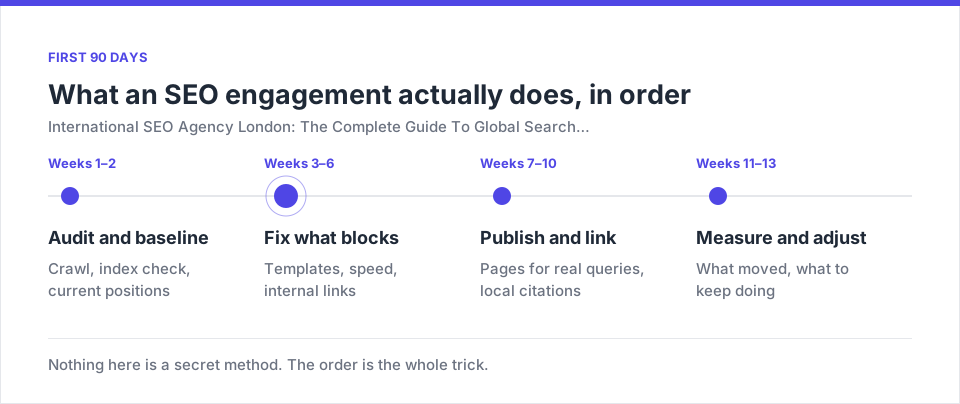
Plan a structured 90-day rollout to embed measurement in daily operations. Phase 1 focuses on baseline data collection and KPI alignment. Phase 2 accelerates instrumentation, creates market dashboards, and establishes governance rituals. Phase 3 runs a limited cross-market pilot, refines attribution models, and scales reporting to more markets. Each phase concludes with a documented CORA Trails entry and a Translation Provenance update to capture insights and terminology consistency as you expand.
With measurement as a core capability, London-based teams can rapidly translate data into action: optimise localised content, reallocate budget to high-potential markets, and tighten governance to sustain growth. If you’d like a tailored measurement framework, our International SEO services page offers editable artefacts you can adapt, and our team can guide you through a discovery via Contact.
Choosing And Working With A London-Based International SEO Agency
Selecting the right international SEO partner is a strategic decision that shapes your ability to grow across markets from a London base. The ideal agency will blend deep technical prowess with local-market fluency, deliver auditable governance, and translate global ambitions into scalable, measurable results. This final part provides a practical framework for evaluating potential partners, outlining what a phased international roadmap should include, and offering collaboration best practices to maximise value from your engagement with londonseo.ai.
Key selection criteria for a London-based partner
- Proven cross-border track record: demonstrable success in multiple markets, with case studies showing measurable lifts in visibility, traffic, and conversions across differing regulatory and cultural contexts.
- Multilingual capability and local insight: access to native or near-native language expertise and a structure that ensures content resonates in each target locale while preserving brand voice.
- Governance and transparency: clear provenance for changes, auditable decision logs, and dashboards that executives can trust and vendors can replicate.
- Technical sophistication and scalability: robust frameworks for hreflang, sitemaps, domain structures, and performance optimisation that scale with market ambition.
- Measurement discipline and ROI focus: market-specific KPIs, cross-border attribution, and dashboards that connect activity to revenue and strategic objectives.
- Collaboration model and programme governance: aligned working rhythms, defined roles (RACI), and seamless collaboration between London governance and local-market specialists.
What a phased international roadmap should include
From London, a disciplined roadmap guides market entry and expansion with auditable milestones. The roadmap should cover market prioritisation, domain and URL strategy, localisation depth, technical readiness, and governance cadence. It also should outline the governance artefacts that enable reproducibility as you add markets, ensuring every decision is transparent to stakeholders.
- Market prioritisation and sequencing: a data-driven method to identify initial markets, with criteria aligned to product-market fit and operational feasibility.
- Domain structure and signals: decisions on ccTLDs, subdirectories, or subdomains, plus hreflang, sitemaps, and canonical strategies tuned to each market.
- localisation depth and content calendars: determine when to translate, localise, or create region-specific content, with templates for district spokes and hub pages.
- Technical readiness: performance, crawlability, indexing, and localisation tooling integrated into a central governance model.
- Measurement and governance cadence: market KPIs, attribution approach, dashboards, and provenance logs to document decisions and outcomes.
In London, governance should be centralised but flexible enough to support parallel market activity. The governance stack typically includes CORA Trails for change provenance and Translation Provenance for terminology consistency, enabling auditable, repeatable decisions as you expand. A practical engagement plan also outlines budget arrangements, milestones, and escalation paths so leadership can track progress against strategic targets.
Collaboration best practices for sustained success
- Clear onboarding and alignment: define objectives, success metrics, and data-sharing protocols at the outset, with a formal discovery and strategy phase.
- Regular governance cadences: schedule quarterly reviews and monthly readouts that pair market performance with governance artefacts (CORA Trails, Translation Provenance).
- Single source of truth for data: consolidate data feeds (analytics, GBP signals, CMS, CRM) into a unified reporting framework to avoid drift between markets.
- Glossary and localisation provenance: maintain a central lexicon and translation provenance to ensure terminology consistency across markets and over time.
- Human-in-the-loop for quality control: combine AI-assisted outputs with skilled editors to safeguard accuracy and cultural resonance in every market.
Practical steps to kick off a London-based engagement
- Request a customised discovery: contact londonseo.ai to initiate a bespoke assessment of markets, language scope, and current technical readiness.
- Define the minimum viable international framework: establish the hub-and-spoke model, initial domain structure, and governance artefacts that will support auditable momentum.
- Build a district-aware content plan: outline hub pages and district spokes, including localisation templates, timelines, and approval workflows.
- Prepare measurement templates: align market KPIs, attribution models, and dashboards that report ROI and progress to senior leadership.
To explore how a London-based international SEO partner can tailor this framework to your brand, visit our International SEO services page or arrange a consultation via International SEO services and Contact. A well-structured engagement can translate global visibility into local relevance, while maintaining auditable governance that executives trust and teams can execute against with confidence.
As you embark on or advance an international expansion, remember that the most durable results come from a repeatable, transparent process. londonseo.ai stands ready to partner with London-based brands to deliver measurable growth, governed by sound data, authentic localisation, and a governance framework designed for scale.
